
A waste management website in Ghana can turn scattered calls and WhatsApp messages into organised collection requests. For e-waste collectors, plastic recyclers and scrap businesses, a clear online process helps the team assess materials, quote for bulk jobs and keep a dependable record of each handover.
A company replacing office computers needs a different service from a household with a few bags of bottles. Your platform should capture those differences before a vehicle leaves the yard. It should also show customers what happens after they submit a request and which records they will receive.
This guide explains how to build that platform with WordPress or a dedicated web application: public service pages, collection forms, a staff workflow, private customer records and evidence-based reports. At Aveshost, we help businesses plan the hosting, domain and business email behind these services.
Table of Contents
Plan a waste management website in Ghana
Start with one operational goal: receive enough accurate information to decide whether a collection can proceed. A request website does not need a public marketplace, customer wallet or live vehicle map on its first day. It needs an intake process your staff can manage consistently.
Separate the public website from the private operations area. Public pages explain materials, locations, contact details and service conditions. The staff area holds customer information, quotations, assignments and evidence. Corporate customers can receive private access to their own requests when that feature becomes useful.
Choose the build around the workflow. A small team can start with WordPress and a maintained form plugin that stores submissions for authorised staff. A larger operation with multiple depots, routes and receiving partners may need a dedicated application or carefully developed integrations.
A form plugin handles intake; it does not automatically provide dispatch planning, customer permissions or recycling traceability. List those requirements separately in the project specification. This prevents a simple enquiry form from being presented as a complete operations system.
Define materials, service areas and collection terms
Publish an accepted-materials list that matches your actual collection and receiving arrangements. Distinguish PET bottles, other plastics, metals and electronic equipment rather than placing everything under one “recyclables” option. Explain sorting, contamination, packaging and minimum-load requirements in plain language.
List exclusions prominently. Batteries, damaged electrical equipment and other potentially hazardous items need an approved handling route and trained personnel. Ask customers to describe unusual items for review; do not encourage dismantling, burning, breaking equipment apart or mixing unknown materials to fit a booking category.
Before offering a service, confirm the applicable environmental permissions, transport arrangements and receiving-facility requirements with Ghana’s environmental regulator. The Environmental Protection Act published through FAOLEX provides the legislative framework. A website registration or online booking does not authorise waste handling.
Define service coverage by the locations your team can actually reach. Name the relevant districts or neighbourhoods in Accra, Tema or other operating areas. Explain whether out-of-area requests receive a separate quotation. Validate the address during review instead of confirming every submitted location automatically.
State the commercial arrangement for each material: the customer pays a collection fee, you purchase accepted material, or pickup is included under a corporate agreement. Explain when inspection and weighing determine the final amount. Never label every collection “free” when transport or handling charges can apply.
Choose your domain, hosting and business email
Use a short, recognisable business name and domain. Our domain registration service can help you check options such as .com, .org or .eco. Confirm availability and registry conditions before choosing. A domain extension does not establish NGO status, regulatory approval or environmental performance.
A public information website with a modest enquiry form can begin on suitable business web hosting. Check storage, database use, PHP requirements, scheduled tasks and backup arrangements against the application. Customer photo uploads can grow faster than the page content itself.
For a custom portal, background processing or more demanding operations, discuss managed VPS hosting with our team. Confirm exactly who maintains the operating system, application, integrations and private storage. Server management and application development are separate responsibilities.
Set up addresses such as collections@yourdomain and accounts@yourdomain with business email. Give staff individual accounts where appropriate and enable available multifactor authentication. Configure the domain’s email authentication records and test message delivery before relying on notifications.
Keep the domain, website and email under documented business ownership. Record renewal responsibility and recovery contacts. When a developer leaves, the recycling business should retain control of its domain, hosting account, source code and operational records.
Build a useful scrap collection request form
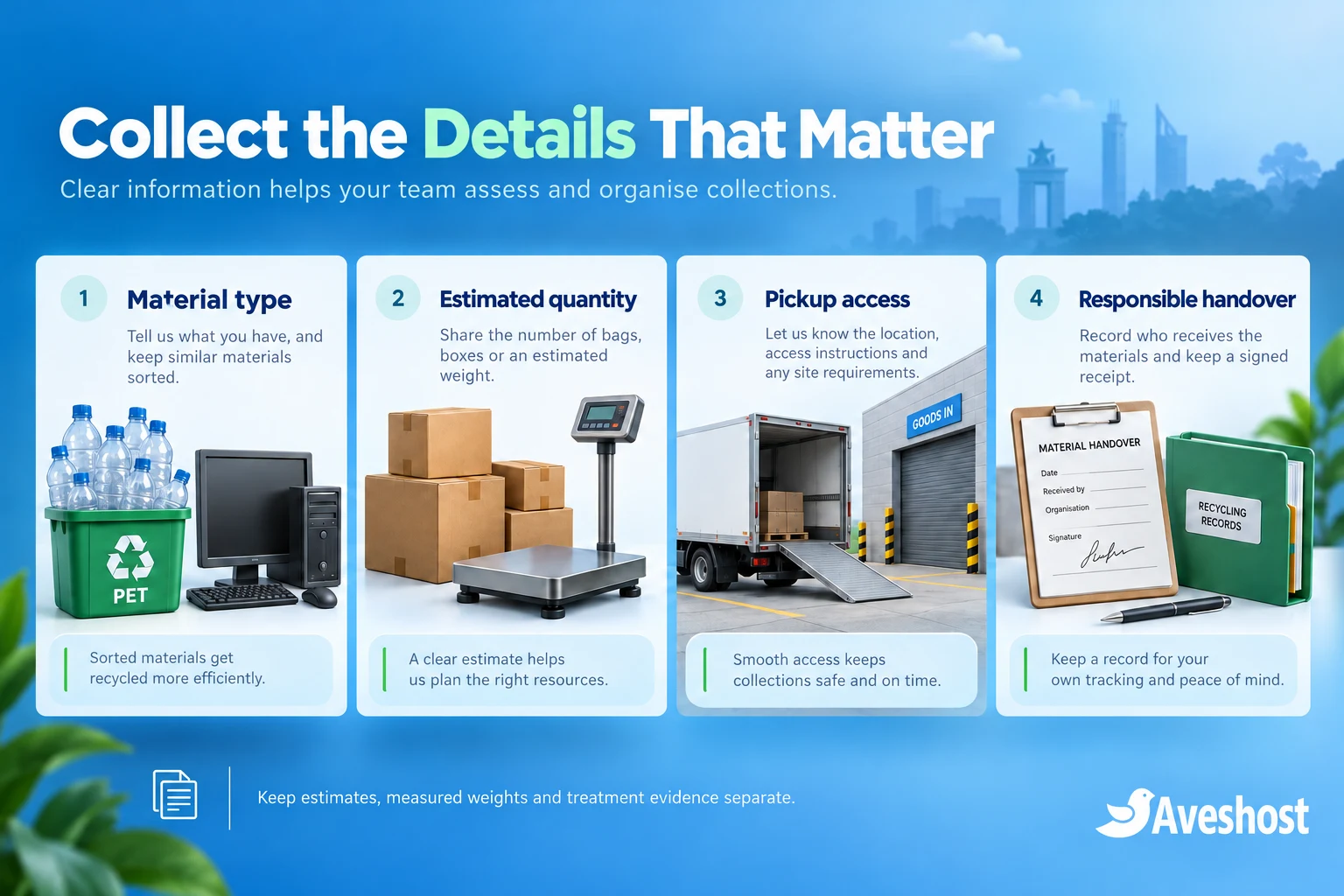
Build a short first form with contact name, organisation when relevant, phone or email, material category, estimated quantity, pickup area and preferred collection window. Mark the minimum required fields clearly. A GhanaPost GPS address, landmark and access notes can help dispatch staff clarify the location.
Capture units explicitly. “Twenty” could mean computers, sacks or kilograms. Use a quantity field together with a unit selector and provide a separate estimated-weight field only where useful. Label every customer estimate as an estimate until the team records an actual measurement.
Use conditional fields to keep the form manageable. A corporate electronics request can ask about asset counts and data-bearing devices; a plastic request can ask about sorting and contamination. Gravity Forms documents conditional field and notification behaviour. Select a suitable licence and test the exact configuration before launch.
Offer a limited optional photo upload for material assessment. State the permitted formats, number of images and size limit. Ask customers to avoid showing staff faces, identity documents, screen contents or confidential labels. For the first version, collecting descriptions without uploads is a practical option.
Finish with a confirmation that includes a reference number and the next step: “Request received. Our team will review the details and contact you to confirm availability and any charges.” Store the request successfully before showing this message. An email alone is a fragile record of a collection enquiry.
Handle corporate bulk requests and quotations
Create a separate bulk-request route for offices, schools, factories, hotels and NGOs. Ask for the collection site, authorised contact, material categories, approximate quantities, access restrictions and required timeframe. Multi-site contracts need a site list and a named coordinator rather than one ambiguous address field.
For retired computers and storage devices, establish who owns the equipment and who can authorise its release. Agree the asset inventory and data-sanitisation responsibilities before pickup. A collection receipt does not prove data erasure, and an ordinary website form cannot perform or certify sanitisation.
Prepare a reviewed quotation with a unique reference, scope, validity period, exclusions, collection conditions and any tax treatment appropriate to the business. Show transport, handling and other agreed charges clearly. Record customer acceptance against the correct quotation version before assigning the job.
Keep payment directions separate from material valuation. A business paying you to collect items follows a different accounting flow from a supplier selling scrap to you. If a measured weight changes the settlement, record the adjustment and approval rather than silently overwriting the original quotation.
Use recurring requests carefully. A weekly pickup agreement still needs operational scheduling, holiday handling and a route-capacity check. A repeated form submission or calendar event does not reserve a vehicle. Assign an operations owner to confirm the service pattern and manage exceptions.
Manage pickup status and staff responsibilities
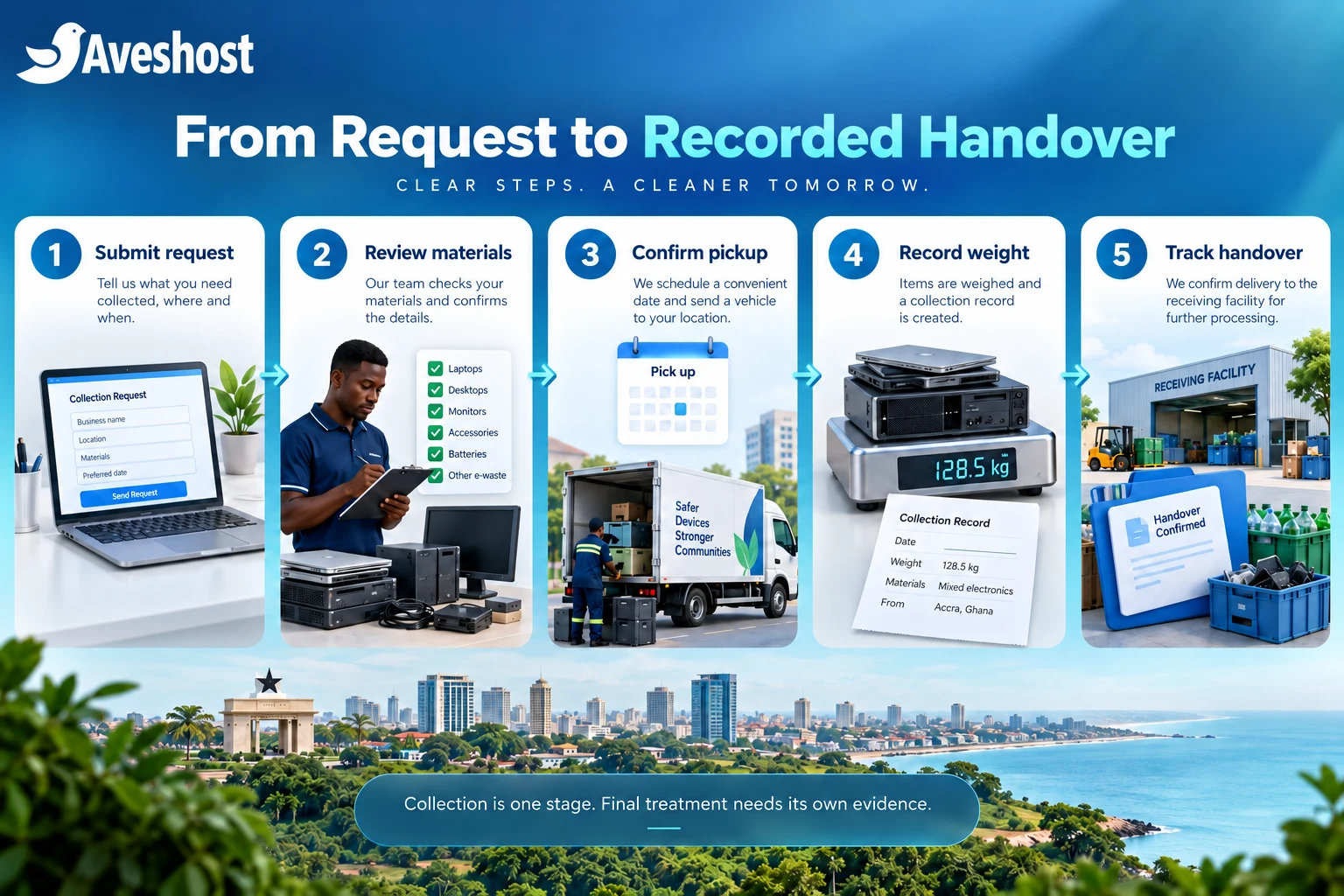
Give every request a stable internal identifier and maintain a clear status history. Start with received, under review, awaiting customer response, quoted, accepted, scheduled, collected and handed over. Add declined, cancelled and failed collection states so staff can record real outcomes without forcing them into “completed”.
Define who can make each change. Intake staff assess details, an authorised manager approves commercial terms, dispatch assigns the collection, and the receiving team records weight and handover. A small team can combine roles, but the system should still record which named person performed the action.
Show customers only the information relevant to their own request. Internal margin notes, staff contact details, other customers and unresolved operational discussions belong in restricted records. Drivers need the assigned job details and safe access instructions, not unrestricted access to every corporate file.
Confirm pickup only after capacity and acceptance checks. A preferred time on a form is a request. Use a separate confirmed window and tell customers how changes will be communicated. Routing, driver location and traffic estimates require their own dispatch tools or integration.
Record failed visits with a reason, contact attempts and the agreed next action. Do not automatically mark an inaccessible site as collected. If materials are outside the accepted scope, pause the job for review and communicate the revised arrangement before proceeding.
| Record | What it establishes |
|---|---|
| Request submitted | A customer has asked for a service |
| Pickup confirmed | The team has accepted a collection window |
| Collection receipt | Material was handed to the collection team |
| Receiving-partner record | A documented downstream handover occurred |
| Treatment evidence | The specified outcome is supported by the relevant records |
Record weights, handovers and downstream evidence
Separate estimated quantity, collected quantity and received weight in the data model. Record the measurement unit, measurement location, equipment or ticket reference, responsible staff member and relevant deductions. Keep gross, tare and net values distinct when those measurements are used.
A collection receipt should identify the customer or site, request reference, material description, recorded quantity, handover time and responsible parties. Where electronic acknowledgement is used, define the process and preserve the record. Limit customer access to the authorised recipient’s own documents.
Track materials onward to the receiving partner with a batch or consignment reference. If several customer collections are combined, maintain an allocation method so the same weight is not counted twice. Record rejected or diverted material separately and retain the explanation.
Use status names that reflect available evidence. “Collected” means your team received the material. “Transferred to partner” records a handover. “Recycled” requires evidence of the relevant downstream outcome. Do not generate a recycling or destruction certificate merely because a driver pressed a completion button.
Where customers require treatment, destruction or data-sanitisation documentation, agree the scope and issuing party in advance. Store the original supporting records and review them before release. Corrections should preserve the earlier value, reason and reviewer so a report can be reconstructed later.
Prepare credible corporate and NGO reports
Build reporting from the operational records rather than a manually increasing homepage counter. Useful measures include accepted requests, completed collections, measured weights by material, receiving-partner handovers, rejected loads and outstanding evidence. Define each measure before presenting it to customers or donors.
Keep the reporting boundary visible. A dashboard of kilograms collected is a collection metric. It does not automatically establish landfill diversion, final recycling or avoided carbon emissions. Those outcomes require suitable evidence and, for calculated estimates, a documented method and its limitations.
For an NGO project, link the request and collection records to a project identifier and reporting period. Keep expenditure records, approvals and supporting receipts in the appropriate finance workflow. A portal improves record organisation; it does not replace the funder’s reporting requirements or an independent audit.
Before exporting a corporate report, filter by the authorised organisation, site and agreed scope. Reconcile totals against source records and remove unrelated personal information. Give customers a reviewed version with a clear identifier, rather than a live spreadsheet that changes without a record of revision.
Publish public impact stories with permission and appropriate anonymisation. Avoid exposing client addresses, employee contacts or device inventories. A small set of traceable results builds more trust than broad environmental promises that cannot be tied back to the work.
Protect customer details and uploaded files
Customer contacts, precise pickup locations and staff records need a defined privacy process. The Data Protection Commission’s organisational guidance explains registration, transparency and security responsibilities. Assign someone to manage those responsibilities before collecting personal information through the platform.
Explain why information is collected, who receives it, how customers can contact you and how retention is managed. Collect only the details needed for the service. Set separate retention rules for unsuccessful enquiries, completed jobs, accounting records and supporting evidence, including any applicable legal holds.
Use named staff accounts, multifactor authentication where available and server-side permission checks. A customer must not obtain another organisation’s request by changing a reference in a URL. Check access on every record view, export and file download, not only when the user signs in.
Store confidential uploads privately. Standard public WordPress media URLs, hidden pages and long filenames do not provide customer-level access control. For a portal, use protected storage and an authorised download route; short-lived download links must also be handled as sensitive access tokens.
Validate upload types and sizes, inspect file contents, scan or quarantine where appropriate and prevent executable content from running. Restrict staff downloads and keep files out of routine email attachments. For initial intake, avoid accepting corporate asset inventories publicly; request them through the approved private process after review.
Document your arrangements with hosting, messaging and other processors, including backup locations and incident handling. HTTPS protects traffic in transit, but it does not settle all privacy obligations. Plan how to revoke access, investigate a disclosure and remove retained data through the agreed lifecycle.
Connect email, SMS and payment updates
Use transactional messages for meaningful events: request received, information needed, quotation ready, pickup confirmed and report available. Keep a single source of truth for status. A message should describe the recorded event rather than changing the job merely because a notification was sent.
Choose an SMS provider after checking coverage, sender approval and current charges. Our WordPress SMS guide compares provider options in Ghana. Request-specific alerts need a connector or custom integration tied to the collection workflow. Keep API credentials on the server and restrict their use.
For collection fees, use an eligible business merchant account and a supported checkout integration. Confirm the transaction through the provider’s server-side verification process before marking the invoice paid. A customer screenshot, browser success page or unverified callback is insufficient payment evidence.
Keep invoice status and job status separate. Paid does not mean collected; collected does not mean recycled. Record refunds, failed payments and adjustments against the relevant invoice. Payments you make to scrap suppliers require a separately controlled disbursement process and appropriate approval.
Make notification failures visible to staff and retry safely without sending duplicates. Avoid including precise addresses, device inventories or private reports in SMS messages. Direct the authorised customer to the portal when there is sensitive information to review.
Test the platform and launch in stages
Launch first with a limited service area and the materials your team handles most consistently. Use fictional requests to test the entire journey before opening the form. Test a household enquiry, a corporate bulk load, an unsupported material, an out-of-area request and a failed collection.
Verify that a saved request survives an email-delivery failure. Check that one customer cannot read another customer’s request or file. Test wrong units, oversized uploads, quotation revisions, cancelled bookings and repeated submissions. Staff should be able to correct a record without erasing its history.
Test reports with a mixed batch, a rejected load and a missing downstream document. Confirm that pending evidence remains pending and that each measured quantity is counted once. Use a deliberately inconsistent sample to check that the review process catches it before release.
Back up the database, private files and essential configuration. Restore them together in an isolated environment with outgoing messages and payment actions disabled. Choose recovery targets that match how much recent operational work the business can reconstruct, and review the actual backup scope with your provider.
Monitor form errors, pending reviews, overdue jobs, storage use and backup results. Resize images for mobile users, keep the application updated and review staff access when roles change. Measure response times and missing information so improvements address real operational delays.
Ready to build a recycling startup web portal in Ghana? Bring your materials list, service area, request workflow and reporting requirements to our team. Explore our business hosting, managed VPS options and corporate email, or discuss your collection platform with Aveshost.
Frequently asked questions
What should a waste management website in Ghana include?
Include accepted materials, service coverage, contact details, a clear collection request form and an organised staff process. Add private customer access when your workflow requires it.
Can I start with WordPress?
Yes. WordPress can support service pages and structured intake. Dispatch, customer-level permissions and traceability need suitable additional development or integrations.
Does submitting the form confirm a pickup?
No. Staff should review materials, location, capacity and any charges before confirming the collection window.
Can customers request corporate e-waste collections?
Yes. Capture the site, authorised contact, equipment categories, approximate quantities and access requirements. Agree ownership and data-sanitisation responsibilities before collection.
Should the form display an instant scrap price?
Only use pricing the business can honour under clearly stated conditions. Inspection, measured quantity and material quality may require a reviewed quotation and final settlement.
Can a collection receipt prove that equipment was recycled?
No. A collection receipt records a handover to the collection team. Final recycling, destruction or data-sanitisation outcomes need the appropriate supporting evidence.
How can NGOs use the platform for reports?
Link verified operational records to project identifiers, reconcile totals and preserve supporting evidence. Follow the funder’s reporting and review requirements.
Where should private customer files be stored?
Use protected storage with server-side permission checks on each file request. Public media links and hidden pages are unsuitable for confidential customer documents.
Can the website send SMS pickup updates?
Yes, through a suitable provider and a workflow integration. Keep messages brief, protect credentials and avoid exposing private job details.
Can Aveshost help with the platform infrastructure?
Yes. Contact our team with the proposed application, request volumes, file storage, access rules and backup needs to plan hosting, business email and the supporting setup.