Choosing between Hermes Agent vs OpenClaw comes down to whether you want a Python-based agent built around a self-improving learning loop or a TypeScript-powered multi-channel gateway with the largest community skill marketplace. Both Hermes Agent (developed by Nous Research) and OpenClaw are completely free, MIT-licensed open-source AI assistant frameworks that you can self-host 24/7 on your own server.
While both frameworks connect large language models (LLMs) to real-world tools, terminal sandboxes, and chat apps like Telegram, Discord, Slack, and WhatsApp, their internal architectures lead to noticeably different server footprints and monthly API token bills when deployed on an Aveshost Self-Managed VPS .
In this guide, we compare Hermes Agent vs OpenClaw across core features, memory and skill management, Ubuntu VPS hardware requirements, and realistic monthly running costs so you can deploy the right autonomous agent for your workflow.
Table of Contents
Hermes Agent vs OpenClaw at a Glance: Core Architecture
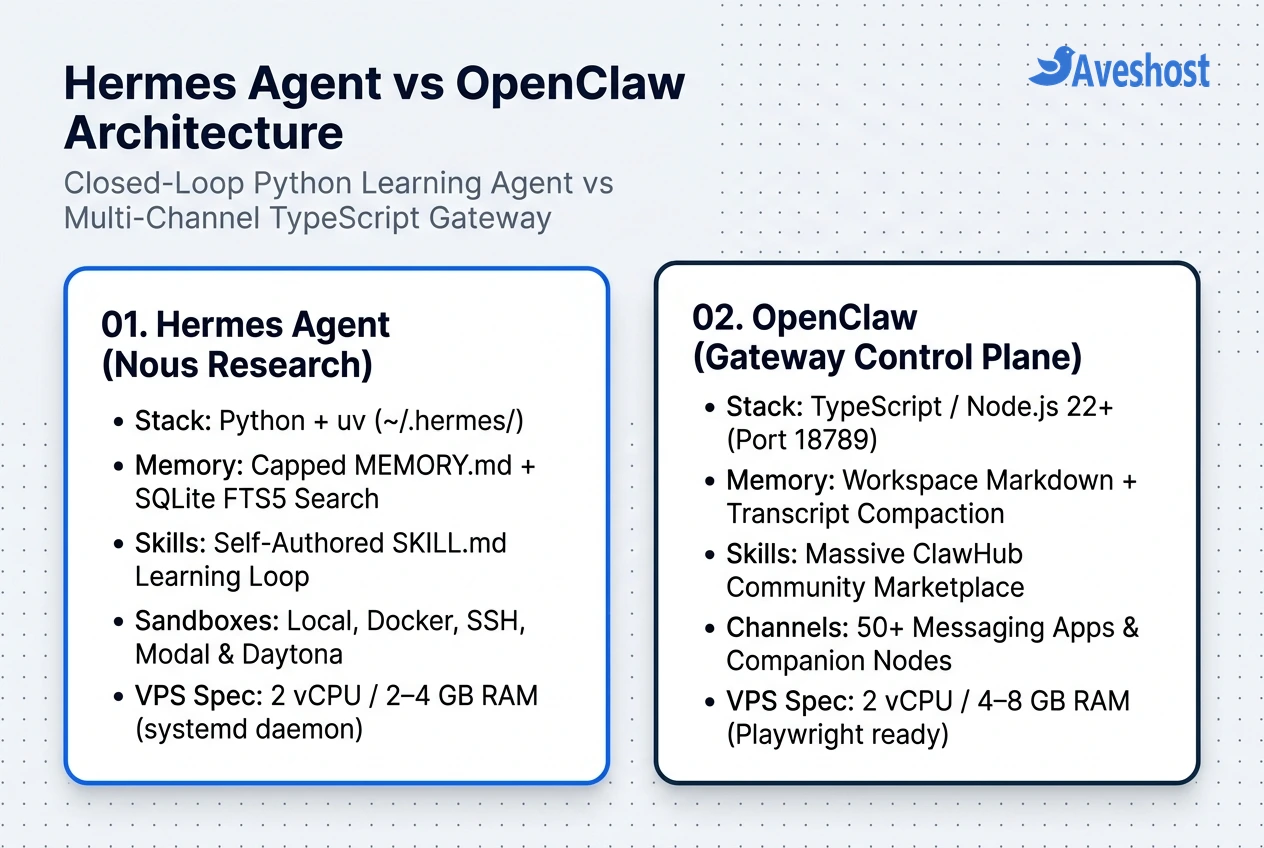
At a high level, Hermes Agent is engineered around a closed-loop learning cycle in Python. Instead of treating every chat session as a disposable conversation, Hermes extracts durable lessons from completed tasks, writes its own procedural skill files, and indexes every session in a local SQLite database with FTS5 full-text search.
OpenClaw, by contrast, is architected in TypeScript (Node.js) as a centralized Gateway Control Plane (running by default on port 18789). Its primary strength is broad channel and device reach—routing events across 50+ messaging platforms, native desktop/mobile companion nodes, and thousands of community-built skills on ClawHub.
Here is how Hermes Agent vs OpenClaw compare side by side across their core technical specifications:
| Comparison Dimension | Hermes Agent (Nous Research) | OpenClaw |
|---|---|---|
| License & Core Stack | MIT License — Python (uv virtual environment) | MIT License — TypeScript / Node.js (Node 22+) |
| Core Architectural Focus | Closed-loop autonomous learning, self-generated skills & curated memory | Multi-channel Gateway Control Plane (port 18789) & device-aware routing |
| Memory & Recall Engine | Capped MEMORY.md & USER.md + SQLite FTS5 cross-session search + Honcho user modeling | File-based workspace (SOUL.md, MEMORY.md, daily logs) + full transcript compaction |
| Skill Ecosystem | Autonomous self-authored SKILL.md files + Skills Hub + ClawHub & MCP compatibility | ClawHub community marketplace (thousands of plug-and-play skills) + MCP support |
| Messaging & Interfaces | CLI/TUI, Telegram, Discord, Slack, WhatsApp, Signal, Email, OpenAI-compatible API | 50+ messaging apps, Web Control UI, plus native macOS, iOS, and Android companion nodes |
| Code Execution Sandboxes | 6 backends: local, Docker, SSH, Singularity, Modal, and Daytona | Local host shell/Node runtime or Gateway-managed Docker containers |
| Recommended Ubuntu VPS Specs | 2 vCPU, 2 GB – 4 GB RAM, 25 GB SSD/NVMe | 2 vCPU, 4 GB – 8 GB RAM, 25+ GB SSD/NVMe |
Features Compared: Memory, Skills and Channel Integrations
When evaluating Hermes Agent vs OpenClaw for daily production work, the biggest day-to-day differences show up in how each agent remembers past instructions, acquires new capabilities, and connects to your tools.
1. Persistent Memory and Context Window Efficiency: OpenClaw stores workspace context in local Markdown files (SOUL.md, MEMORY.md, and daily journals) and retains raw conversational transcripts until the model’s context window fills up, at which point it triggers context compaction. Hermes Agent takes a more structured, token-frugal approach: it enforces a strict character cap on MEMORY.md and USER.md so your system prompt stays lean, while offloading historical recall to a local SQLite FTS5 search engine paired with a fast, inexpensive auxiliary summarization model.
2. Self-Improving Skills vs Community Marketplace: If you want instant plug-and-play integrations for smart home devices, SaaS webhooks, or niche productivity apps, OpenClaw’s ClawHub registry gives you thousands of ready-made community packages. Hermes Agent, however, shines when your workflows are custom: after solving a multi-step engineering or research problem, Hermes autonomously drafts a reusable SKILL.md procedure in ~/.hermes/skills/ and refines it on future runs—while still letting you import skills from ClawHub and connect remote MCP servers.
3. Execution Sandboxes and Multi-Agent Delegation: For developers who let their AI agent run bash scripts or repository builds, Hermes Agent natively supports six execution backends right out of the box—including local execution, Docker, remote SSH, Singularity, and serverless cloud sandboxes via Modal and Daytona. It can also spawn isolated subagents in parallel for heavy coding or research tasks.
Hosting Compared: Ubuntu VPS Requirements and Deployment
Because both frameworks are designed to listen for incoming Telegram, Discord, or WhatsApp messages and execute scheduled cron jobs around the clock, running them on a personal laptop quickly becomes frustrating whenever your machine sleeps. Deploying on an Ubuntu 22.04 or 24.04 LTS VPS gives your agent a dedicated 24/7 home.
Hermes Agent Hosting Footprint: Because Hermes runs on a lean Python + uv stack and keeps its active memory footprint small, an entry-level Ubuntu VPS with 2 vCPU cores and 2 GB to 4 GB of RAM is more than enough. You can follow our step-by-step guide on how to install Hermes Agent on an Ubuntu VPS to configure its built-in systemd gateway service in under 10 minutes.
OpenClaw Hosting Footprint: OpenClaw’s Node.js 22+ Gateway daemon and Web Control UI use slightly more baseline memory, and many popular ClawHub skills spin up headless Chromium via Playwright for web scraping and browser automation. For smooth 24/7 operation without out-of-memory kills, provision at least 2 vCPU cores and 4 GB to 8 GB of RAM (see our tutorial on how to build an AI help desk with OpenClaw).
Can You Host Both on the Same Ubuntu VPS? Yes. Because Hermes Agent uses outbound HTTPS/WebSocket polling for Telegram and Discord and stores all state inside ~/.hermes/, while OpenClaw stores its workspace in ~/.openclaw/ and binds its gateway to 127.0.0.1:18789, you can easily run both agents side by side on a single 4 GB or 8 GB RAM Aveshost Self-Managed VPS:
# Check resource usage when running Hermes Agent and OpenClaw on the same Ubuntu VPS
sudo systemctl status hermes-gateway.service
sudo systemctl status openclaw-gateway.service

# Inspect live RAM consumption per agent daemon
ps -o pid,user,%cpu,%mem,rss,comm -C python3,node
If you prefer a visual server control panel alongside your SSH terminal for managing domains, SSL certificates, or web webhooks, you can also deploy on an Aveshost Fully Managed VPS (which includes DirectAdmin by default).
Running Costs Compared: VPS Hosting vs LLM API Token Spend
Although both Hermes Agent and OpenClaw are free to download, your actual monthly running cost consists of two parts: server infrastructure and LLM API token consumption.
First, avoid high-markup third-party managed agent wrappers that charge a steep monthly premium just to run a single container for you. Self-hosting on your own Ubuntu VPS gives you full root control, dedicated NVMe or SSD storage, and predictable infrastructure billing. For example, if a self-managed VPS plan costs GH₵120 per month while a third-party managed wrapper costs the equivalent of GH₵450 per month, self-hosting saves GH₵330 every month before you even count API tokens. (These figures illustrate the calculation; check the live plan page for current billing options.)
Second, pay close attention to how each agent’s memory architecture impacts your monthly LLM API token consumption across providers like OpenRouter, Anthropic Claude, OpenAI, DeepSeek, or Nous Portal:
| Cost Component / Usage Tier | Hermes Agent (Self-Hosted on VPS) | OpenClaw (Self-Hosted on VPS) | 3rd-Party Turnkey Managed Hosts |
|---|---|---|---|
| Software License | Free (MIT Open Source) | Free (MIT Open Source) | Free software bundled with high hosting markup |
| Monthly VPS Infrastructure | Low (2 vCPU / 2–4 GB RAM Ubuntu VPS) | Low–Medium (2 vCPU / 4–8 GB RAM Ubuntu VPS) | High (3x to 5x the cost of a standard Linux VPS) |
| LLM Token Footprint — Light Daily Use | Very Low (capped MEMORY.md + selective FTS5 recall) | Moderate (workspace file injection + periodic heartbeats) | Moderate to High (BYOK or credit markup) |
| LLM Token Footprint — Heavy Cron & Tool Loops | Controlled (uses cheap auxiliary model for search summarization) | High if unoptimized (full-session transcript compaction on frontier models) | High (scales with raw token volume) |
| Zero-API-Cost Local Model Support | Excellent (optimized for Nous Hermes, DeepSeek, Qwen & Ollama) | Supported (via Ollama, OpenRouter & custom endpoints) | Restricted to provider's hosted model list |
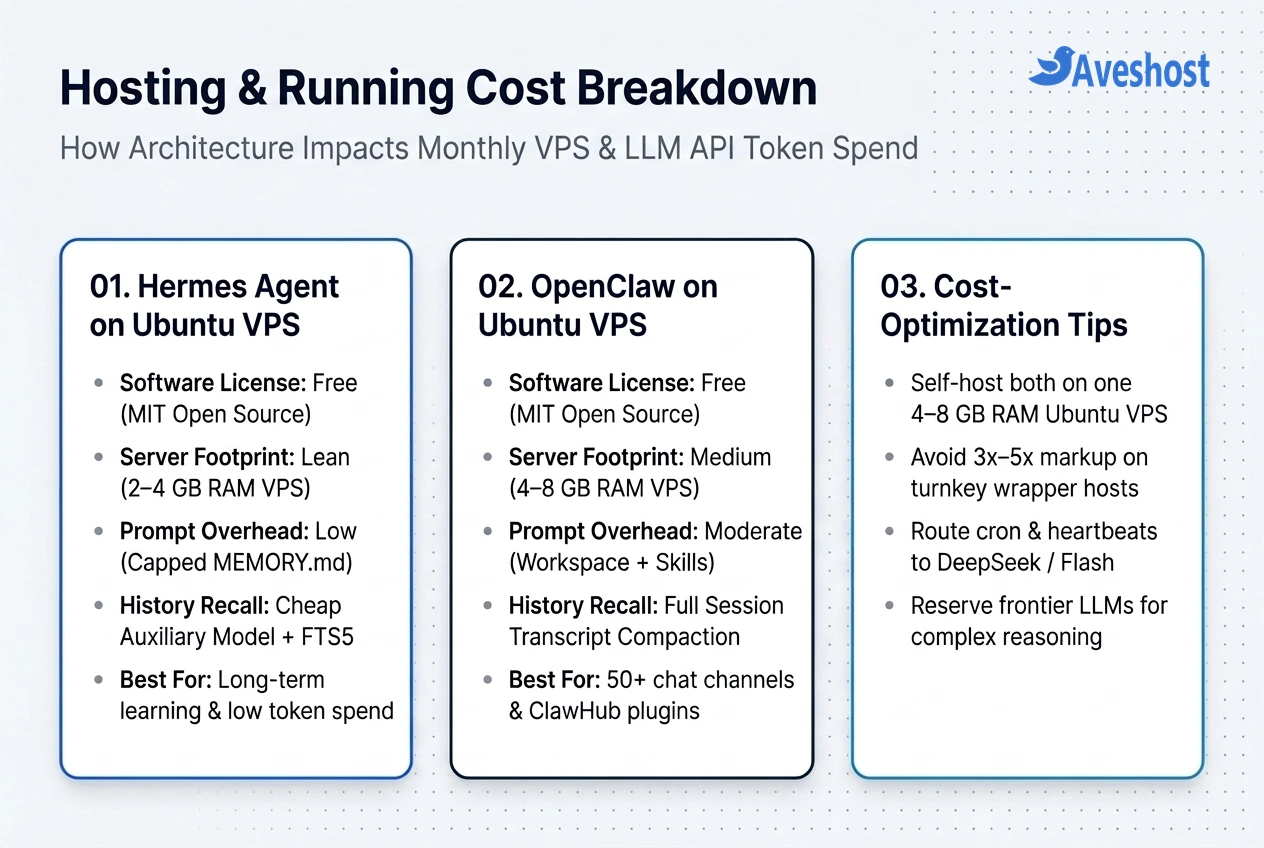
Why Hermes Agent Is Easier on Your API Budget: Because Hermes caps the size of its injected MEMORY.md file and uses a lightweight model to summarize FTS5 search hits before passing them to your primary reasoning model, its per-turn input token count remains flat even after months of daily conversations. OpenClaw users who enable frequent background heartbeat checks (for instance, every 15 minutes) with a large MEMORY.md file on a frontier model like Claude Sonnet can burn through input tokens rapidly unless they route background heartbeats to a lower-cost model like DeepSeek V3 or Gemini Flash.
Which AI Agent Should You Choose? (Decision Checklist)
Both projects represent the cutting edge of open-source autonomous agents, and neither locks you in—in fact, Hermes Agent can read OpenClaw-compatible SKILL.md packages, and both store your memories in portable plain-text Markdown files.
Choose Hermes Agent if:
• You want an agent that genuinely improves over time by authoring and refining its own reusable skills after completing tasks. • You want predictable, lower monthly LLM token costs thanks to bounded system prompts and SQLite FTS5 cross-session search. • You work heavily in Python, run coding/research subagents, or want native support for Docker, SSH, Modal, and Daytona execution sandboxes.
Choose OpenClaw if:
• You need broad multi-channel connectivity across 50+ messaging platforms, smart home systems, or native macOS/iOS/Android companion nodes. • You want immediate access to thousands of pre-built community automations on ClawHub without writing custom skills from scratch. • Your team prefers extending and customizing a TypeScript / Node.js gateway architecture.
Frequently asked questions
Is Hermes Agent more cost-effective to run than OpenClaw?
Yes, in most 24/7 production setups Hermes Agent uses fewer server resources and fewer LLM API tokens. Its Python runtime runs comfortably on a 2 GB to 4 GB RAM Ubuntu VPS, and its capped MEMORY.md plus SQLite FTS5 search architecture keeps prompt token usage low compared to compacting raw conversation transcripts.
Can Hermes Agent use skills built for OpenClaw and ClawHub?
Yes. Both frameworks follow open SKILL.md conventions and support the Model Context Protocol (MCP). Hermes Agent includes a built-in Skills Hub that can search, inspect, and install skills from multiple registries, including ClawHub-compatible repositories.
What Ubuntu VPS specs do I need for Hermes Agent vs OpenClaw?
For Hermes Agent, an Ubuntu 22.04 or 24.04 LTS VPS with 2 vCPU cores, 2 GB to 4 GB of RAM, and 25 GB of SSD or NVMe storage is ideal. For OpenClaw, we recommend 2 vCPU cores and 4 GB to 8 GB of RAM, especially if your skills launch headless Chromium browsers via Playwright.
Can I run both Hermes Agent and OpenClaw on the same Ubuntu VPS?
Yes. Hermes Agent stores its data in ~/.hermes/ and connects to Telegram or Discord via outbound connections, while OpenClaw stores its files in ~/.openclaw/ and runs its Gateway on localhost port 18789. On a 4 GB or 8 GB RAM VPS, both systemd services can run side by side without port conflicts.
How do I keep my monthly LLM API costs low when running a 24/7 agent?
Route routine background cron jobs, heartbeats, and session summarization to fast, low-cost models (such as DeepSeek V3, Qwen, or Gemini Flash via OpenRouter) and reserve premium frontier models (like Claude Sonnet/Opus or GPT-4o) for complex coding and reasoning tasks.