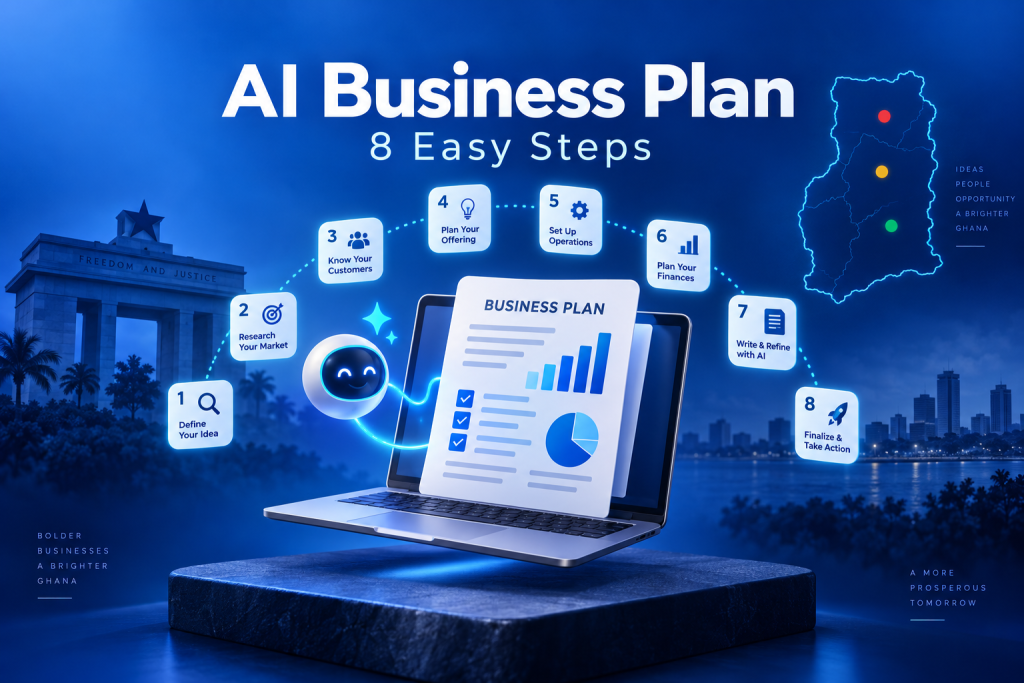
Learning how to use AI to write a business plan in Ghana can save you time and help you organise your ideas. Whether you are starting a shop in Accra, launching a service in Kumasi, or growing an online business, the useful result is a plan built on real customers, realistic costs, and clear next steps.
AI can turn rough notes into a professional draft, but the quality depends on what you give it. Asking “write a business plan for me” often produces confident generalities. A stronger approach combines your local knowledge and verified evidence with clear prompts, checked financial calculations, and careful review.
In this guide, we take you through eight easy steps, with reusable prompts, Ghanaian business considerations, and an illustrative financial example in Ghana cedis. You will learn how to create a plan you can use for launch decisions, partnerships, or preparation for a funding application—without confusing a polished draft with verified business evidence.
Table of Contents
Before you start: what AI can and cannot do
AI can help you organise ideas, ask useful questions, turn notes into clear paragraphs, compare scenarios, and spot gaps in a draft. It cannot know your actual costs, customer demand, permissions, or funding eligibility unless you provide reliable evidence. A convincing paragraph is not proof that a business will work.
Use an AI writing assistant you can access comfortably, alongside a document editor and spreadsheet. You do not need an expensive subscription just to begin this workflow. Tool features and limits vary, so check whether your chosen service supports file uploads, web research, and exporting before relying on those features.
Work section by section rather than asking for a finished plan in one sentence. Start a project folder with your interview notes, supplier quotations, sales records, cost spreadsheet, and source links. Keep a separate list of planning inputs that still need checking. This makes revisions easier and prevents fictional details from becoming “facts” through repetition.
Remove customer names, account numbers, Ghana Card details, passwords, and confidential agreements before uploading material. Use anonymised summaries and rounded figures when exact private details are unnecessary. Review your AI service’s data settings and your authority to share business documents before using uploads.
For structure, the SBA’s business-plan guidance distinguishes lean plans from detailed traditional plans and outlines sections such as the business description, market, operations, marketing, and finances. Use that as a structural reference, then adapt the plan to Ghana and the actual requirements of its reader.
| Step | What you will do | What you should finish with |
|---|---|---|
| 1 | Define the purpose and business brief | A clear fact sheet and plan scope |
| 2 | Research the Ghanaian market | An evidence log and competitor comparison |
| 3 | Understand your target customers | Specific customer segments and a tested problem |
| 4 | Plan the offer, pricing, and sales | A workable route from discovery to repeat purchase |
| 5 | Design operations and responsibilities | A delivery process and compliance checklist |
| 6 | Build and check the financial model | Cost, cash-flow, break-even, and scenario tables |
| 7 | Draft the plan and executive summary | A coherent document linked to evidence |
| 8 | Verify, tailor, and turn it into action | A reviewed plan and a 90-day action schedule |
Step 1: Define your business idea and the purpose of the plan
Before AI writes anything, decide who the plan is for. A plan for your own launch can be short and practical. A bank, investor, grant programme, or potential partner may require a particular template, historical records, or supporting documents. Obtain those requirements first; use the specific template and supporting records required for the application.
Next, describe the business in plain language. What will you sell, to whom, where, and why will they choose you? “An innovative enterprise transforming commerce across Africa” is much less useful than “a lunch-delivery service for office teams within a defined part of Tema.” Specificity helps AI produce a plan you can actually test.
- Business name and current stage: idea, pilot, or already trading.
- Products or services and the problem they solve.
- Location, service area, and whether sales are online, physical, or both.
- Customer types and any evidence of interest or purchases.
- Founder skills, available equipment, team, and time commitments.
- Starting funds, expected funding gap, and launch timeline.
- Purpose, reader, required format, and planning period.
- Known facts, planning inputs that need research, and information still missing.
Copy-and-paste AI prompt:
Act as a practical business-planning assistant for a Ghanaian small business. My business is [description], based in [location], serving [customer group]. The plan is for [purpose and reader]. Here are my verified facts: [facts]. Here are planning inputs: [planning inputs]. Ask me up to 10 important questions before drafting. Do not invent sales, customers, registrations, team experience, funding approvals, or market statistics. Use Ghana cedis for financial planning.
Answer the questions yourself and save the responses as a business fact sheet. If you do not know an answer, label it “to verify” rather than letting the tool fill the gap. For an existing business, include actual sales and costs from a stated period; for a startup, label forecasts as forecasts.
For our running example, we will use a fictional Tema lunch-delivery startup. Every financial number later in this article is a illustrative input, not a current supplier quote or evidence about Ghana’s food market. The business intends to test office lunch orders within a limited delivery area before expanding.
Step 2: Research the Ghanaian market and your competitors
AI is useful for designing research, but it should not be your only source of market facts. Ask it to identify the questions you need to answer: customer demand, competing offers, local prices, delivery options, purchase habits, and barriers to switching. Then gather evidence through interviews, observation, verified public data, and current quotations.
Begin with the actual area you can serve. A business selling fresh lunch in Tema does not have every resident of Ghana as its immediate market. A Kumasi printing service might begin with nearby schools, shops, churches, and office clients. A software consultant could serve customers nationally or internationally, but still needs a credible route to reaching them.
Use the Ghana Statistical Service for relevant official statistical publications and data resources. Check the publication date, geography, definitions, and coverage before using a statistic. National population or economic data may provide context; it does not directly measure demand for your particular product.
Collect competitor evidence from their public websites, social pages, catalogues, or direct observations. Note the date, advertised price, included services, location, and whether you confirmed the information. Avoid turning one social post into a statement about a competitor’s full business performance.
| Research question | Useful evidence | What to record |
|---|---|---|
| Will customers buy? | Interviews, enquiries, pilot orders | Who responded, when, and what they actually did |
| What alternatives do they use? | Customer interviews and competitor offers | Price, convenience, quality, and switching reasons |
| Can we deliver at the planned cost? | Supplier and delivery quotations | Date, minimum order, validity, and included charges |
| How large is the reachable market? | Relevant official data plus local evidence | Geographic scope, method, and planning inputs |
| What affects demand? | Customer calendars and trading records | Seasonality, payment cycles, and local events |
Copy-and-paste AI prompt:
Create a research checklist for [business] serving [specific area and customer group] in Ghana. Suggest customer interview questions and a competitor-comparison table. Separate questions I can answer through public sources from questions requiring fieldwork. For every factual statement in a draft, ask for a source, date, and geographic scope. If you cannot verify a statistic, write “needs research” instead of supplying a plausible number.
Maintain an evidence log with the statement, source, date, and implication for the plan. If the AI provides a link, open it and check that the page supports the statement. Do not accept invented references, old figures presented as current, or a large market estimate calculated from unrelated national data.
For the lunch example, a useful pilot would test whether office customers order repeatedly, how many meals the team can prepare, and whether deliveries remain practical at lunchtime. A few positive comments are encouraging, but paid orders and repeat purchases provide different evidence.
Step 3: Identify your customers and test the problem
“Everyone who needs our service” is rarely a useful target market. Define the first customer group narrowly enough that you can reach and serve it. Consider location, buying occasion, budget, preferred communication channel, and the problem that prompts a purchase.
For the fictional lunch business, possible segments include individual office workers and administrators ordering for a team. These customers may have different priorities: one values affordable daily variety, while the other needs predictable timing, consolidated ordering, and a clear invoice. A plan should acknowledge those differences.
Ask AI to turn your interview notes into customer segments, but make it distinguish observed behaviour from speculation. A persona is a planning tool, not research evidence. Avoid invented names, incomes, or lifestyle details that make a customer profile look scientific without supporting it.
- What triggers the purchase, and how often does it happen?
- What does the customer currently do instead?
- What is frustrating about that alternative?
- Who decides, who pays, and when is payment made?
- Which channel do they use to discover and contact suppliers?
- What evidence would make them trust a new supplier?
- Why might they choose not to buy or stop ordering?
Copy-and-paste AI prompt:
Using only these anonymised interview notes [notes], identify up to three customer segments for [business]. For each, describe the buying problem, current alternative, purchase trigger, decision-maker, payment timing, and useful sales channel. Label each point as supported by the notes or still an planning input. Suggest a small pilot that could test willingness to pay and repeat demand.
Turn the result into a testable statement: “We believe office teams within our delivery area will order because they need reliable lunch delivery at a predictable price.” Decide how you will test it, what success looks like, and what would make you revise the idea. Set thresholds before seeing the result so you do not reinterpret every outcome as success.
Speak with customers in the language they prefer. You can ask AI to simplify a questionnaire or draft a translation, but have a fluent person check it before use. Local expressions, tone, and meaning matter, particularly when discussing price or dissatisfaction.
Step 4: Plan your offer, pricing, and marketing
Now connect the customer problem to a specific offer. Describe what is included, what is excluded, how it is delivered, and what the customer pays. “High quality at affordable prices” is too vague to explain why someone should choose you over an established alternative.
A clear lunch offer might state the menu, portion options, order deadline, delivery area, minimum team order, and policy for changes. A digital service might specify deliverables, revision limits, turnaround time, and maintenance responsibilities. Use those details to set expectations before a sale.
Ask AI for pricing approaches, but base the final decision on your costs, customer evidence, competitor context, and the value of the offer. A competitor’s price is not proof that you can profitably charge the same amount. Include packaging, delivery, transaction charges, wastage, and your time where relevant.
Copy-and-paste AI prompt:
Help me draft the product and sales section for [business]. My verified customer findings are [findings]. The offer includes [details], excludes [details], and will be delivered through [process]. My proposed price is [amount] GHS and estimated variable cost is [amount] GHS. Identify weaknesses in the offer and propose a realistic sales journey from discovery to enquiry, order, payment, delivery, and repeat purchase. Identify the customer research or pilot results needed to test demand.
For Ghanaian businesses, the sales journey may combine social discovery, WhatsApp enquiries, a website, Mobile Money, card payments, collection, or delivery. Choose the channels your customers actually use and the payment options your business can support. Record fees, confirmation procedures, and settlement timing in the financial model.
Give each marketing activity an owner, budget, and measure. For example, test a small campaign within your actual service area and track qualified enquiries, completed purchases, cost per new customer, and repeat orders. Do not forecast sales simply by projecting sales directly from follower counts.
Follow our guide to selling on social media for a practical sales workflow. If your plan includes a website, define its job: showing a menu, collecting bookings, displaying a catalogue, or handling checkout. Budget for the domain, hosting, content, maintenance, and any payment integration you need.
You can explore our web hosting packages when that website is part of the launch plan. For branded communication, compare our business email packages. Choose services around the business requirements; they support the sales process but do not create customer demand by themselves.
Step 5: Work out operations, responsibilities, and requirements
The operations section explains how you will keep the promises made in the marketing section. Map the process from order to fulfilment: who accepts the order, buys supplies, produces the item, checks quality, takes payment, delivers, and handles complaints? If one person does everything, check whether that is realistic at the forecast volume.
Include capacity. If your team can reliably fulfil 20 orders per day, a forecast requiring 50 daily orders needs a different staffing or production plan. Identify the bottleneck: preparation time, equipment, delivery vehicles, skilled labour, customer support, or working capital.
- Premises, equipment, stock, and supplier arrangements.
- Staff responsibilities, training, and founder time.
- Operating days, order deadlines, and delivery coverage.
- Quality control, customer complaints, refunds, and recordkeeping.
- Internet, power, transport, or supplier disruptions relevant to the business.
- Inventory controls, wastage, and replacement supplies.
- Required registrations, permits, insurance, and professional advice.
- Website, email, backup, and access arrangements for digital operations.
Copy-and-paste AI prompt:
Create an operations plan for [business] in [location, Ghana] using these facts [facts]. Map the order-to-delivery workflow, responsible roles, daily capacity, supplier needs, quality checks, and likely bottlenecks. Produce a checklist of registrations or permits to verify with the relevant Ghanaian authorities. Do not state that we hold a licence, are fully compliant, or have an approved location unless I supply evidence.
Check registration information with the Office of the Registrar of Companies and tax information with the Ghana Revenue Authority. Depending on your activity and location, additional local-authority or sector requirements may apply. Ask the relevant authority or a qualified adviser to confirm the current rules rather than copying an AI-generated checklist as legal advice.
Do not let a tool import foreign company structures, tax rates, permits, or employment rules into a Ghanaian plan. Also distinguish a future action from a completed one: “we will apply” is not the same as “we are registered.” Record the responsible person, estimated cost, and verification status for each requirement.
If a domain is part of your setup, remember that domain registration and business registration are different. Read our guide to business names versus domains and our Ghana domain guide when planning the online identity.
Step 6: Build realistic financial projections in Ghana cedis
This is the section where AI needs the most supervision. Ask it to explain formulas, organise planning inputs, and identify missing costs. Calculate and validate the model in a spreadsheet. Every important number should trace to a quotation, trading record, explicit planning input, or checked formula.
Separate startup spending from recurring costs. Equipment and initial setup require cash before or during launch, while ingredients, packaging, salaries, rent, transport, data, and subscriptions recur on different schedules. A refundable deposit, equipment purchase, and ordinary monthly expense should not all be treated identically in an accounting forecast.
Start with a clear planning inputs table
| Planning input for our fictional example | Illustrative amount | Status |
|---|---|---|
| Average selling price per order | GH₵100 | Illustrative input |
| Variable cost per order | GH₵60 | Illustrative input including direct fulfilment costs |
| Monthly orders in the base case | 300 | Untested demand estimate |
| Monthly fixed operating costs | GH₵9,000 | Illustrative input |
| Startup equipment and setup cash | GH₵24,000 | Illustrative input |
| Initial working-capital reserve | GH₵18,000 | Illustrative input |
| Founder funds available | GH₵22,000 | Illustrative input |
These are invented numbers for learning the method. They are not recommended food prices, supplier quotations, tax-inclusive market rates, or a forecast for an actual business. Replace them with your own dated evidence. The example does not calculate taxes, depreciation, financing charges, or a full balance sheet.
Check revenue, contribution, and break-even
Revenue = orders × selling price. At 300 orders × GH₵100, monthly revenue is GH₵30,000. Variable costs = 300 × GH₵60 = GH₵18,000. Contribution = GH₵30,000 − GH₵18,000 = GH₵12,000. After GH₵9,000 of fixed operating costs, the illustrative operating surplus is GH₵3,000 before the excluded items.
Contribution per order = GH₵100 − GH₵60 = GH₵40. Break-even orders = GH₵9,000 ÷ GH₵40 = 225 orders per month, equivalent to GH₵22,500 in revenue under these planning inputs. If the calculation gives a fraction of an order, round up. With multiple products, use an appropriate sales mix rather than applying one product’s margin to the whole business.
If the business operates 26 days a month, 300 orders means roughly 12 orders per day on average. Compare that with realistic production and delivery capacity. An average also hides busy days, so check peak demand and plan for daily variation.
Model a downside as well as a growth case
| Scenario | Monthly orders | Revenue | Contribution after variable costs | Surplus after GH₵9,000 fixed costs |
|---|---|---|---|---|
| Downside | 200 | GH₵20,000 | GH₵8,000 | −GH₵1,000 |
| Base case | 300 | GH₵30,000 | GH₵12,000 | GH₵3,000 |
| Growth case | 400 | GH₵40,000 | GH₵16,000 | GH₵7,000 |
These scenarios hold the price, variable cost per order, and fixed costs constant to isolate volume. Real growth may need more staff or equipment. Test cost increases too: if variable cost rises to GH₵70 at 300 orders, contribution falls to GH₵9,000 and the operating surplus becomes zero under the same fixed-cost planning input.
Keep profit separate from cash flow
A business can record a sale before it receives payment. Suppose our example recognises GH₵30,000 of monthly sales but collects only GH₵24,000 by month-end. Starting with GH₵18,000 cash, paying GH₵18,000 of variable costs and GH₵9,000 of fixed costs leaves GH₵15,000 cash. The GH₵6,000 difference between sales and collections remains receivable in this simplified example.
That cash balance falls by GH₵3,000 even though the simplified operating model shows a GH₵3,000 surplus. Payment timing explains the difference. Build a monthly cash-flow forecast showing when customers pay, when suppliers must be paid, and when large expenses occur. Add taxes, loan payments, equipment purchases, owner drawings, and other applicable cash flows in the real model.
Calculate the funding gap
Illustrative startup and reserve requirement = GH₵24,000 + GH₵18,000 = GH₵42,000. With GH₵22,000 of founder funds, the simple gap is GH₵20,000. Check that the reserve has not already been counted in another line. The actual requirement depends on the launch schedule and the forecast cash shortfall, not just a round number that sounds suitable for a loan.
Copy-and-paste AI prompt:
Review this financial model for a Ghanaian [business]: [planning inputs and tables]. Show formulas for revenue, variable costs, contribution, break-even, and monthly cash flow. Separate startup spending, recurring costs, working capital, and funding sources. Check arithmetic and units, flag double counting, and identify excluded costs. Create downside, base, and growth scenarios. Do not invent tax rates, loan interest, exchange rates, or verified demand. Return an planning inputs list for me to validate in a spreadsheet.
For imported stock or equipment, record the currency and quotation date and test exchange-rate changes using verified inputs. For taxes and accounting treatment, use current guidance and professional review where needed. A lender or investor may require historical statements, a balance sheet, and a particular forecast period; adapt the model to those requirements.
Step 7: Draft the business plan and write the executive summary
Once you have the evidence and financial model, ask AI to draft one section at a time. Supply the relevant fact sheet, source notes, and approved planning inputs for each section. Review before moving on so a mistake does not spread across the entire document.
| Section | What it should answer |
|---|---|
| Executive summary | What is the business, who is it for, and what is the plan asking for? |
| Business description | What do you sell, where do you operate, and what stage are you at? |
| Customer and market analysis | What evidence supports demand and the target segments? |
| Products, pricing, and competition | Why will customers choose the offer, and can you deliver it profitably? |
| Marketing and sales | How will customers discover, buy, and buy again? |
| Operations and management | Who does the work, with what resources and capacity? |
| Financial plan and funding | What do the checked numbers show, and what funds are needed? |
| Risks and milestones | What could go wrong, and how will progress be measured? |
| Appendix | Which quotations, records, sources, or supporting documents substantiate the plan? |
Copy-and-paste AI prompt:
Draft only the [section name] of my Ghanaian business plan. Use these approved facts [facts], evidence [sources], and financial planning inputs [planning inputs]. Write clear, professional English with specific details. Preserve the distinction between actual results, forecasts, and planned actions. Use placeholders for missing information. Avoid invented testimonials, guaranteed success, unsupported market-share statements, and generic promotional language.
Use your own voice in the final version. Replace broad statements such as “we will revolutionise the sector” with a specific advantage you can support: a defined delivery window, relevant founder experience, a tested process, or a clear customer problem. Keep statements proportional to the evidence.
Write the executive summary last, even though it appears first. It should accurately compress the completed plan: the offer, target customers, current stage, evidence, operating approach, key financial planning inputs, funding need if any, and next milestone. Do not introduce a new revenue figure or statement that is absent from the main document.
Copy-and-paste AI prompt:
Using this reviewed plan [text], draft a concise executive summary for [reader and purpose]. Include the business, customer problem, offer, evidence, operating model, main forecast planning inputs, funding request if applicable, and next milestone. Do not add facts. Flag anything in the summary that is unclear or inconsistent with the financial tables.
For a one-page internal plan, keep only the information needed to make the next decisions. For an external submission, follow the reader’s template and supporting-document requirements. A long document is not automatically a stronger plan; clarity and evidence matter more than page count.
Step 8: Verify the plan and turn it into a 90-day action schedule
Treat the AI draft as something to audit. Read every factual statement, check all source links, recalculate the tables, and compare the wording with your actual circumstances. A plan can look consistent on the surface while using different customer numbers or prices in different sections.
- Do all figures use the same currency, period, and units?
- Do the sales forecast and operational capacity fit each other?
- Do pricing, delivery fees, and payment terms match across sections?
- Are historical results clearly separated from forecasts?
- Does the funding request match the uses of funds and cash-flow need?
- Are quoted sources real, current enough, and relevant to the market described?
- Are planned registrations or partnerships presented honestly?
- Are risks linked to actions, owners, and measurable warning signs?
- Does the document follow the intended reader’s requirements?
Copy-and-paste AI prompt:
Audit this business plan as a sceptical reviewer [plan]. Identify contradictions, unsupported statements, invented-looking sources, missing costs, unrealistic capacity, and cash-flow risks. Do not rewrite weaknesses into confident statements. Return a table with issue, evidence needed, responsible person, and suggested correction. Then create a 90-day action schedule using only the agreed business priorities.
Ask someone who understands your market to review the practical planning inputs, and have the financial or compliance sections reviewed by the appropriate professional when they affect an application or important decision. AI critique is useful, but a second AI response is not independent proof that the first one was correct.
| Period | Example priority | Evidence of progress |
|---|---|---|
| Days 1–30 | Validate demand, collect quotations, and verify requirements | Interview notes, pilot results, dated quotes, and checked checklist |
| Days 31–60 | Improve the offer and set up a workable fulfilment process | Tested pricing, capacity record, payment process, and updated model |
| Days 61–90 | Launch or expand cautiously and compare forecasts with actuals | Sales, collections, costs, repeat orders, and revised planning inputs |
Give each task an owner and due date. “Improve marketing” is vague; “test one campaign within the service area, record cost per completed order, and review the result on Friday” is actionable. Set a regular review date so the plan changes when the evidence changes.
Export the final document in the format the reader requests, keep a dated version, and preserve the spreadsheet and source log. Before sending it, check that it contains no private information the recipient does not need. Do not attach raw customer lists merely to make the appendix look substantial.
A reusable master prompt for your Ghanaian business plan
Use this prompt after gathering your notes. Replace every bracketed item and keep unknowns visible. If the tool produces too much at once, ask it to pause after the questions and work through the sections in order.
Copy-and-paste AI prompt:
Act as a business-planning assistant for a business in Ghana. Business: [name and description]. Stage: [idea/pilot/existing]. Location and service area: [details]. Target customers: [details]. Plan purpose and reader: [details]. Required template and forecast period: [details]. Verified facts: [facts]. Customer and competitor evidence with dates: [evidence]. Financial inputs in GHS: [spreadsheet summary]. Known planning inputs: [planning inputs]. Missing information: [gaps]. First ask clarifying questions. Then propose an outline, draft one section at a time, and request my review before continuing. Distinguish actual results from forecasts and planned actions. Do not invent market statistics, customer traction, licences, funding eligibility, partnerships, citations, tax rates, or loan terms. Use placeholders for unknowns. Show formulas and exclusions in the financial section, and flag arithmetic for independent spreadsheet verification. Finish with a consistency audit, a risk table, and a 90-day action plan.
Save the prompt, your inputs, and the reviewed outputs. If you change the price, service area, staffing, or order volume, tell the AI exactly which approved planning inputs changed and ask it to identify every section that needs updating. Still check the revisions yourself.
Common AI business-plan mistakes to avoid
| Mistake | Why it weakens the plan | What to do instead |
|---|---|---|
| Asking for a complete plan without supplying facts | The output fills gaps with generic or invented details | Begin with a fact sheet and questions |
| Treating a persona as customer research | A believable profile does not prove demand | Use interviews and pilot results |
| Using national population as the sales market | Most people are outside your reachable audience | Define geography, segment, and a realistic route to customers |
| Accepting AI arithmetic without checking | Small errors can change the funding decision | Validate formulas and reconcile the spreadsheet |
| Confusing revenue with cash received | The business may run out of money before customers pay | Forecast collection and payment timing |
| Copying foreign regulations into Ghana | The requirements may not apply | Verify with Ghanaian authorities |
| Presenting funding or approvals as guaranteed | A plan cannot promise another organisation’s decision | Check eligibility and state the actual application status |
| Overpolishing weak planning inputs | The writing hides uncertainty instead of resolving it | List the evidence needed and test the planning input |
If you already trade, do not replace real results with a more attractive AI forecast. Show the actual performance, explain what you learned, and justify the changes you expect to make. If you are pre-launch, avoid words such as “proven” or “established” unless the supporting evidence warrants them.
A useful business plan should help you decide what to do, what to measure, and when to stop or adjust. If the finished document cannot answer those questions, simplify it and bring the missing facts back into view.
From business plan to a practical launch
Using AI to write a business plan in Ghana works best when you bring the knowledge of your customers and operations, and let the tool help with structure and clear writing. The eight steps turn a broad idea into a researched offer, a checked financial model, and a plan you can act on.
Start with your business brief, gather evidence, and build one section at a time. Check the numbers before polishing the executive summary. Then review progress against the plan and update it when costs, customer behaviour, or capacity change.
When an online presence is part of your launch, search for your domain, compare our web hosting packages, and choose business email that fits your team. For setup guidance, follow our business email hosting guide. Include these services in your budget and launch schedule so the digital setup supports a clear business objective.
Frequently asked questions
Can AI write a business plan for a business in Ghana?
AI can help organise your ideas, draft sections, explain formulas, and review consistency. You must supply and verify the actual business facts, customer evidence, costs, and relevant Ghanaian requirements. Treat the output as a draft, not proof that the business is viable.
What are the eight steps for writing a business plan with AI?
Define the business brief; research the market; identify customers; plan the offer and sales; design operations; check financial projections; draft the plan and executive summary; then verify the document and create an action schedule.
Do I need a paid AI tool to begin?
You can begin with an AI assistant you can access and a document editor and spreadsheet. Available features, usage limits, and data settings vary. Check whether your tool supports the functions you need before paying for a subscription.
What information should I give AI before it drafts the plan?
Provide the business purpose, location, customer group, offer, current stage, team, funding available, verified research, and financial inputs. Mark planning inputs and missing information clearly. Avoid uploading private identifiers, passwords, or unnecessary customer details.
Can an AI-written plan be submitted to a Ghanaian bank?
It can be a drafting aid, but the final plan must meet the bank’s current requirements and contain accurate, supportable information. Check the template, financial statements, eligibility, and supporting documents required. An AI-written plan does not guarantee approval.
How long should my business plan be?
Use the length needed for the purpose. A short internal plan may help you test an idea, while an external funding application may need detailed sections and supporting records. Follow the recipient’s requirements instead of aiming for an arbitrary page count.
Where can I find Ghanaian market information?
Start with relevant Ghana Statistical Service publications and data resources, then combine them with customer interviews, pilot sales, competitor observations, and supplier quotations. Record source dates and geographic scope. National statistics alone do not prove demand for your offer.
Should my financial projections use Ghana cedis?
Use Ghana cedis when that is appropriate for the business and intended reader. State the currency and time period clearly. For imported goods or foreign-currency sales, record the original currency, quotation date, exchange-rate input, and sensitivity planning inputs.
Can AI calculate my startup costs and break-even point?
AI can help list costs and explain formulas, but check the calculations in a spreadsheet. For a single offer, break-even units equal fixed costs divided by contribution per unit, provided the planning inputs fit the business. Include payment timing and other relevant cash needs separately.
How do I stop AI from inventing facts?
Supply verified inputs, ask it to use placeholders for unknowns, require source dates, and review each section before continuing. Open cited links and verify statements yourself. These instructions reduce unsupported output but do not eliminate the need for checking.
Do I write the executive summary first or last?
Draft it last so it reflects the completed and checked plan, then place it at the beginning of the final document. It should summarise the business, evidence, operating approach, key finances, funding need if relevant, and next milestone without adding new statements.
How often should I update my business plan?
Review it regularly and whenever important planning inputs change, such as prices, costs, demand, payment timing, staffing, or service area. Compare actual performance with the forecast and update the action schedule rather than leaving the plan untouched after submission.