
Affiliate marketing in Ghana can turn useful recommendations into a source of income. A review or coupon website helps readers compare products, understand an offer and visit a merchant through an approved referral link. You earn when the programme records a qualifying action and approves the commission.
The word “passive” needs context. Articles can keep attracting visitors after publication, but research, promotion, software updates and expired-offer checks still take work. There is no guaranteed income, and a new site may earn nothing while you build an audience.
This guide shows students, creators and side-hustlers how to build a focused WordPress website, publish helpful reviews and maintain genuine coupons. It also explains how to explore our affiliate programme without confusing clicks, pending commissions and money you can actually withdraw.
Table of Contents
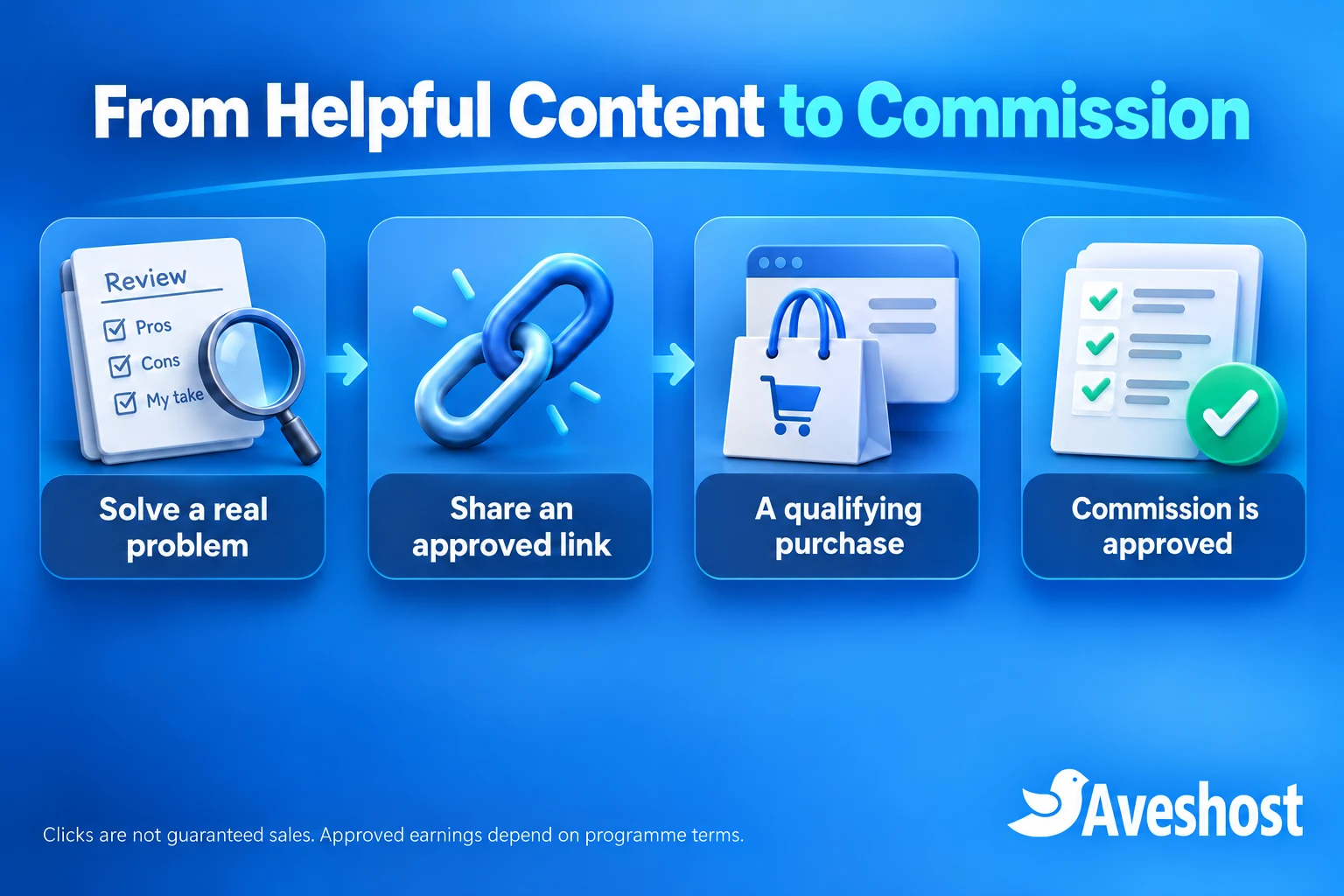
How affiliate marketing in Ghana actually earns income
An affiliate website is a publishing business. You provide information and send interested readers to a merchant. The merchant normally handles the sale, payment, delivery and returns. Your role and commission depend on the agreement; placing a link on a page does not create a commercial partnership by itself.
| Stage | What happens | What it does not prove |
|---|---|---|
| Visitor reads your guide | Someone considers your recommendation | That they will buy |
| Visitor follows an affiliate link | The programme may record a referral | That a commission is payable |
| A qualifying action is recorded | An order or other eligible event appears | That it has passed validation |
| Commission is approved | The programme accepts the earning | That the payout threshold has been reached |
| Payout is processed | Funds are sent under programme rules | That future earnings will repeat |
Coupon websites follow the same principle, but a discount code is not automatically an affiliate tracking method. Some programmes attribute purchases through links, others have approved code arrangements, and some use both. Confirm the actual mechanism before assuming a code will earn you commission.
Start with a small project you can afford to maintain. A narrow site with accurate information and a consistent publishing routine is more manageable than a directory claiming to cover every shop in Ghana. Reinvest based on approved results, rather than the biggest number on a dashboard.
Choose a niche you can serve consistently
Pick a reader and a problem before picking a theme. “Deals for everyone” is difficult to research and promote. A site helping university students choose study equipment, or helping small businesses understand website tools, gives you a clearer editorial purpose.
| Possible niche | Helpful content | What to verify |
|---|---|---|
| Student study equipment | Practical laptop and accessory comparisons | Ghana availability, warranty, specifications and total price |
| Home-office electronics | Router, monitor and power-backup buying guides | Local support, compatibility and realistic use cases |
| Website tools for small businesses | Hosting explainers, setup tutorials and plan comparisons | Renewal terms, included resources and service responsibilities |
| A defined local retail category | Merchant profiles and genuinely current offers | Delivery area, returns, stock and coupon permission |
Choose something you can investigate. If you have not used a product, label the article as a researched comparison instead of inventing hands-on experience. You can still add value by explaining specifications, local service options and the questions a buyer should ask.
Before committing, draft ten useful article ideas and identify potential partners. If you cannot find a legitimate programme that accepts your audience or a merchant willing to agree referral terms, the niche may be difficult to monetise through affiliates. An interesting topic and a workable business model need to meet.
Avoid selecting products solely because the commission looks high. A recommendation that is unsuitable for your reader can damage the trust that makes the website useful. Explain who a product suits, who should skip it and which limitations matter in everyday Ghanaian use.
Find suitable affiliate programmes and check the terms
Use a merchant’s official website or verified business contact to find its programme. Confirm whether Ghana-based publishers are eligible, which websites and channels are accepted, and whether your application must be approved before you publish promotional material. Do not rely on an old list of “best affiliate programmes” as evidence of current availability.
For local shops without a published programme, you can propose a small referral partnership. Agree the eligible products, tracking method, validation period, reporting process and payment arrangements in writing. Avoid collecting customer payments on the merchant’s behalf unless that is a separate, clearly defined service you are equipped to provide.
| Term to check | Why it matters |
|---|---|
| Commission basis | It may apply only to particular products, eligible amounts or first purchases |
| Attribution rules | A cookie window or coupon does not guarantee that your referral wins attribution |
| Reversals and validation | Refunds, cancellations and invalid orders can remove pending earnings |
| Payout rules | Confirm the threshold, schedule, currency, fees and method available to you |
| Promotion restrictions | Paid search, brand bidding, email, social media and coupon use may have limits |
| Content permissions | Get approved use of logos, product images, feeds and promotional copy |
To explore web hosting referrals, follow the Aveshost Affiliates link in our website footer and sign in to the client area. At the time of writing, this route leads to the client login; review the programme information available in your account or ask our team for the current terms and activation process.
Confirm the eligible services, commission structure, attribution, payout threshold and withdrawal options before planning your campaign. We are not quoting a public rate or promising recurring commissions here. Use only your own approved referral link and current promotional materials; do not copy another affiliate’s identifier.
If you want to make money online as a web hosting affiliate, publish tutorials and comparisons that explain real customer decisions. Help readers choose the resources and management level they need. Keep the relationship transparent and avoid claiming every plan is right for every project.
Choose your domain and hosting foundation
Choose a brand you can own and develop. A .com domain is familiar, while other extensions can work if the name is clear and renewal costs fit your budget. Check availability with our domain search. Avoid a name that impersonates a merchant or suggests you are its official support desk.
Register the domain in your own account, use current recovery details and enable supported account security. Record renewal dates and keep access separate from a freelancer’s personal account. Your domain, website content and business records should remain accessible if a designer stops working with you.
A small review website normally needs ordinary website hosting rather than a VPS. Our web hosting plans provide a starting point; choose capacity around your site and check current storage, backup and renewal details. Our managed WordPress hosting is another route when you want WordPress-focused tools.
Budget for the full first year: domain registration, hosting, any paid extensions, original images or product testing, and the time needed for content. You can launch with a legitimate free theme and core WordPress blocks. Buying a premium coupon theme does not create visitors or affiliate approval.
Use HTTPS, a lightweight design and compressed images from the start. Keep independent backups and protect administrator accounts. Follow our website security checklist before adding contributors or giving a developer access.
Build your review and coupon website with WordPress
Install WordPress using your hosting tools and choose a supported theme that works well on a phone. Create a staging copy for experiments. Start with the pages a reader needs: Home, Buying Guides, Reviews, Coupons, About, Contact, Affiliate Disclosure and Privacy. Write the policy pages around how your site actually operates.
Organise articles into a small number of clear categories. Create a reusable layout with a summary, key facts, useful comparison, limitations, disclosure and a descriptive merchant button. A visitor should understand the next step without having to close several pop-ups.
For a handful of offers, WordPress Group, Heading, Paragraph and Button blocks can form a simple coupon card. Maintain a private offer register with the source, conditions, expiry date and last check. This keeps your first release simple while you learn which pages readers use.
For a larger catalogue, Affiliate Coupons by Deetronix is one plugin to evaluate. Its listing describes vendors, coupons, categories and shortcode display in the free version; click-to-reveal and additional statistics are advertised as Pro features. Check current compatibility, support and pricing, and test in staging before committing.
To evaluate it, open Plugins → Add New, find the matching listing, then install and activate it in staging. Create a vendor, add a coupon, link the two and use the generated shortcode in a Shortcode block on your Coupons page. Preview the result and inspect the destination link. The plugin displays offers; it does not grant merchant approval or guarantee commission tracking.
You do not need WooCommerce just to link readers to another merchant’s checkout. Add e-commerce software only if your own site will sell something. Keep the initial plugin list small and remove unused tools after checking dependencies.
Create coupon pages that remain useful
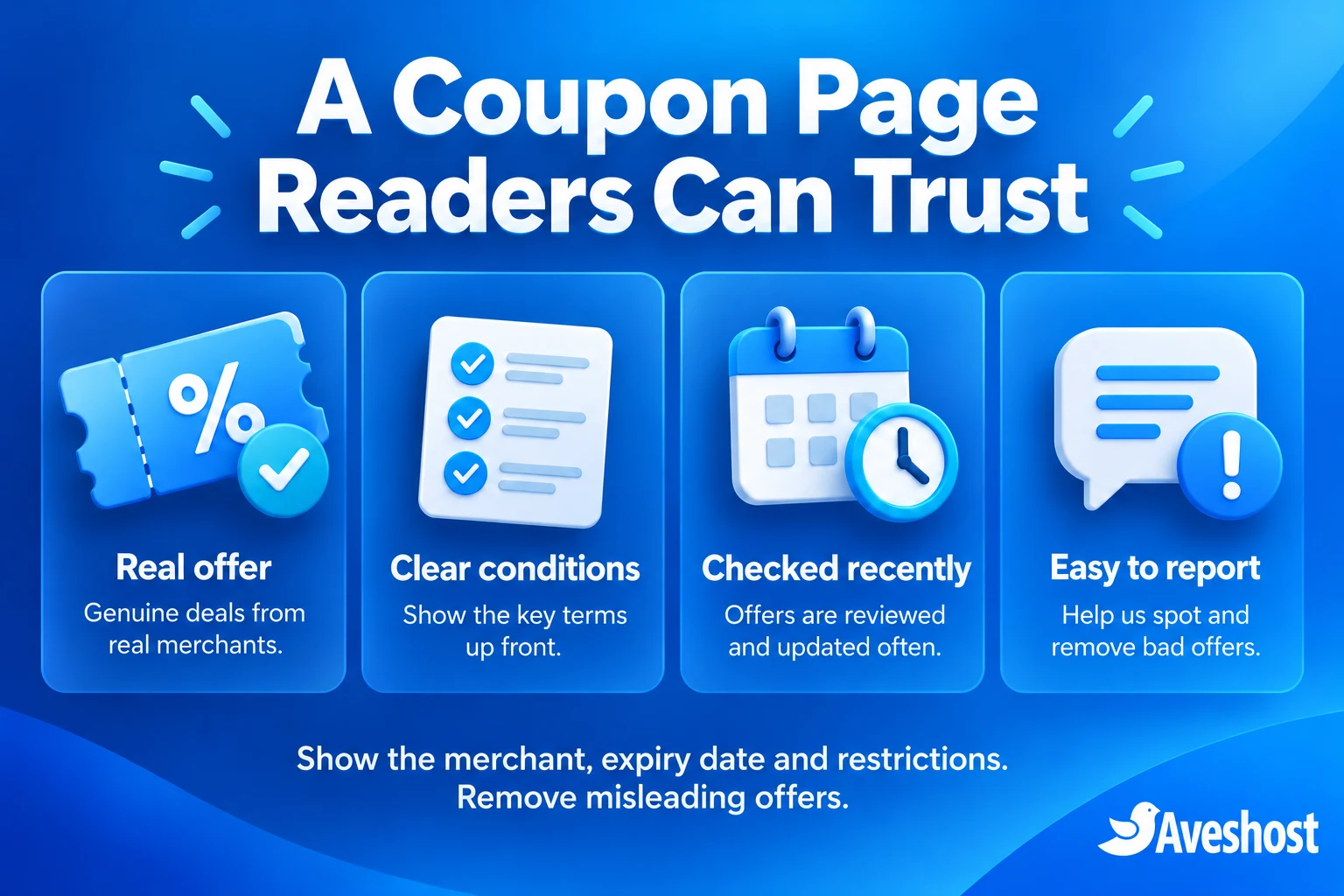
A coupon page should answer a practical question: what can this visitor save, on which items, and under what conditions? Show the merchant, exact benefit, expiry or availability status, restrictions and when you last checked the offer. Distinguish a code from a sale that needs no code.
| Coupon field | Illustrative entry |
|---|---|
| Merchant | Example Study Shop — fictional demonstration |
| Benefit | 10% off selected accessories — not a live offer |
| Code | STUDY-DEMO — example only |
| Conditions | Eligible items, minimum spend and location restrictions |
| Availability | Merchant-provided expiry or clearly stated uncertainty |
| Verification | Date, source and method of the latest check |
| Action | View the merchant’s offer and confirm final checkout terms |
Use only codes you are authorised to publish. A private customer code or leaked staff discount is not a public offer. Do not advertise a standard price as a special discount, invent expiry timers or show a “verified today” badge without doing the check.
Check the merchant’s offer page and, where practical, the eligible checkout conditions without submitting a purchase. Record what you tested. If you only confirmed that a promotion was listed, say that; do not imply that you completed a successful order. Availability, stock and delivery can still change.
When an offer expires, remove its active claim promptly. You may keep a clearly labelled expired entry if it helps readers understand the merchant’s offer history, but show current alternatives where relevant. Give readers an easy way to report a code that fails, and review those reports.
If you use click-to-reveal, make the action clear and comply with the programme’s rules. Do not silently redirect visitors or trigger affiliate attribution without an intentional permitted action. A visible code and an honest merchant link often provide a better first experience than a complicated reveal mechanism.
Write reviews that help readers make a decision
A helpful review explains a decision. Begin with the user’s situation, describe what you assessed, then give the evidence behind the recommendation. For a student laptop, that might include software needs, memory, battery expectations, local warranty and the total purchase cost.
Separate measured results from specifications supplied by the manufacturer. If a device was loaned or a merchant sponsored the article, disclose that relationship. If you have no access to a product, use clear research labels and avoid fabricated photos, benchmark numbers or personal stories.
Explain trade-offs. A lower purchase price may come with limited support, storage or upgrade options. A hosting review should distinguish introductory and renewal prices, storage limits and who maintains the server. Link to current official details and state when price information was checked.
Use original photographs where you have permission and describe how comparisons were made. Do not copy another reviewer’s verdict or reproduce merchant descriptions as if they were your independent assessment. Google’s thin affiliation policy distinguishes copied affiliate pages from pages that add useful information or analysis.
Keep an update queue. Product availability, service specifications and merchant terms change. Review pages that send readers to unavailable items, and correct recommendations when new evidence changes the conclusion. Your editorial judgement should remain separate from the commission rate.
Disclose commissions and handle links responsibly
Tell readers about affiliate relationships before they act on your recommendation. A short visible statement near the first commercial link works better than relying on a footer that many visitors will never read. Keep a fuller disclosure page linked from the main navigation or footer.
Example wording: “Some links on this page are affiliate links. We may earn a commission if you make a qualifying purchase through them. Our recommendations explain the benefits and limitations we consider relevant.” Adapt that wording to your actual arrangements and disclose additional sponsorship separately.
For search engines, qualify paid or affiliate links appropriately. Google recommends rel="sponsored" for compensated links. This HTML attribute does not replace a human-readable disclosure. An illustrative link is:
<a href="https://merchant.example/approved-referral-link" rel="sponsored">
  View the merchant’s offer
</a>
That is a non-working example, not your actual referral URL. Replace it with the exact approved link from your programme. In WordPress, use a supported sponsored-link option or a correctly configured template, then inspect the published HTML. Coupon plugins and ordinary buttons may handle attributes differently.
Explain analytics, forms and referral tracking in your privacy information. Collect only what you need and use appropriate consent controls for your audience and tools. Do not add customer email addresses, phone numbers or other personal details to affiliate URLs. Use programme-approved campaign identifiers instead.
Bring the right visitors to your website
Choose search topics with a clear reader need. A page answering “what laptop specifications suit accounting students?” has a different purpose from a generic list of expensive products. Connect your buying guide to a detailed comparison, then to an appropriate current offer.
Write descriptive page titles and organise content with useful headings. Keep navigation simple and submit the site through Google Search Console when ready. Search visibility is not guaranteed, and publishing more pages does not compensate for inaccurate or repetitive information.
Use social channels to share the useful part of the work: a compatibility tip, a short demonstration or a comparison lesson. Include affiliate disclosures where relevant and respect community rules. Avoid dropping unsolicited links into WhatsApp groups or sending promotional messages to people who did not ask for them.
Build an email list only with a clear subscription choice and a working unsubscribe route. Offer a focused update, such as a weekly summary of checked study-equipment offers. Keep the promise realistic; a newsletter full of expired discounts quickly loses its value.
Do not buy advertising until you understand the programme’s restrictions and can measure approved results. Some programmes restrict branded search ads or certain destinations. Start with a capped experiment only after checking the rules; traffic that costs more than it earns can erase a small commission margin.
Measure approved earnings and control your costs
Track a short funnel: relevant visits, intentional outbound clicks, recorded qualifying actions, approved commissions and processed payouts. Merchant reports are the source for commission status. Website analytics can show a click without proving that an order was attributed to you.
Here is fictional arithmetic in Ghana cedis, not an income forecast or an Aveshost rate. If 1,000 relevant visits produce 100 outbound clicks, five qualifying purchases and an average approved commission of GH₵20, gross approved earnings would be GH₵100. Every assumption can change, and the result could be zero.
If the same period costs GH₵80 for the expenses allocated to the project, the remaining amount would be GH₵20 before other costs and any applicable taxes. Your time, product testing, refunds, payment fees and currency conversion may reduce the result further. Pending commissions should not be treated as money already received.
Measure which pages help readers rather than just which buttons attract clicks. A misleading headline can increase clicks while reducing trust and qualifying sales. Improve a small number of useful pages before paying for a larger catalogue or elaborate design.
Keep programme statements, expenses and payout records. Check current registration, reporting and tax responsibilities with the appropriate Ghanaian authorities or a qualified adviser for your circumstances. The example above is a planning illustration, not a tax calculation.
Use a focused 30-day launch plan
Treat the first month as a launch experiment. The goal is a trustworthy small website with a repeatable publishing process, not a promised earnings target. Adjust the schedule around your studies or main job, and avoid spending money needed for essential expenses.
| Period | Main task | Deliverable |
|---|---|---|
| Days 1–7 | Choose a niche and verify potential programme terms | Audience statement, ten article ideas and partner checklist |
| Days 8–14 | Set up domain, hosting, WordPress and core pages | Working mobile site with security, backups and disclosures |
| Days 15–21 | Publish a small set of researched guides and genuine offers | Three useful guides and a manageable checked-offer list |
| Days 22–30 | Test links, share content appropriately and review feedback | Link test record, initial traffic observations and update schedule |
Before launch, check every merchant button, coupon condition, expiry label and disclosure. Test on a phone and a desktop, including the menu and contact form. Confirm that tracking links remain intact without generating artificial purchases or breaching a programme’s self-referral rules.
After launch, schedule weekly offer checks and regular content and software reviews. Increase frequency for fast-changing promotions. Keep a record of corrections and retired offers so the site remains accurate as your catalogue grows.
Ready to build your affiliate or coupon website? Start with our domain search and web hosting plans, then explore the Aveshost affiliate area for current programme information. If you need help with the website setup, discuss your project with our team.
Frequently asked questions
Can I start affiliate marketing in Ghana with a WordPress website?
Yes. Build useful content, check that each programme accepts your location and promotion methods, and obtain any required approval before using its referral links.
Is affiliate marketing completely passive income?
No. Content can keep attracting readers, but research, promotion, offer verification, updates and account administration require ongoing work. Earnings are not guaranteed.
How do I start a coupon website in Ghana?
Choose a niche, arrange legitimate merchant relationships, build a simple WordPress site and publish offers with clear conditions, expiry information and a verification process.
Does copying a coupon code automatically earn commission?
No. Attribution depends on the programme’s approved tracking method and qualification rules. A public code alone may not identify you as the referrer.
Do I need WooCommerce for an affiliate review site?
Usually not when readers buy on the merchant’s website. Ordinary content pages and referral links can be enough; use e-commerce software if you also sell directly.
Can I use a free coupon plugin?
Yes, after checking its source, compatibility and maintained features. A display plugin does not create affiliate approval or guarantee that commissions track.
How do I join the Aveshost affiliate programme?
Follow the Affiliates link to the Aveshost client area, sign in and review current information or ask our team about activation, eligible services and payout terms.
Must I tell readers that I earn a commission?
Use a clear visible disclosure near commercial recommendations and explain additional sponsorships. Also qualify compensated links appropriately for search engines.
How much can a new affiliate website earn?
There is no fixed amount. Audience relevance, merchant conversion, attribution, commission terms, reversals and expenses determine the result, which may be zero.
Should I leave expired coupons on my website?
Remove active claims promptly. Keep an expired entry only if it is clearly labelled and useful, and provide a way for readers to report problems.