
Learning how to build a brand in Ghana starts with a practical question: why should a customer choose your business and come back? A memorable name and attractive logo help, but a strong brand also needs a clear offer, dependable service and a consistent experience wherever people meet you.
Whether you run a fashion business in Accra, a food brand in Kumasi, a professional service in Takoradi or an online business serving customers across Ghana, your brand should make buying easier. People need to understand what you provide, who it is for and what they can expect.
This guide takes you through ten smart steps, with practical examples, a positioning template and a 30-day action plan. You can start small and build a more recognisable business without trying to look like a large corporation overnight.
Table of Contents
What does building a brand really mean?
Your brand is the set of expectations and associations people have about your business. Your visual identity helps them recognise it; your products, communication and service give that identity meaning.
| Element | What it does | Practical example |
|---|---|---|
| Brand strategy | Defines whom you serve and why they should choose you | Office lunches for teams that need dependable delivery |
| Brand identity | Makes the business visually recognisable | A consistent logo, colour palette and packaging style |
| Brand message | Explains the offer and its value | Clear menus, delivery terms and ordering instructions |
| Brand experience | Shows whether you deliver the promise | Accurate orders, helpful updates and a fair issue-resolution process |
Think of a customer who discovers you on Instagram, asks a question on WhatsApp and receives a product by delivery. The same business should be recognisable at every stage. If the advertisement promises care but the order arrives incorrectly with no explanation, the experience weakens the brand.
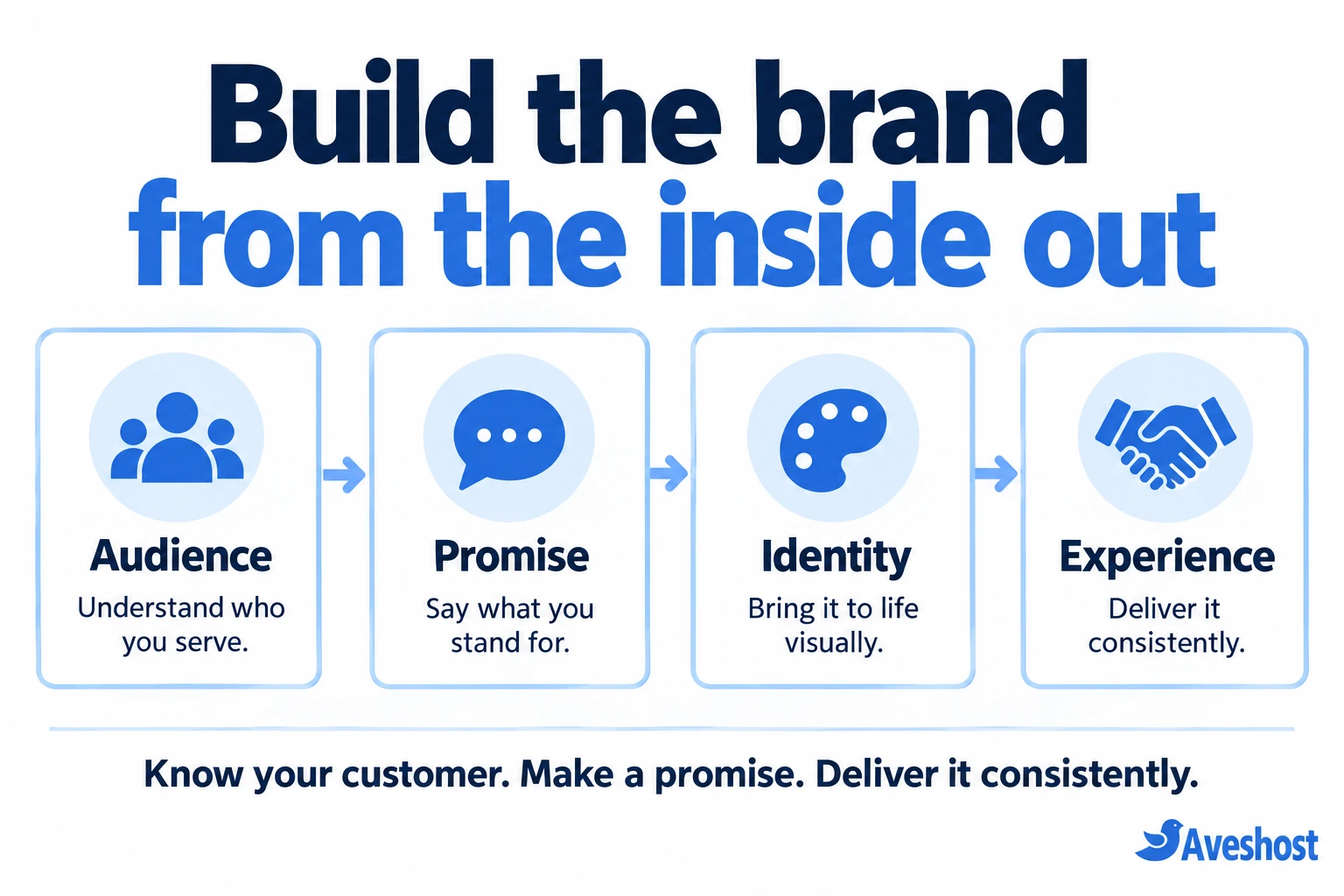
1. Understand the customers you want to serve
“Everyone in Ghana” is too broad to guide useful branding decisions. Start with a customer group whose needs you can describe. Geography matters, but so do budget, buying frequency, purpose and the problems people face.
For example, a clothing business might focus on young professionals who want comfortable workwear, or on customers ordering coordinated outfits for events. Those audiences may need different photographs, sizing information, delivery arrangements and messages.
- What are customers trying to achieve when they buy?
- What makes them hesitate: quality, price, fit, delivery or trust?
- Where do they look for information and recommendations?
- Which details do they need before paying?
- What would make them order again or refer someone?
Talk to a small initial group of customers or likely buyers. Ask about a recent purchase rather than only asking whether they like your idea. Review genuine enquiries and complaints to identify repeated questions. These conversations help you build your messaging around customer feedback.
Avoid treating Ghana as a single customer profile. A business serving a neighbourhood, a corporate purchasing team and customers abroad may need different delivery information and levels of detail. Choose your initial focus, then expand when you can serve the next audience well.
2. Choose a clear position in the market
Positioning explains where your business fits and why its offer matters to a particular customer. Focus your positioning on a specific strength customers value. Choose a useful difference that you can demonstrate.
Use a simple positioning statement
For [specific customer], we provide [offer] that helps them [desired outcome], supported by [credible reason to believe us].
Here is an illustrative example: “For small offices in Accra, we provide weekday lunch packages that simplify team ordering, supported by a clear menu, an agreed delivery window and one contact for order updates.” The statement is useful because it connects an audience, a need and an operating commitment.
Compare a few relevant alternatives. Look at what they offer, how they explain pricing, what customers praise and where questions remain unanswered. Find a gap you can serve well rather than copying another business’s slogan or visual style.
Your position must work financially and operationally. A promise of personalised service requires time and staff attention. A low-price position needs a cost structure that supports it. Choose a commitment you can keep when orders increase.
3. Choose and check your brand name
A useful brand name is easy for your audience to say, remember and search. Test it aloud, in a phone conversation, on a small package label and in a social media profile. Ask whether people can spell it after hearing it once.
If you use a Ghanaian-language word, check its meaning and pronunciation with people who understand the language. Consider how it will be understood by the customers you plan to serve. A local connection can be valuable when it fits the business; it should not make the offer harder to understand.
- Search for businesses using the same or confusingly similar name.
- Check relevant social handles and domain availability.
- Consider whether the name can accommodate future products or locations.
- Check official business-name requirements before investing heavily in signage or packaging.
The Office of the Registrar of Companies’ name-search guidance explains its business-name checks and notes that final approval rests with the Registrar. A domain search is a separate step; an available web address does not confirm business-name approval or resolve every possible name conflict.
You can search for a domain name with us and explore our .gh domain options. Choose the extension and spelling that fit your audience. For the basics, read our guide to why a domain name matters in Ghana.
4. Create a simple, consistent visual identity
Create a small visual system that works across the materials you actually use. Begin with a readable logo, a limited colour palette, suitable fonts and a consistent approach to photographs or illustrations.
Test the identity on a phone screen, an invoice, a delivery label and any physical signage. A detailed logo that looks impressive at full size may become unreadable as a profile picture. Keep versions suitable for light and dark backgrounds and request usable files from your designer.
- Logo files for digital and print use, including a simple small-size version.
- Colour codes and clear guidance on backgrounds and contrast.
- Fonts with appropriate usage rights and readable sizes.
- Templates for social posts, quotations, invoices and product information.
- Photo guidance covering lighting, backgrounds and an accurate representation of the product.
Consistency does not mean making every post identical. It means customers can recognise the business while the content stays useful. If you use a cultural motif, understand its context and use it thoughtfully rather than treating it as decoration.
Keep the scope realistic. A small business can launch with a simple, well-made identity and expand it later. Spend on clear product photography and essential customer information before commissioning materials you have no immediate use for.
5. Write a brand message people understand
People should understand your offer quickly. Put the customer’s need before a vague slogan. “Made for your everyday commute” is clearer when followed by the actual product, its features and who it suits.
Create three core messages
- What we do: one sentence describing the product or service.
- Why it matters: the customer problem or outcome you address.
- Why trust us: relevant evidence such as actual work, clear specifications or genuine customer feedback.
Choose a tone that fits your audience: helpful and direct, warm and conversational, or formal and precise. Use English, a relevant Ghanaian language or a combination based on customer needs. Test important wording with real customers and keep order instructions, prices and policies unambiguous.
Write one useful version of your business introduction, then adapt it for your website, social profile, WhatsApp greeting and proposals. Update them together when your offer changes. Include awards, credentials and performance results backed by your records.
6. Build a professional online presence
Give customers a reliable place to understand and contact your business. Social media can introduce the brand, while a website brings together the information people need before buying.
Start with a focused website
A useful first website can include your offer, product or service details, examples of your work, delivery or service areas, contact information and a clear next step. Depending on the business, that step might be ordering, requesting a quotation or booking a consultation.
Show the details that remove hesitation. For a store, explain sizes, prices, delivery charges and return arrangements. For a service, explain scope, the enquiry process and what information a customer should provide. Test the website on a phone and make forms easy to complete.
Explore our web hosting packages when you are ready to launch, or our web design service if you need help creating the site.
Use a professional email address
An address such as [email protected] keeps the business name visible in enquiries, quotations and follow-up messages. Separate business communication from your personal inbox and organise access as your team grows. See our business email packages and our business email hosting guide for Ghana.
Keep your contact details consistent
Use the same accurate business name, contact information and opening hours across your public channels. If your business meets customers in person, assess whether it qualifies for a Google Business Profile. Follow Google’s business representation guidelines; check the eligibility requirements for a purely online operation.
7. Make the buying experience match your promise
The buying experience is where your brand promise becomes real. Map the journey from the first enquiry to payment, delivery and follow-up. At each step, ask what the customer needs and what could create uncertainty.
| Stage | Customer question | Useful brand behaviour |
|---|---|---|
| Enquiry | Is this suitable for me? | Give clear information and explain limitations |
| Order | What am I paying for? | Confirm the item, total, delivery terms and next steps |
| Fulfilment | When will I receive it? | Provide a realistic timeline and communicate changes |
| After purchase | What if something goes wrong? | Offer a clear contact and issue-resolution process |
If you accept mobile money or other payment methods, give clear instructions and confirm orders through an agreed process. Keep payment references organised and explain what is included in the quoted amount. Avoid surprising the customer with charges after they have decided to buy.
For delivery, confirm the location information your delivery method needs, the service area and any relevant charge. For appointments, confirm the date, location and preparation required. Specific instructions create more confidence than a broad promise of “excellent service.”
Set a response standard you can maintain. Train staff on common questions and what to do when something is delayed or incorrect. Acknowledge the problem, explain the next step and follow through. Ask for honest feedback, and get permission before publishing customer photos or testimonials.
8. Grow visibility through useful content and partnerships
Choose a few channels your customers actually use and create content that supports a decision. A fashion brand might show fit and styling; a service business might explain its process and answer common questions. A food brand might show portions, ordering cut-offs and delivery information.
- Demonstrate: show products, completed work or how the service operates.
- Explain: answer questions about options, care, prices or the ordering process.
- Reassure: share genuine customer experiences with permission and explain policies.
- Invite: give a clear next step for an enquiry, booking or purchase.
Plan content around customer questions rather than posting offers every day. If you use paid promotion, start with a defined objective and a budget you can afford to test. Review qualified enquiries and sales before increasing spending.
Partnerships can connect you with a relevant audience. Consider complementary businesses, industry communities or local events where your offer fits. Agree responsibilities, costs and how enquiries will be handled. Evaluate an influencer or partner by audience fit and credible results, not only follower count.
For a practical channel guide, read our guide to selling on social media. Keep the offer consistent when customers move from a post to a conversation or your website.
9. Measure trust, enquiries and repeat business
Branding should help the business attract the right customers and serve them well. Track a small set of measures you can use to make decisions, rather than collecting numbers with no next action.
| Measure | What it helps you understand |
|---|---|
| Qualified enquiries | Whether your message attracts people who fit the offer |
| Enquiry-to-sale conversion | Whether information, pricing or the buying process needs work |
| Repeat purchases and referrals | Whether customers see enough value to return or recommend you |
| Recurring feedback | Where the experience matches or misses expectations |
| Cost of acquiring customers | Whether promotion is sustainable for your margins |
For example, if enquiries increase but orders do not, inspect the questions people ask. They may need clearer sizing, delivery terms or proof of quality. If customers buy once but rarely return, review the product and experience before changing your logo.
Use a consistent method to record where enquiries came from. Review the figures regularly alongside seasonal demand, promotion changes and capacity. Compare several periods before describing growth as a lasting trend.
10. Document your brand and improve consistently
Create a short brand guide so the business remains consistent as people help you. Include the audience, positioning statement, key messages, visual rules, contact details and templates. Add practical standards for enquiries, orders and complaints.
Keep ownership of your domain, website, email and social accounts clear. Use business-controlled access and recovery arrangements so the brand is not dependent on a contractor’s personal account. Store original design files and keep track of licences and renewal dates.
Review the brand when your audience or offer changes, but distinguish a strategy problem from a service problem. A new identity will not resolve unreliable delivery. Improve the part of the business that is causing friction, then update the message and assets where necessary.
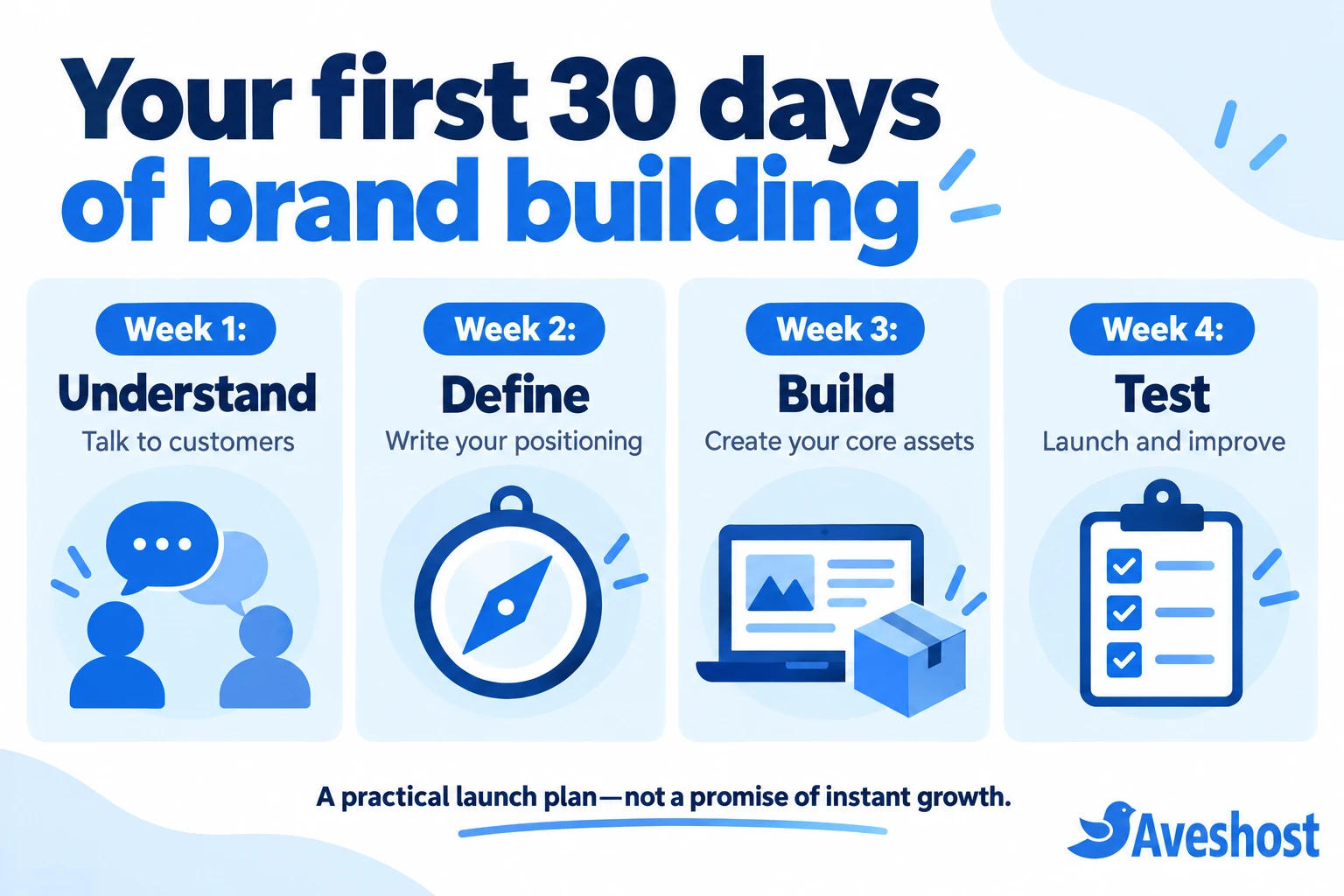
A practical 30-day brand-building plan
Use this as a starting schedule, not a deadline for building a complete reputation. Adjust the pace to your business and the work needed to deliver your offer.
| Period | Main task | Useful output |
|---|---|---|
| Week 1 | Understand customers and relevant alternatives | Customer questions and an initial audience description |
| Week 2 | Define your position and test the name | A positioning statement and a checked name shortlist |
| Week 3 | Create essential assets and processes | Core identity, website information and order templates |
| Week 4 | Launch a focused test and collect feedback | A small campaign, enquiry records and a list of improvements |
Prioritise spending in the same order: understand the customer, make the offer clear, deliver it well and then expand promotion. Your budget should include ongoing costs such as domain renewal, hosting, email, packaging and staff time, not only the first design invoice.
If you want to organise the wider business plan behind your brand, read our guide to using AI to write a business plan in Ghana. Keep your customer research and actual business figures at the centre of the plan.
Branding mistakes to avoid
- Trying to serve every customer with the same offer.
- Copying another brand’s name, design or marketing promises.
- Investing in appearance before fixing product or service problems.
- Using different prices or contact details across channels without explanation.
- Choosing slogans that promise more than the business can deliver.
- Treating follower growth as a substitute for useful demand and repeat business.
- Changing the identity repeatedly before customers can recognise it.
To build a brand in Ghana that lasts, connect a clear promise with a dependable experience. Start with an audience you understand, create a simple identity and make each customer interaction consistent. Recognition grows when people repeatedly see—and receive—the value you offer.
When you are ready to build the digital foundation, you can find a domain name, choose a web hosting package and set up professional business email with us. Start with what your business needs now and expand as it grows.
Frequently asked questions
How do I build a brand in Ghana?
Start by understanding a specific customer group and the problem you solve. Define your position, choose a suitable name, create a consistent identity and build a clear online presence. Then deliver a dependable customer experience and use feedback to improve.
What is the difference between a brand and a logo?
A logo is a visual identifier. Your brand includes the expectations people have about your business, shaped by your products, communication, service and reputation. A good logo helps recognition, but it cannot replace a reliable experience.
Can I build a brand with a small budget?
Yes. Begin with customer research, a clear offer, a simple visual identity and consistent communication. Prioritise the assets and service improvements customers need to buy confidently. Add more elaborate design and campaigns as your results and budget justify them.
Do I need a website if I already sell through social media?
A website gives customers a central place to understand your offer, find contact details and check important information. Social media can bring people to that site. You can start with a focused website rather than a large online store.
Should I choose a .com or .gh domain for my Ghanaian brand?
Choose an extension that fits your audience, name and growth plans. A .com can suit a broad audience, while a .gh option can express a Ghana connection. Check availability and the relevant registration requirements before deciding.
Does registering a domain register my business name?
No. Domain registration and business registration are separate processes. Check your proposed business name through the Office of the Registrar of Companies and manage your domain separately. Seek relevant advice when assessing name conflicts or brand protection.
Should my brand use English or a Ghanaian language?
Use the language your target customers understand and prefer. English may fit some audiences; a relevant Ghanaian language or a combination may fit others. Test the wording with actual customers and keep pricing, policies and instructions clear.
How long does it take to build a strong brand?
There is no fixed deadline. You can establish your basic strategy and assets in a planned launch period, but recognition and trust develop through repeated customer experiences. Measure progress over time rather than expecting a new logo to produce instant growth.
How do I measure whether my branding is working?
Track qualified enquiries, enquiry-to-sale conversion, repeat purchases, referrals and recurring customer feedback. Review which channels bring useful demand. Compare these results with your costs and service capacity rather than judging success only by followers.
When should I rebrand my business?
Consider a rebrand when your existing identity or message no longer fits your customers, offer or direction. First identify the real problem. If customers are confused by pricing or dissatisfied with service, fix those issues before replacing the name or logo.