
Is an .ai domain still worth it? Yes, when it gives your AI business a clear, memorable identity and its ongoing cost fits your budget. But an expensive extension cannot rescue a confusing name, and a low launch price does not tell you what you will pay to keep it.
For founders choosing between .ai, .com and other tech extensions, the smart decision combines brand fit, availability and renewal planning. In this guide, we explain the real .ai domain cost, show how to compare recurring prices and explore five alternatives that can work just as well for the right business.
Start with the name your customers can remember. Then use our domain search to compare available options before committing to a brand.
Table of Contents
Is an .ai domain still worth it?
.ai is the country-code top-level domain for Anguilla. Its letters also make it an appealing shorthand for artificial intelligence, which is why an AI product can use the extension to communicate its focus immediately. It is a branding choice; owning the extension does not certify the technology behind a product.
We recommend .ai when artificial intelligence is central to what you sell, the exact name is easy to say and type, and you can fund the initial term plus future renewals. A focused assistant, model platform or AI workflow tool may benefit from that clear signal.
A general consultancy, online store or business likely to expand beyond AI should also consider .com. You can describe your AI features in your website copy without making the entire company identity depend on one technology. A domain should still feel appropriate when your product range grows. For a closer look at brand positioning, follow our .ai versus .com guide with tech-brand examples.
- Choose .ai for relevance: AI is the reason customers seek your product, rather than a small feature in a broader service.
- Choose .ai for a better name: the available address is cleaner than the long or awkward alternatives you would otherwise use.
- Choose .ai for a sustainable budget: paying for the name will not displace essential hosting, product development or customer acquisition.
- Choose another extension when it fits better: an intuitive .com or product-specific .app can be a stronger address than a difficult .ai.
What does an .ai domain really cost?
There is no single retail price for every .ai domain. The registrar, registration term, currency, taxes and the specific name all affect the amount. Standard registration is also different from buying a premium name or acquiring a domain from its current owner.
Understand the two-year commitment
When you register an .ai domain with us, the minimum registration term is two years. Renewal also has a two-year minimum. Check our domain pricing and read the number of years beside each price. An annual equivalent helps with budgeting, while your checkout shows the total for the selected registration term.
For example, an example quote of $100 per year with a two-year minimum means $200 upfront before additional charges. A displayed $200 price for the entire two-year term means $100 per year. Those are two different ways of presenting the same term cost; neither should be compared directly with a one-year checkout without adjustment.
Compare our published domain prices
Our domain pricing page, checked on 12 October 2026 in USD, lists a standard .ai new-registration price of $278.72 for 2 years and a renewal entry of $102.72 for 2 years. Read these as the displayed term entries, and review the final quote for your exact domain and selected duration before purchase. Future renewal rates can change.
This is also why “renewal shock” should not be read as a promise that every .ai renewal costs more than registration. Our published entries currently show a lower renewal figure. The practical lesson is to check both prices and their terms, to budget for the actual renewal total.
Here are the five alternatives at our published standard rates. The four-year projection uses one initial year and three renewals at the current listed renewal rate. It excludes optional services and additional checkout charges, and keeps the current rates constant for the calculation.
| Extension | New registration | Renewal | Illustrative 4-year domain cost |
|---|---|---|---|
| .com | $18.25 / 1 year | $18.25 / 1 year | $73.00 |
| .io | $54.76 / 1 year | $82.13 / 1 year | $301.15 |
| .tech | $20.48 / 1 year | $82.13 / 1 year | $266.87 |
| .app | $22.82 / 1 year | $27.38 / 1 year | $104.96 |
| .dev | $18.25 / 1 year | $20.99 / 1 year | $81.22 |
For .ai, using the displayed two-year entries gives an illustrative four-year amount of $381.44: $278.72 for the first two years plus one $102.72 two-year renewal. This is a planning calculation using the listed figures, not a locked future quote. Premium names and resale purchases have separate pricing.
Notice that .io and .tech have the same current annual renewal price in this comparison, despite very different first-year prices. Choosing an alternative can reduce spending, but the extension alone does not establish that it is cheap.
How to avoid domain renewal shock
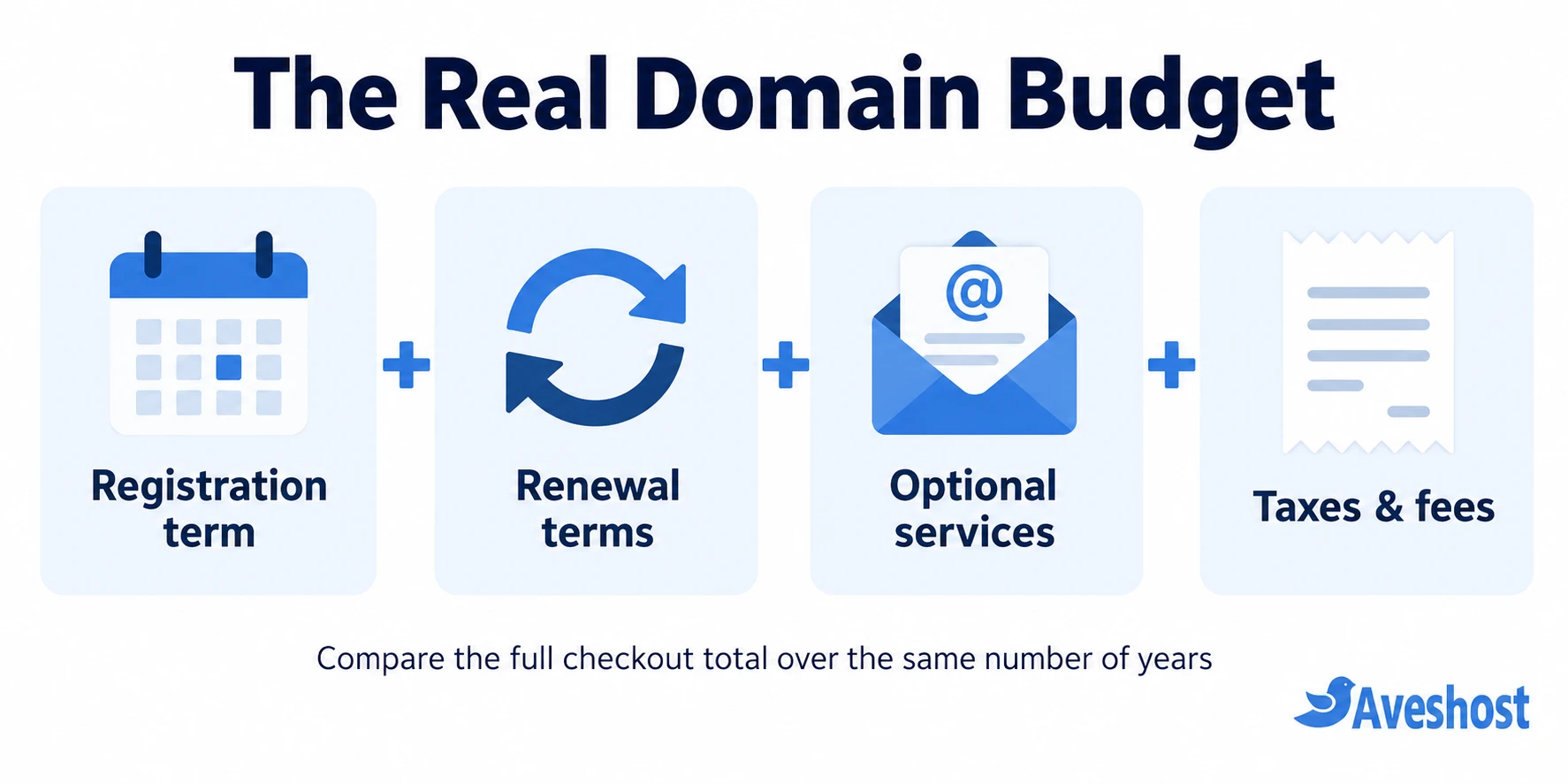
Renewal shock happens when the amount needed to keep a domain differs from what you budgeted. A promotional first term, a multi-year invoice, a premium renewal or a changed exchange rate can all create that gap. Build your decision around the recurring obligation, rather than the cheapest number on a banner.
Build a simple long-term budget
Write down the initial term total, its duration, the next renewal term and its quoted cost. Then add any services you actually want. Compare names over four years if one option requires a two-year term; that keeps the periods aligned and avoids counting only the first invoice.
Budget formula: initial registration term + renewal terms needed for your comparison period + selected services + applicable taxes and fees. If the quote is annual, multiply it by the number of years being purchased. If it is already a term total, do not multiply it again.
- Save your registration invoice and the renewal quote used when choosing the name.
- Record the renewal date in a business calendar and enable available reminders.
- Keep your payment method current and check that auto-renew is enabled for the domain.
- Review renewal notices early enough to resolve payment or account problems before expiry.
- Keep the account recovery email accessible even if your business domain stops working.
- Track every defensive domain separately; five unused names still produce five renewal obligations.
A domain expiry can affect both your website and domain-based email. Treat renewal as an operating expense for a business asset. Auto-renew helps, but a failed payment still needs attention; keep an owner responsible for checking the account.
Separate premium prices from renewal prices
A premium registry name may have a higher registration price and may also carry a higher renewal rate. An aftermarket purchase involves paying an existing owner or marketplace, with ongoing registrar renewal separate from that purchase. Before buying either, ask for the exact renewal price for the specific name. A general extension price is not enough.
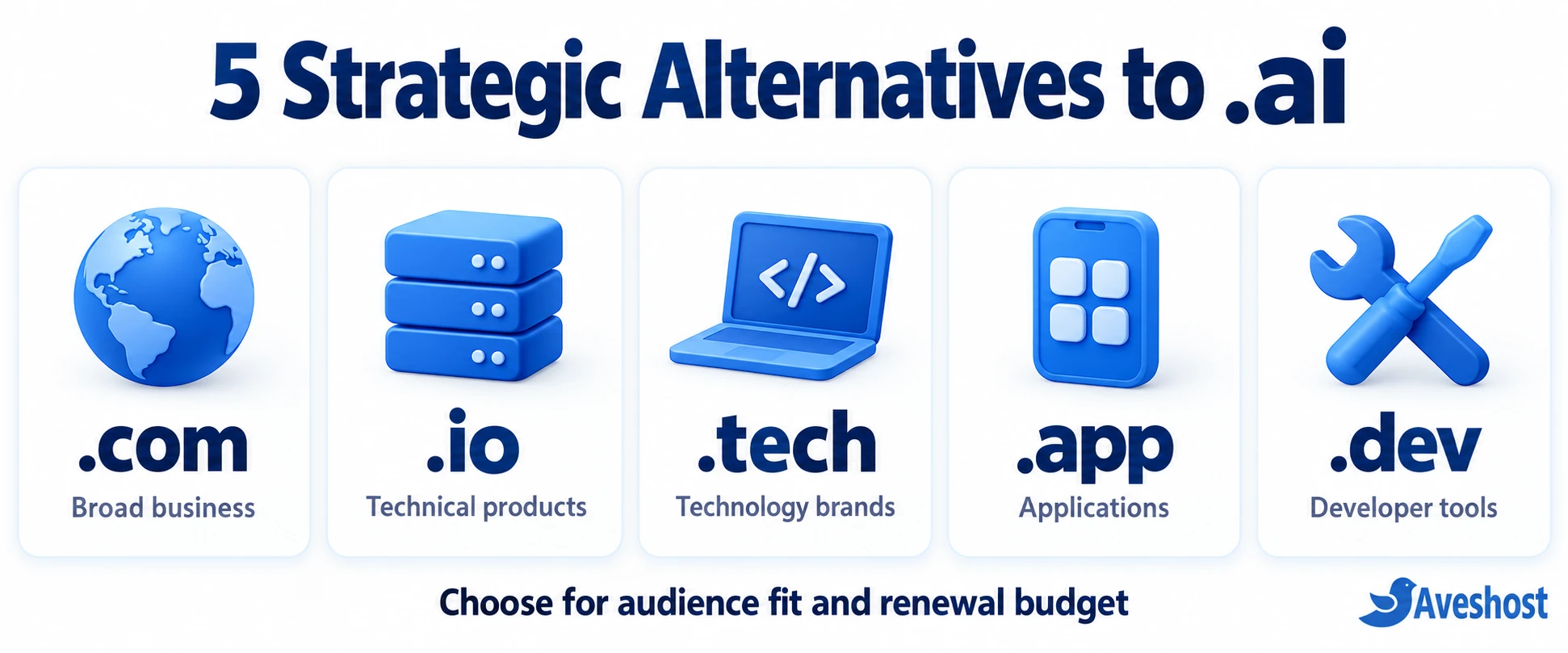
5 strategic alternatives to .ai
These five options solve different branding problems. Use them as a shortlist, then test the complete address for pronunciation, spelling, audience fit and recurring cost.
1. .com: the versatile business choice
.com is our first option for a brand serving a broad audience or selling several types of products. It gives you room to introduce AI features without making them the company’s defining identity. A short, distinctive name is preferable to a crowded string of keywords added just to secure the extension.
At the current rates above, .com also offers a straightforward annual registration and renewal comparison. If the exact brand name is unavailable, try a natural modifier such as “get” or “use” only when it still sounds like your business. Do not copy another company’s identity to obtain a familiar extension.
Best fit: established businesses, general SaaS, commerce and brands that expect to expand. Trade-off: your preferred short name may already be registered. Explore .com registration and compare complete names.
2. .io: a technical product identity
.io can suit developer platforms, infrastructure tools and SaaS products whose customers are comfortable with technical branding. It is a country-code extension that is also used beyond its geographic origin; it is not a special technical certification for a website.
The main budget consideration is the recurring price. In our table, a discounted first year is followed by a higher annual renewal, so .io is not automatically the lowest-cost replacement for .ai. If your audience is less technical, test whether people can recall and type the ending correctly.
Best fit: developer tools and technical SaaS. Trade-off: renewal cost and audience familiarity. Compare .io domain options before choosing.
3. .tech: a broad technology brand
.tech tells customers that technology is part of your identity without narrowing the business to AI. It can work for software companies, technology communities, product studios and technical service providers. Pair it with a distinctive brand word so the full address reads naturally.
Its launch discount deserves particular attention. Our published .tech renewal is substantially higher than its current new-registration price. A strong technology label can be useful, but calculate the full period before deciding that the introductory offer makes it a bargain.
Best fit: businesses that want a technology association beyond one product category. Trade-off: the recurring price may be much higher than the launch offer. See our .tech options.
4. .app: a clear address for your application
.app is a natural candidate when the product itself is an application. It can support a landing page, documentation or the application’s web interface. The name should make sense when someone hears it spoken aloud, especially if customers will find you through recommendations.
.app requires HTTPS because the extension is on the HSTS preload list. Set up a valid SSL certificate and test the secure address before launch. That requirement concerns encrypted browser connections; you still need good account security, application updates and data protection.
Best fit: web applications, mobile app landing pages and focused software products. Trade-off: HTTPS must be ready from the start. Search .app choices.
5. .dev: a home for developer products
.dev fits projects aimed at people who build software: APIs, documentation, coding tools, developer communities and technical portfolios. It can make the intended audience immediately clear without requiring your product to be based on AI.
Like .app, .dev is on the HSTS preload list and requires HTTPS. Configure the secure website before directing visitors to it; buying the name does not deploy your application or create its certificate automatically.
Best fit: developer tools, documentation and programming projects. Trade-off: it may be less intuitive for a general consumer brand. Explore .dev registration.
Does .ai help your SEO?
An .ai domain does not automatically make your pages rank for artificial intelligence searches. Google lists .ai and .io among the country-code extensions it treats as generic for geographic targeting. That makes them usable for a global audience; it does not establish an extra ranking benefit.
Choose the extension for your customers, then build the website that answers their needs. Clear page titles, useful original content, crawlable navigation, reliable HTTPS and relevant links do more for a sound SEO strategy than choosing an ending because it looks fashionable.
You can run an AI business on .com, .app or .dev and explain its purpose through the product, headings and content. Equally, a .ai website still needs convincing information about what it does. The domain is the address; your website supplies the substance.
Choose a domain that fits your business
Before choosing, put your top three complete addresses through the same practical test. Ask someone in your target audience to repeat the name after hearing it once. Check whether they spell it correctly and remember the ending without a reminder.
| Question | What a strong choice looks like |
|---|---|
| Does the name match the product? | The address supports the business you sell today and the direction you expect to take. |
| Can people remember it? | It is short, easy to pronounce and free of confusing punctuation. |
| Can you sustain it? | The initial term and several renewal terms fit the business budget. |
| Will it stand apart? | It is distinctive and avoids confusion with existing brands. |
| Can you launch it properly? | You have a plan for hosting, HTTPS, email and account security. |
For a pre-revenue AI prototype, spending less on the domain may leave more room for product testing. For a product whose core proposition is AI, a clean .ai can support the positioning if the recurring cost is manageable. For a business selling a wider service portfolio, a good .com is often the more adaptable choice.
If you already own a suitable company domain, an AI product can start on a subdomain such as ai.example.com. That avoids registering another parent domain, although hosting and application costs remain. It also keeps the new product visibly connected to your existing business.
Owning both .com and .ai can make sense for a valuable brand, but choose one primary website and redirect the secondary address. Do not publish duplicate competing copies of the same site. Register extra names for a clear business reason and include each renewal in your budget.
How to register and protect your domain
1. Search your preferred names
Open our domain search, enter the full name and review availability. If you need ideas, use our AI domain generator to create a shortlist. Treat suggestions as starting points and evaluate the final name yourself.
2. Review the name and full quote
Check the spelling, extension, registration duration and total. Review the current renewal rate and any premium pricing for that exact name. Availability does not establish that you can use someone else’s brand, so check for conflicts before investing in a logo, website or marketing materials.
3. Register with business-controlled details
Use an account controlled by the business, accurate registration information and a recovery email you can reliably access. Enable the account’s available security protections, keep transfer locking enabled where supported and store recovery details securely. Set reminders and review the auto-renew option.
4. Review privacy and DNS settings
Our domain registration service includes free WHOIS privacy protection. Review the settings for your selected extension after registration. Privacy helps reduce exposure of contact details in public lookups; it does not replace accurate registration information or strong account security.
Point the website’s DNS records to your hosting service and add the records required by your email provider. Follow the actual record values supplied for your account rather than copying example IP addresses. Changing nameservers can affect existing email and verification records, so retain the records you still need.
5. Connect hosting, HTTPS and business email
A domain registration gives you the address. Choose our web hosting packages for your website, or our self-managed cloud VPS for an application you manage. Eligible hosting packages offer a free domain with qualifying annual billing; choose from the extensions included in the offer.
For a branded mailbox, review our business email plans. Domain registration alone does not create a business mailbox. Connect the provider’s MX and authentication records, then test sending and receiving. Before announcing the launch, verify HTTPS, forms, sign-ins and email from an external connection.
Already on .ai? Decide whether to keep or switch
If your .ai name already works well for customers, compare its renewal cost with the cost and effort of rebranding. Keeping a recognisable name can be sensible even when another extension has a lower registration price. Moving for a small discount may create more work than it saves.
If you do switch, register the new name first and prepare the new website without interrupting the existing service. Create a page-by-page redirect plan, test HTTPS and update internal links, canonical URLs, sitemaps and your search management tools. Check integrations that depend on the old address, including login callbacks, webhooks and payment settings.
Treat email as a separate migration. Add the new domain to your mail service, update authentication records and retain the old addresses or forwarding during the transition. Update customer contacts, social profiles, documentation and invoices. Keep the old domain renewed while customers and services still rely on it.
Build your online presence with us
Our recommendation is simple: buy .ai when its branding value is clear and the term cost is sustainable. Otherwise, choose the cleanest alternative that fits your audience. .com offers broad flexibility; .io and .tech support technical positioning; .app and .dev give focused products a clear identity.
You can search and register your domain with us, compare the current registration and renewal prices, then connect hosting and business email from the same service provider. If you need help reviewing the options, contact our support team before choosing your name.
Frequently asked questions
Is an .ai domain worth it for a startup?
It can be a strong fit when AI is central to your product and the name is short, memorable and affordable across several renewal terms. For a broader business, a good .com may offer more flexibility. Compare the full term cost before choosing.
Why are .ai domains expensive?
The extension has its own registry pricing and registration rules, including a minimum two-year term. Registrar pricing, premium names and optional services also affect the checkout total. A quoted annual equivalent is not necessarily the amount you pay upfront.
Can I register an .ai domain for one year?
The standard minimum registration and renewal term is two years. Read the term beside the price and confirm the full amount for your selected name before paying.
Does .ai always cost more at renewal?
No. Renewal pricing depends on the registrar and the name. Registration and renewal prices can be equal, higher or lower. Use the current renewal quote to plan the next renewal payment.
What are the best alternatives to .ai?
Our five strategic options are .com for broad business use, .io for technical products, .tech for a technology identity, .app for applications and .dev for developer tools. Choose by audience and recurring cost, not just the launch discount.
Is .io a cheap alternative to .ai?
Not necessarily. Compare its renewal price over the same number of years as .ai. A one-year registration discount can hide a much larger recurring bill.
Does .ai improve Google rankings?
The extension does not automatically give your content a ranking advantage. Google lists .ai and .io among country-code extensions it treats as generic for geographic targeting. Relevant content, crawlability and a useful website remain essential.
Do .app and .dev require HTTPS?
Yes. These extensions are on the HSTS preload list, so browsers require HTTPS for their websites. Have a valid certificate and working HTTPS before launching.
Is business email included with a domain?
Domain registration and a business mailbox are separate services. Some hosting packages include email, while dedicated business email has its own plans. Review the package details and connect the required DNS records.
Can I change from .ai to .com later?
Yes, by registering the new name and migrating your website and email. Redirect matching website pages, update account integrations and keep the old domain renewed during the transition. A domain change does not simply rename an existing registration.