
A land surveying website in Ghana can give clients a clear place to request a consultation, submit documents privately and follow agreed professional work. For surveyors and property-law firms, a secure portal also keeps enquiries, case records and client updates organised.
A buyer abroad may need help understanding a site plan, arranging a visit or commissioning the appropriate official checks. The website should explain the service and provide a dependable communication route. It should also make clear which findings are preliminary and which work has been completed and reviewed.
This guide covers the website and hosting setup behind that service: public information pages, private case access, protected documents, appointments and report delivery. A consultation portal supports the professionals doing the work. It does not certify ownership, settle a boundary dispute or replace the required official processes.
Table of Contents
Plan a land surveying website in Ghana
Start with the services the firm is qualified and equipped to deliver. Examples include an initial document consultation, survey instructions, arranging an official search and explaining a reviewed report. Keep surveying and legal advice assigned to the appropriate professionals rather than presenting every service as one automated check.
Publish the firm’s real identity, office contact, team and relevant professional credentials accurately. Explain who takes responsibility for each type of work. A professional website builds trust through a clear process and accountable people, not through official-looking seals or a promise of guaranteed clean title.
| Website area | Purpose |
|---|---|
| Public service pages | Explain scope, team, process and contact routes |
| Initial enquiry form | Collect enough information to assess the request |
| Private client portal | Share authorised case documents and updates |
| Appointment workflow | Agree consultation time, scope and any fee |
| Reviewed report delivery | Release the appropriate professional output securely |
Begin with a focused service and a manageable number of clients. A well-run consultation and document-review workflow is more useful than a broad “instant verification” tool that the firm cannot substantiate. Define who responds to new enquiries and who reviews a report before release.
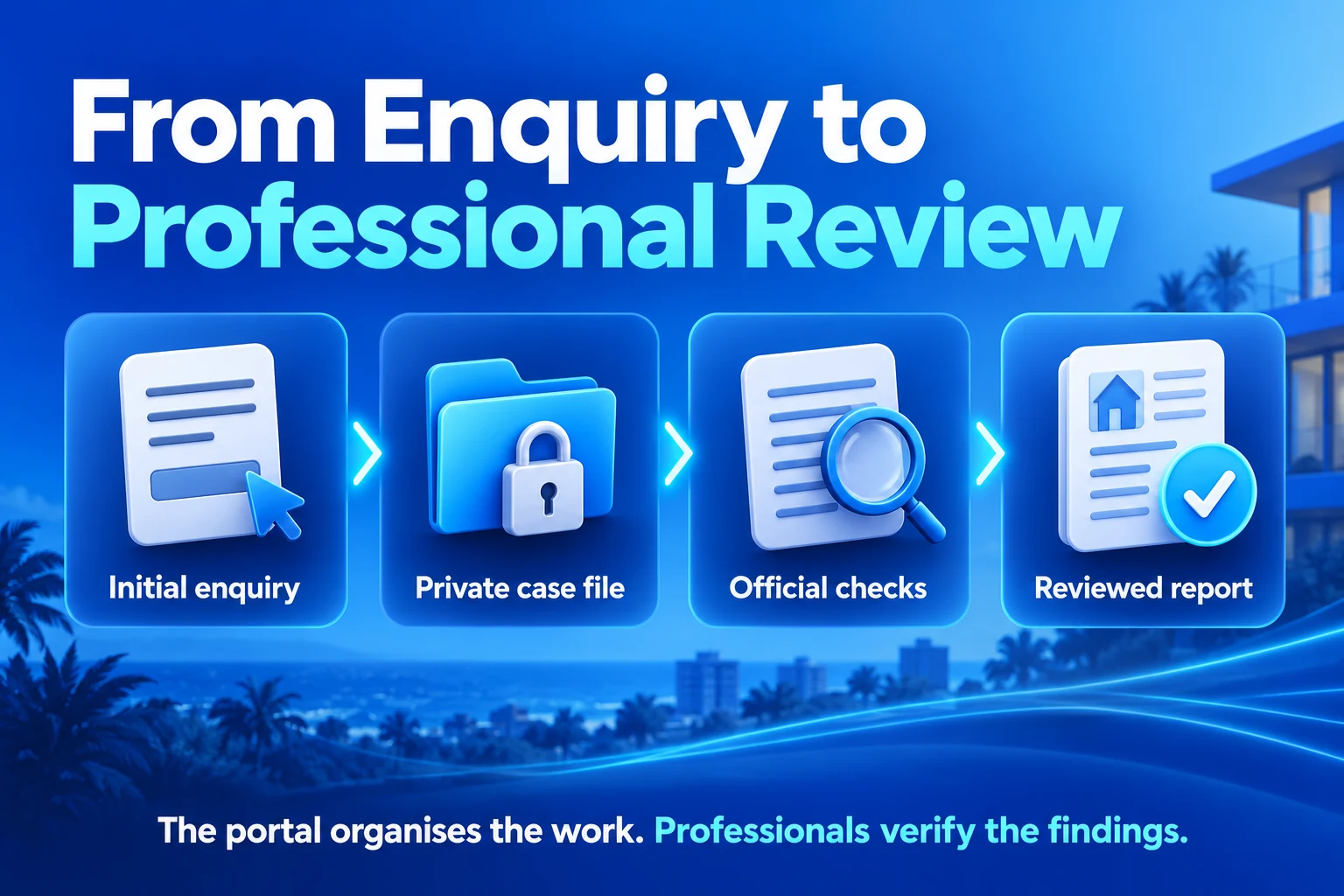
Separate consultation from official verification
A client upload is source material for review. A map pin helps identify a location. Neither establishes that the person presenting the property can transfer it or that a boundary is legally settled. Present location checks and professional conclusions as different activities.
The Lands Commission’s Client Service Access Unit guidance shows that formal surveying and plan-related applications can require specified records and licensed-surveyor details. The professional handling the case should confirm the current requirements for the actual service and location.
The Lands Commission Online Services portal provides official service functions such as application-status checks, payments and receipts. A private firm’s portal is a separate system. Do not imply that it is government-operated or connected to official records unless that integration is genuinely authorised and implemented.
Explain what the client is buying: a consultation, a defined search instruction, a survey task or a legal review. State which records and inspections are included, what remains outstanding and who interprets the findings. A search response should be reviewed in its context rather than converted into an automatic “safe to buy” badge.
For GPS or coordinate work, have the responsible survey professional assess the source, reference system and required fieldwork. A consumer map or phone location is not a substitute for a properly conducted survey. Keep the website’s description within the service the firm actually performs.
Design a clear client consultation journey
Use a short initial enquiry form before requesting a full document pack. Ask for the client’s name, contact route, general property location, requested service and a brief description. Explain the response window and that the firm will confirm scope before work begins.
After review, provide an engagement scope covering the service, responsible professional, documents needed, fees, third-party charges and delivery expectations. Complete the firm’s client-acceptance and authority checks before opening a private case. A booking acknowledgement should not imply that an engagement has already been accepted.
| Stage | Client sees | Staff responsibility |
|---|---|---|
| Enquiry received | Acknowledgement and next step | Assess the request |
| Scope agreed | Service, charges and requirements | Complete acceptance checks |
| Case opened | Private account and document request | Assign the case team |
| Work in progress | Useful status and any action required | Record work and outstanding dependencies |
| Report ready | Reviewed output and follow-up route | Approve the release |
| Case closed | Completion note and record policy | Apply retention and access rules |
Use plain status labels such as “Awaiting documents”, “Official response pending” and “Professional review in progress”. Reserve “Verified” for a defined finding with a clear scope. The client should never confuse an upload checkmark with completed property verification.
Give each case a unique internal reference. Link every appointment, invoice, document request and report to that reference. Avoid putting a client name, identity number or precise property details in a public URL or an email subject line.
Choose the domain, hosting and business email
Register a business-controlled domain through our domain services, or review Ghanaian domain options. Keep renewal and recovery contacts with the firm, and use individual business accounts for domain and hosting administration.
Use professional business email for enquiries and client notices. Give staff separate accounts and appropriate access. For sensitive casework, email should usually notify the client that an update is available rather than circulate complete document packs as attachments.
Separate the public marketing website from the private application’s access requirements. WordPress can publish service pages and manage a consultation booking flow. A confidential case portal needs a maintained application or a properly scoped custom implementation with tested file and case permissions.
Discuss the application, document volume, concurrent users, backup requirements and administration responsibilities before selecting hosting. Our fully managed VPS hosting can be assessed for the project, while Ghana-based virtual dedicated servers provide another infrastructure option where local hosting is part of the requirements.
Specify HTTPS, supported software, patch ownership, private storage, logging and restoration needs in the project brief. A VPS, SSL certificate or Ghana server location alone does not make the portal secure or compliant. The application, staff practices and provider arrangements all matter.
Create private client accounts and case permissions
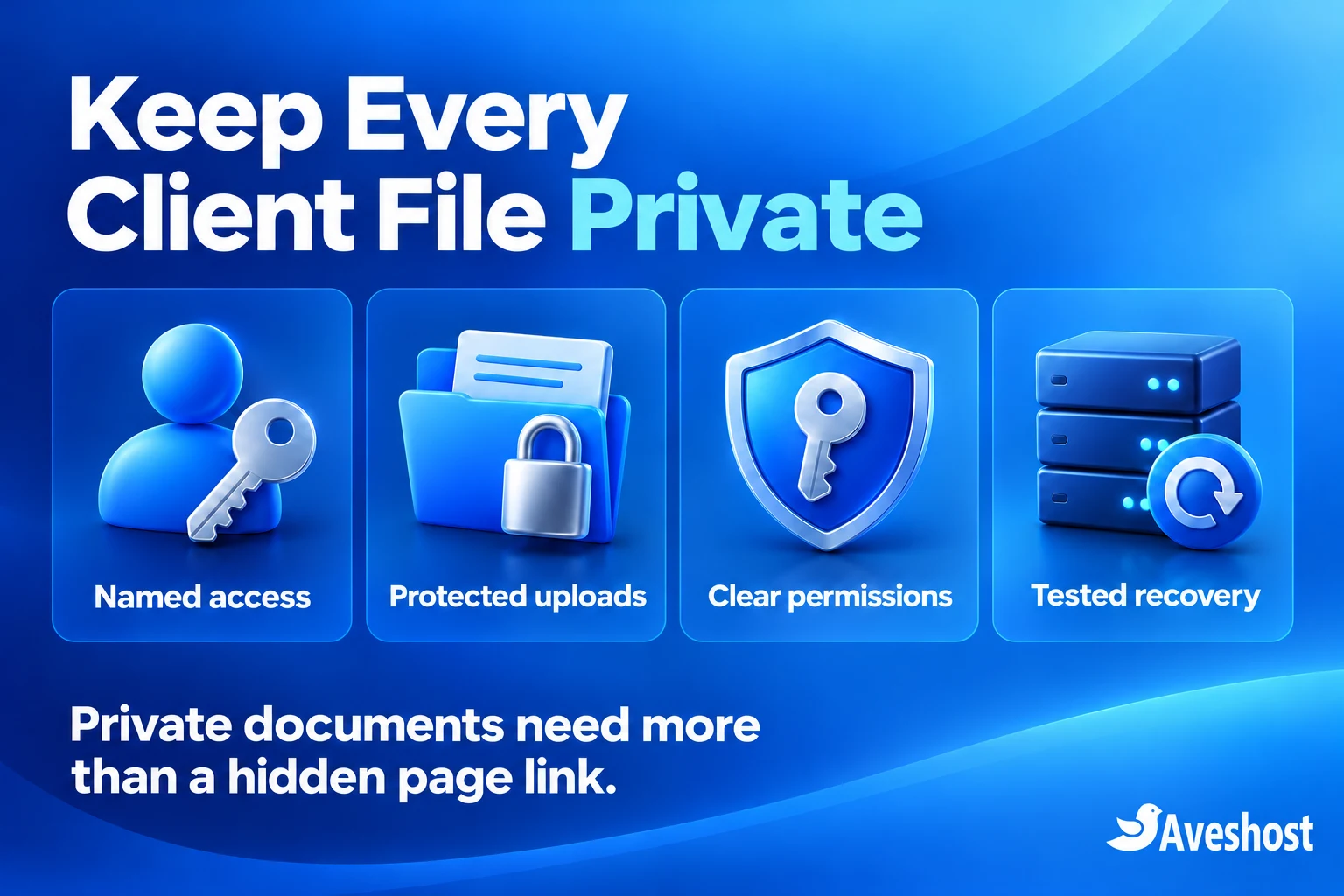
Invite clients into named accounts after the case is accepted. Confirm the intended recipient before sending an invitation and use a secure activation process. A portal should not expose case records just because someone knows the client’s email address or case number.
Build permissions around case membership. A client sees only the cases and documents assigned to that account. A case officer sees their assigned work, a reviewer sees the material needed for approval and an administrator receives only the operational powers required for the role.
Check authorisation on the server for every case view, download, upload and report action. Hiding a menu item or protecting a page with a shared password is insufficient. Changing a record ID in a URL must never reveal another client’s file.
Use multi-factor authentication for staff and privileged accounts, secure session expiry and a controlled recovery process. Remove access promptly when staff leave or a client representative’s authority changes. Do not share one administrator login across the office.
A WordPress subscriber role does not automatically implement client-by-client case access. Any portal extension or custom application must prove that isolation in testing. Keep the case system’s permissions separate from public editorial roles so a content editor cannot casually browse confidential instructions.
Record significant actions such as document uploads, report releases and access changes. Restrict those logs and avoid copying the complete sensitive document into them. Audit records help the firm explain who accessed or changed a case without creating another uncontrolled copy of the case file.
Protect site plans and property documents
Site plans, agreements and identity documents can contain personal information, signatures and precise locations. Request only the records needed for the agreed task. Explain why a document is required and provide a private submission route after the case is opened.
The OWASP file-upload guidance recommends layered controls. Allow only necessary formats, validate the file content as well as the extension, apply size limits, use server-generated storage names and scan or quarantine uploads before they become available to staff.
Store case files outside the public web root or in a private storage bucket. Deliver them through an authenticated route that checks the user’s permission for the specific case. A long filename or an unlisted public link is not access control.
If signed download links are used, issue them only after an access check and keep them short-lived. Treat them as bearer access while valid, keep them out of public logs and define what happens when a case is reassigned or closed. Never publish permanent direct storage URLs in reports or messages.
Keep originals, working copies and released reports distinguishable. Preserve upload time, source, version and review status so staff do not mistake a client-supplied scan for an official response. A file hash can help detect a changed file; it does not establish the legal authenticity of the document.
In WordPress, the ordinary Media Library is intended for publicly accessible website assets. Do not place confidential case documents there and rely on a hidden page to protect them. Use the portal’s private document mechanism and test logged-out access to the actual file URL.
Book consultations and collect clearly scoped fees
Offer a consultation request with the client’s preferred time and service. Confirm the appointment after the firm has accepted the request. For diaspora clients, show Ghana time clearly and repeat the agreed timezone in the confirmation so the video call is not missed.
If the firm needs live appointment availability, a paid scheduling extension such as WooCommerce Bookings can manage a defined booking service. It does not provide confidential case management by itself. Keep its booking reference linked to the accepted case.
For payment, an eligible Ghanaian merchant can use the integration described in Paystack’s WooCommerce setup guide. Use test credentials first, configure the gateway’s webhook and verify the result before marking a consultation fee paid. Keep the payment reference separate from any professional conclusion.
Describe consultation charges, professional work and official disbursements separately. For example, a demonstration GH₵350 consultation fee should state exactly what meeting or review it covers. It is not an official Lands Commission charge, a complete due-diligence price or an Aveshost service quote.
Explain refund and rescheduling terms before payment. If official charges or additional work need a separate quotation, obtain approval first. Paying an invoice should not automatically label a search completed or a property verified.
Organise searches, surveys and reviewed reports
Use a case checklist owned by the responsible professional. It can record accepted instructions, documents received, fieldwork scheduled, requests submitted, responses received and review completed. The checklist should describe work performed rather than make the website decide legal or surveying conclusions.
Record the source and scope of each official response, along with its reference and any follow-up needed. Keep client-provided documents separate from records obtained through the instructed process. Staff should be able to trace the report’s supporting material without relying on a chat history.
Make dependencies visible. A missing plan, an unclear parcel description or a response from another office can affect the next step. Give a realistic update and explain what action is needed. Do not promise an official turnaround time that the firm cannot control.
Use a review-and-release step for reports. The reviewer checks the document, scope, supporting material, outstanding questions and intended recipient. Release the approved version to the authorised client account, with a clear description of what it addresses and any limitations that remain.
If the work identifies inconsistencies or requires legal interpretation, route it to the appropriate professional. The portal can schedule a follow-up and collect further instructions. It should not turn incomplete information into an automated recommendation to buy, transfer money or sign a property document.
Keep diaspora clients informed securely
Give clients a concise dashboard showing the current stage, documents requested, next appointment and messages requiring action. Keep internal deliberations and draft notes in staff-only records. A client-facing progress view should reveal useful information without exposing unrelated work.
Send a short business-email notice when there is a private update. Avoid attaching identity documents, full plans or confidential reports to routine notifications. The client signs in to review the material through the portal’s access controls.
Use SMS for a neutral reminder or an invitation to check the portal, not for detailed property findings. Our Ghana SMS integration guide compares provider options. Case-specific messages need a suitable connector or custom integration that respects the current case permissions.
Check the recipient’s authority before adding a family member, agent or other representative to a case. A shared surname or an email request does not establish permission to see the file. Record who authorised access and what the representative may view.
Keep a defined response process for requests from another timezone. Tell clients how to raise urgent concerns and when the team is available. Do not advertise round-the-clock professional review unless the firm has the staffing and service arrangement to provide it.
Build privacy responsibilities into the service
The Data Protection Commission’s organisational guidance sets out registration, transparency and security responsibilities for organisations processing personal data. Confirm the firm’s registration position and assign responsibility for its privacy programme before launching the portal.
Publish a privacy notice explaining the information collected, purposes, recipients, retention approach and client contact route. Identify the hosting and other processors involved. Assess where the main files, backups and support access are located, including any cross-border handling.
Document the provider arrangements for confidentiality, security, incident response and the end of the service. Hosting in Ghana does not by itself resolve every processing or transfer issue. The firm should review the actual data flows and its professional obligations with the appropriate advisers.
Define retention by record type and business requirement. Closing a portal account is not the same as deleting every professional record. Apply approved retention, any legal holds and a documented deletion process across active files, exports and backup lifecycles.
Prepare an incident procedure covering containment, investigation, affected records and escalation. Decide who assesses applicable reporting and client-notification duties. Staff need a clear route to report an accidental disclosure or suspicious login rather than attempting to resolve it privately.
Test access, backups and the complete workflow
Test the portal with fictional cases and documents before accepting real client records. Include two unrelated client accounts, a case officer, a reviewer and an administrator. Successful login is only the beginning of the security check.
| Test | Required result |
|---|---|
| Client A requests Client B’s case | Access denied by the server |
| Logged-out direct file URL | No private document returned |
| Upload with an unsupported type or excessive size | Rejected or quarantined safely |
| Staff access removed | Old sessions and new requests no longer expose the case |
| Representative added or removed | Only the approved case access changes |
| Report release | Correct reviewed version reaches the intended client |
| Payment success, failure or delay | Invoice status stays separate from verification findings |
| Neutral email or SMS update | No confidential attachment or case detail leaked |
| Backup restoration | Files, permissions and case records recover together |
| Mobile consultation journey | Client can request, sign in and read the next step clearly |
Back up the database, private files and essential configuration with restricted access. Rehearse a restore in an isolated environment with outgoing messages and payments disabled. Reconcile permissions and recent case activity before reopening client access.
Monitor access failures, unusual downloads, upload scanning, scheduled jobs and backup results. Keep the operating system and application maintained. Our website security checklist explains broader account and maintenance controls.
Launch with a limited client group and review the complete workflow. Measure missing documents, response delays, support questions and access problems. Improve the process before expanding the portal or adding integrations with external systems.
Ready to build a property consultation portal in Ghana? Explore our managed VPS hosting and business email, or discuss your client portal with our team. Bring your case workflow, document volumes, access requirements and recovery needs so we can plan a suitable setup.
Frequently asked questions
What should a land surveying website in Ghana include?
It should explain the firm’s services and team, provide a clear enquiry route and link accepted clients to a private case and consultation workflow.
Can a private portal certify land ownership automatically?
No. It can organise documents and professional work, but it does not replace official processes, a properly conducted survey or the appropriate legal review.
Is the firm’s portal the same as Lands Commission Online Services?
No. It is a separate private service. Present official functions and references accurately and do not imply government affiliation or an unauthorised integration.
Can a map pin verify a property boundary?
A map pin helps identify a location. Boundary and coordinate work require the responsible survey professional’s assessment and any necessary fieldwork.
Where should confidential property documents be stored?
Use private storage with server-side case authorisation. Do not rely on public WordPress media links, hidden pages or long filenames.
Can diaspora clients book video consultations?
Yes. Confirm the service, appointment and timezone clearly, and share case documents through the private portal rather than public links.
Can the firm collect consultation fees through MoMo?
Yes, through an eligible merchant account and supported integration. Verify payment and keep fee settlement separate from the professional findings.
Does Ghana-based hosting guarantee data-protection compliance?
No. The firm must also address its registration, transparency, access controls, processor arrangements, retention and other applicable responsibilities.
Can a client share access with an agent or family member?
Use a documented authorisation process and a separate named account with the approved permissions. Do not share the client’s login.
Can Aveshost help plan the portal infrastructure?
Yes. Contact our team with the application, case workflow, document volumes, privacy requirements and backup needs to discuss hosting and setup.