When evaluating n8n vs OpenClaw for business automation, you are comparing two fundamentally different operational models: n8n is a workflow-first visual orchestration engine built for deterministic, repeatable API pipelines, whereas OpenClaw is an agent-first autonomous AI gateway built for open-ended reasoning, stateful memory, and natural-language execution across WhatsApp, Telegram, Slack, and Discord.
If your goal is to sync thousands of Stripe invoices into PostgreSQL, route webhook payloads across CRM stages, and inspect a strict node-by-node audit trail at near-zero marginal cost, n8n is the stronger foundation. If your goal is to deploy an AI teammate that triages unstructured customer inquiries, researches leads, remembers context across conversations, and invokes custom tools using markdown skills, OpenClaw is purpose-built for the job. Below, we compare both platforms across architecture, execution state, VPS resource requirements, security, and how to combine them on a single Linux server.
Table of Contents
n8n vs OpenClaw: The Core Architectural Difference
Although both tools run on Node.js and can be self-hosted on a Linux VPS, they approach business automation from opposite directions:
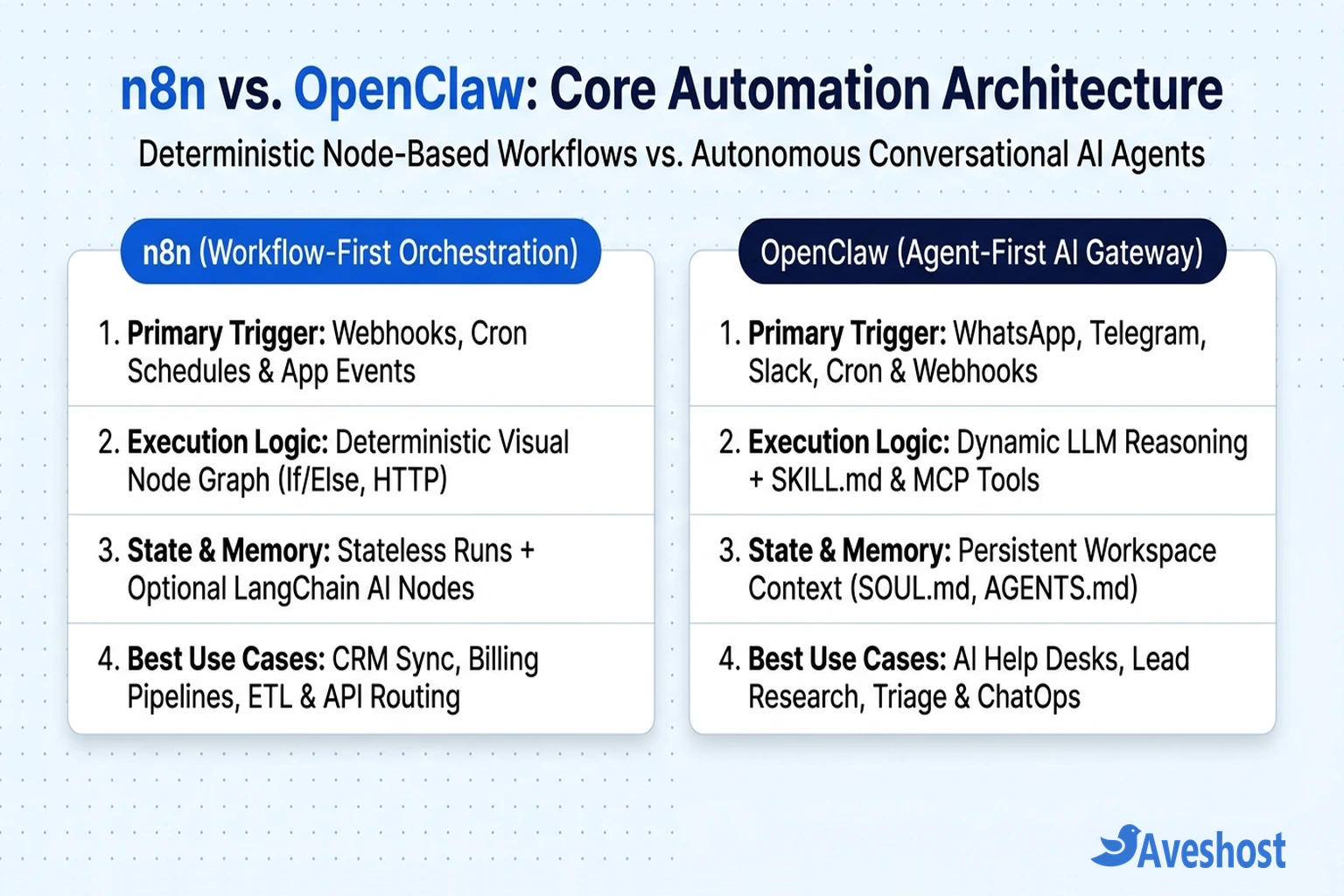
- n8n is rule-driven and deterministic: You design a visual graph of connected nodes in a browser canvas (Trigger → Transform JSON → If/Else Branch → Database Insert → Slack Notification). Every execution follows the exact wire paths you drew, making n8n a self-hosted alternative to Zapier and Make.
- OpenClaw is goal-driven and conversational: As we explained in our foundational guide on what OpenClaw is and how self-hosted AI agents work, OpenClaw connects large language models (such as Anthropic Claude, OpenAI, Google Gemini, or local Ollama models) directly to messaging channels, local workspace files, and Model Context Protocol (MCP) tools. Instead of pre-wiring every conditional branch on a canvas, you define the agent’s persona (
SOUL.md), operating rules (AGENTS.md), and tool definitions (SKILL.md), allowing the agent to reason through multi-step tasks dynamically.
Quick Comparison Table: n8n vs OpenClaw
Use the matrix below to compare n8n vs OpenClaw across licensing, interface, state management, and primary business use cases.
| Comparison Factor | n8n | OpenClaw |
|---|---|---|
| Automation Paradigm | Workflow-First (Deterministic Node Graph) | Agent-First (Autonomous LLM Reasoning Gateway) |
| Software License | Sustainable Use License (Fair-Code) | MIT License (100% Open-Source) |
| Primary Interface | Browser-Based Visual Node Canvas | WhatsApp, Telegram, Slack, Discord & CLI |
| Execution State | Stateless per run (JSON passed node-to-node) | Stateful workspace (SOUL.md, AGENTS.md, session logs) |
| Tool & API Integration | 400+ Built-in UI Nodes + HTTP Request Node | Modular SKILL.md Files, Shell Scripts & MCP Servers |
| Marginal Cost per Run | Near zero for non-AI data routing | Scales with LLM token usage (or local GPU compute) |
| Ideal Workload | CRM sync, invoicing, ETL pipelines, webhook routing | AI help desks, lead research, inbox triage, ChatOps |
How n8n Works: Deterministic Visual Workflows
n8n is built for processes where deviation is a bug, not a feature. In accounting, order fulfillment, and database synchronization, you want the exact same input to produce the exact same API call every single time.
- Visual node editor and payload inspection: Every step in an n8n workflow takes an array of JSON objects, transforms or filters them, and passes the output to the next node. When an external API returns a
500or429error, n8n’s execution history shows the exact node that failed, the raw HTTP headers, and the JSON payload so you can replay the failed run in one click. - 400+ pre-built connectors: n8n ships with built-in credential managers (OAuth2, API keys, JWTs) and ready-made nodes for HubSpot, Salesforce, Stripe, Shopify, Google Sheets, PostgreSQL, and webhooks.
- Where n8n hits friction: While n8n includes LangChain AI Agent nodes, building a conversational assistant that handles multi-turn follow-up questions across WhatsApp or Telegram, maintains long-term workspace files, and adapts to unpredictable user requests requires wiring dozens of fragile Switch, Merge, and Redis memory nodes on the canvas.
How OpenClaw Works: Autonomous AI Agent Gateway
OpenClaw is engineered for the unstructured side of business operations—where inputs arrive as natural-language messages, emails, support tickets, or voice notes rather than neatly formatted JSON webhooks. Once you install and set up OpenClaw on an Ubuntu server, the OpenClaw Gateway runs as a persistent background daemon connecting your LLM provider to your communication channels and tools.
- Markdown-defined behavior and skills: Instead of dragging wires on a screen, you configure an OpenClaw agent using readable workspace files inside
~/.openclaw/workspace. YourSOUL.mdfile sets tone and strict anti-hallucination boundaries,AGENTS.mddefines your company’s Standard Operating Procedures (SOPs) and escalation rules, and modularSKILL.mdfiles teach the agent how to call internal APIs or MCP servers. - Native multi-channel presence: OpenClaw natively pairs with WhatsApp, Telegram, Slack (via Socket Mode), and Discord. As demonstrated in our guide on how to build an AI help desk with OpenClaw, a single agent profile can verify a customer’s order status via an API skill, consult your markdown knowledge base, and either resolve the ticket or escalate to a human supervisor in Slack.
- Where OpenClaw hits friction: You should never use an autonomous LLM loop to move 50,000 rows between two SQL tables every night. Paying an LLM to reason through routine, identical data transformations wastes token budget and introduces unnecessary latency compared to a deterministic n8n pipeline.
Comparing AI Capabilities, Memory, and Tool Use
Because n8n added AI Agent nodes and OpenClaw added webhook triggers, the two platforms overlap in the middle. However, their handling of memory and tool execution remains distinct:
- Bounded AI inside a workflow (n8n): In n8n, an AI Agent node is a single step inside a larger deterministic pipeline. For example, a webhook receives a support form submission, an n8n AI node classifies its sentiment into
urgentorbillingand extracts a JSON summary, and standard n8n nodes write that JSON into PostgreSQL. The AI cannot step outside the tools attached to that specific node. - Persistent, workspace-aware autonomy (OpenClaw): In OpenClaw, the agent owns the session lifecycle. It maintains persistent markdown and JSON memory across days or weeks, runs scheduled proactive heartbeats, and can chain multiple
SKILL.mdand MCP tools together in a single conversation to investigate a problem end to end.
Self-Hosted VPS Sizing, Costs, and Security
Both n8n and OpenClaw are popular among businesses that self-host on a Linux VPS to avoid per-task SaaS fees and keep proprietary customer data on their own infrastructure. Use the sizing and operational table below to plan your server deployment.
| Deployment Stack | Minimum VPS Specs | Recommended Production VPS | Primary Security Priority |
|---|---|---|---|
| n8n Standalone (Docker) | 1 vCPU / 2 GB RAM | 2 vCPU / 4 GB RAM + PostgreSQL | Lock down webhook auth headers, N8N_ENCRYPTION_KEY & HTTPS proxy |
| OpenClaw Gateway | 1–2 vCPU / 2 GB RAM | 2 vCPU / 4 GB RAM (Node.js 22+) | Enforce dmPolicy pairing/allowlists & scope SKILL.md tool permissions |
| Hybrid (n8n + OpenClaw + Postgres) | 2 vCPU / 4 GB RAM | 4 vCPU / 8 GB RAM + NVMe/SSD | Isolate internal Docker bridge ports & restrict shell tool execution |
When self-hosting n8n, always set a permanent N8N_ENCRYPTION_KEY in your environment file so stored OAuth credentials survive container upgrades, and place the web editor behind Caddy or Nginx with HTTPS. When self-hosting OpenClaw, treat agent tool permissions with the same care as an SSH key: customer-facing WhatsApp or Telegram agents should only be granted scoped, read-only lookup skills or webhook triggers rather than unrestricted root shell access.
The Hybrid Pattern: Running n8n and OpenClaw Together
You do not have to treat n8n vs OpenClaw as an either-or decision. Many engineering and operations teams run both platforms side by side on the same Ubuntu VPS—using n8n as the deterministic execution backbone and OpenClaw as the conversational reasoning brain.
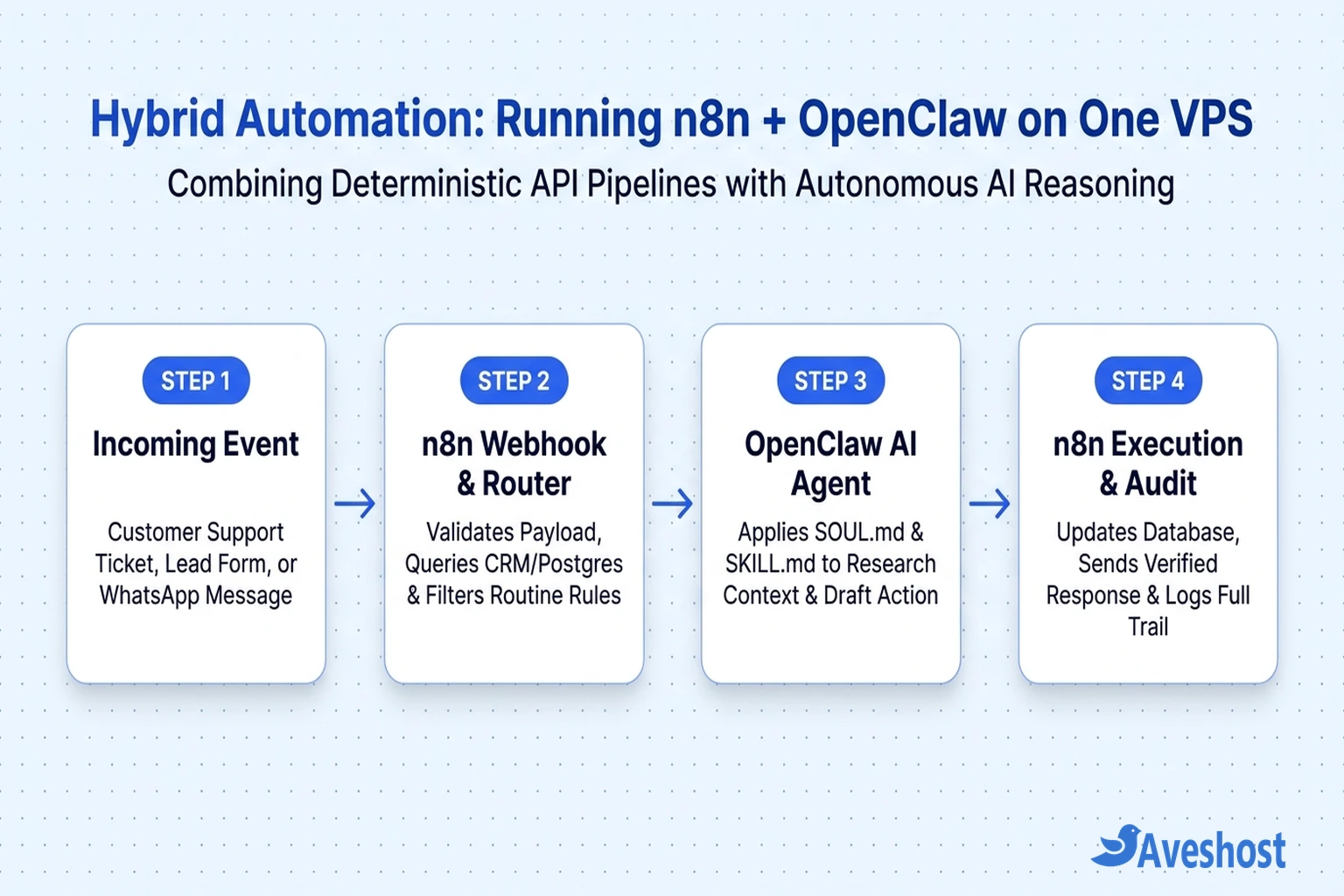
In this hybrid architecture, each tool handles what it does best:
- n8n ingests and validates high-volume events: When a Stripe payment, CRM webhook, or form submission arrives, n8n validates the signature, logs the raw event in your self-hosted Supabase or PostgreSQL database, and handles routine deterministic updates immediately.
- n8n delegates complex triage to OpenClaw: Whenever an event requires qualitative judgment—such as a custom enterprise quote request, an ambiguous support ticket, or multi-step lead research—n8n forwards the enriched context to the local OpenClaw Gateway.
- OpenClaw calls n8n webhooks as safe, scoped tools: Instead of giving your OpenClaw agent direct write credentials to your production billing database or CRM, you give OpenClaw a
SKILL.mdtool that calls a local n8n webhook (http://127.0.0.1:5678/webhook/...). n8n validates the parameters, executes the database write or email dispatch deterministically, and records a permanent visual audit trail.
Ready to deploy your own automation stack without per-task cloud limits? Provision a self-managed Linux VPS with full root SSH access and fast SSD storage, or choose our Ghana VDS for dedicated CPU/RAM and low-latency Accra NVMe storage. If you need assistance planning your server architecture, reach out to the Aveshost team.
Frequently Asked Questions
Can OpenClaw completely replace n8n for business automation?
No. OpenClaw excels at unstructured, conversational, and multi-step reasoning tasks (such as AI customer support, inbox triage, and research), but it should not replace n8n for high-volume deterministic data pipelines like syncing thousands of invoices or CRM records where every run must follow an exact, zero-token-cost rule path.
Is n8n or OpenClaw cheaper to self-host on a VPS?
Both run comfortably on an entry-level 2 GB to 4 GB RAM Linux VPS. However, n8n has a near-zero marginal cost per execution when routing standard webhooks and APIs, whereas every autonomous reasoning turn in OpenClaw consumes LLM API tokens (unless you run local models via Ollama on a higher-spec server).
What is the license difference between n8n and OpenClaw?
OpenClaw is released under the permissive MIT open-source license, allowing unrestricted commercial and SaaS use. n8n uses the fair-code Sustainable Use License, which is free to self-host for internal business automation and client consulting, but prohibits reselling n8n itself as a hosted multi-tenant SaaS product without a commercial license.
Can I run both n8n and OpenClaw on the same Ubuntu VPS?
Yes. A 2 vCPU, 4 GB RAM (or 4 vCPU, 8 GB RAM for heavier production workloads) Ubuntu VPS can easily run both n8n (in Docker) and the OpenClaw Gateway daemon behind a single Caddy or Nginx reverse proxy. They can communicate securely over localhost webhooks without exposing internal APIs to the public internet.
How do I keep an autonomous OpenClaw agent from making unauthorized changes to my business systems?
Use the hybrid pattern: instead of giving OpenClaw direct database write credentials or unrestricted shell access, configure OpenClaw’s SKILL.md tools to trigger local n8n webhooks. That way, OpenClaw handles the natural-language reasoning while n8n enforces strict schema validation, rate limits, and a full visual execution log before any external action occurs.