

Paying for hosting in Ghana cedis makes budgeting easier when your business earns and spends in cedis. You can compare the hosting invoice with your available funds without first estimating a foreign-currency conversion. The best choice still depends on the total payable, renewal terms and the service your website needs.
A low advertised figure can become a larger expense once the billing period, currency conversion, payment charges and optional services are included. A cedi price also needs checking: a website can display an estimate while the actual invoice is issued in another currency.
At Aveshost, we want you to understand the bill before you pay. This guide explains how to compare cedi and foreign-currency hosting, organise your renewal budget and choose a plan on its practical value. All monetary examples below are shown in Ghana cedis; they are not current hosting quotations or exchange-rate forecasts.
Table of Contents
Paying for hosting in Ghana cedis: what changes?
The main advantage of a cedi invoice is clarity for a cedi budget. Once the amount and applicable charges are confirmed, the business can plan that payment in the same currency as its ordinary income. This is useful for shops, schools, agencies and other organisations that collect most customer payments locally.
When an invoice is in US dollars and the payment is funded from a cedi account, a conversion is involved. The final cedi cost depends on the conversion arrangement and any applicable charges. An unchanged foreign-currency subscription price can therefore produce different cedi payments at different renewals.
A cedi invoice does not promise an unchanged price forever. Hosting fees can change under the provider’s terms, and the next invoice may differ from the current one. Compare the amount for the term you are purchasing, then check how renewal pricing is communicated.
Currency also tells you little about where the server runs or who manages it. A Ghanaian company can offer several server regions, and a foreign-currency invoice does not establish better performance. Our Ghanaian versus international hosting guide explains those service differences.
Check the displayed price, invoice and account debit
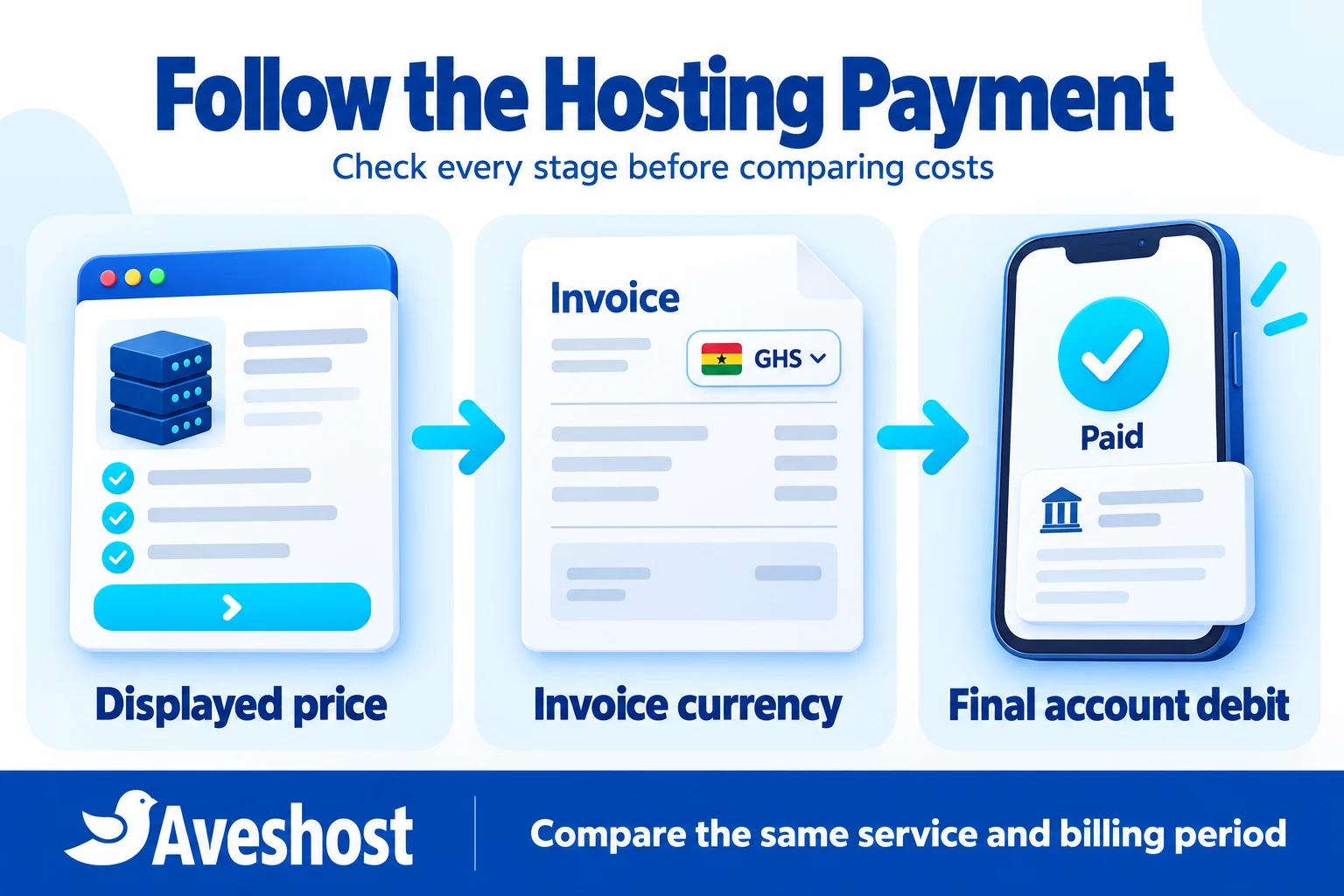
Follow the payment through three stages: the price displayed on the product page, the currency and total on the invoice, and the amount debited from your payment account. These may match, but checking each stage prevents an estimated figure from becoming your final budget.
A currency selector can show a converted display price or select a genuinely different billing currency. Before paying, inspect the order summary and invoice. Look for GHS or GH₵ on the payable total, the chosen billing period, mandatory charges and any optional products already included.
For card payments, also identify the currency of the card account being charged. A Ghana-issued card is not necessarily funded from a cedi account, and a cedi invoice paid from a foreign-currency account can involve conversion in the other direction. The issuing bank can explain the account and charging arrangement.
If the product page and checkout disagree, ask billing support to confirm the applicable amount before completing the purchase. Keep the quotation or invoice for the exact configuration. A screenshot of a headline monthly price alone does not show the whole commitment.
For a business purchase, name the service clearly in your records: hosting plan, website or account, service period and invoice number. This makes the later bank or MoMo entry easier to match and helps another authorised person understand what was purchased.
Understand exchange rates and payment fees
A public exchange-rate result is a reference for comparison, not a guaranteed card charge. The conversion can be handled by the card network, issuing bank, payment service or a merchant-side conversion arrangement. Establish which route applies to your payment before estimating the cedi debit.
The official Mastercard currency converter describes its result as indicative. It explains that a bank can use a different rate or add fees, and that the applicable conversion timing depends on authorisation or processing. Use the issuer’s current guidance for your card.
Separate a conversion margin from a separately listed transaction charge. A payment can carry a cost through the rate even when no separate conversion fee is displayed. Ask your bank about foreign-currency and cross-border charges for the particular account and merchant; there is no single fee that applies to every Ghanaian customer.
When checkout offers to convert an overseas card transaction into the cardholder’s currency, review that offer carefully. Visa’s dynamic currency conversion guidance describes showing the currencies, conversion rate and markup, with a choice for the customer. Compare the offered total with the alternative using your own issuer’s terms.
Avoid counting the same cost twice. If the quoted converted amount already includes the conversion markup, do not add that markup again. Add only charges that actually apply and have not already been included. After payment, use the posted account entry and invoice to reconcile the real cost.
Compare the full cost in Ghana cedis
Compare equivalent service periods in one working currency. For a cedi-funded business, record the expected total in Ghana cedis, the source of the estimate and which parts can change. Include hosting, the domain, required licences, selected extras and applicable payment charges or taxes.
For an annual hosting example, one option has a confirmed invoice of GH₵600. A second option has a foreign-currency bill whose converted base cost is estimated at GH₵570. If that second payment carries an additional 3% charge on the converted base, its estimated total is GH₵587.10. This example demonstrates arithmetic, not a bank tariff.
Now change only that second option’s converted base to GH₵650. With the same 3% charge in this example, it becomes GH₵669.50. The cheaper result has changed even though the service description has not. A currency comparison needs the actual rate and fee arrangement available when you pay.
Use a normal case and a higher-cost case for planning. A reserve can help cover a less favourable conversion or a changed renewal price, but it does not fix the exchange rate or guarantee affordability. Choose the reserve using your business’s cash flow and the importance of keeping the website available.
Keep separate totals for the first term and the next term. Domain promotions, introductory hosting discounts and one-time setup charges affect the comparison differently. Our domain registration, renewal and transfer cost guide helps you separate those domain expenses.
| Annual cost example | Cedi option | Converted option |
|---|---|---|
| Base amount | GH₵600 | GH₵570 |
| Additional charge in this example | GH₵0 | 3% = GH₵17.10 |
| Total for comparison | GH₵600 | GH₵587.10 |
| Higher converted-base scenario | GH₵600 | GH₵650 + GH₵19.50 = GH₵669.50 |
Separate the first payment from the renewal
The first payment answers what it costs to start. The renewal answers what it costs to continue. Read both before choosing a plan, particularly where the product page highlights an introductory offer or a monthly equivalent that requires a longer upfront term.
For another example, a first annual term costs GH₵480 while the next annual term costs GH₵720. The first term works out at GH₵40 per month and the renewal at GH₵60 per month. Record the GH₵720 renewal requirement instead of continuing to budget from the introductory monthly equivalent.
Check whether a free domain is limited to a particular extension and qualifying billing period. Establish the later domain renewal price and whether it renews separately from hosting. Also check the future cost of premium themes, extensions, security services and mailboxes selected for the website.
Cedi billing removes the need for the customer to convert that cedi invoice from a cedi account; it does not remove the provider’s ability to revise future fees under its terms. At Aveshost, our billing terms allow fee changes to take effect at the next renewal. Read the current invoice and any pricing notices.
Store renewal reminders somewhere the business controls. Include the hosting account, domain and essential software, because their periods can differ. Review the expected bill early enough to correct a payment issue or change a plan without rushing on the due date.
Choose a payment method you can maintain
Choose a payment route that the business can use repeatedly. For a cedi-funded operation, a supported local payment method can simplify paying an invoice. For another business, a suitable card account may fit its existing controls. Compare convenience, charges, authorisation steps and how payment reaches the hosting invoice.
Aveshost supports Mobile Money payments for services through its checkout. Our MoMo payment guide explains selecting a service and proceeding through the payment process. Follow the options shown for the actual order and verify the merchant and amount before authorising payment.
An invoice created automatically is not proof that money will be collected automatically. Our billing terms distinguish supported automatic payments from methods that require you to log in and submit payment for each invoice. Aveshost’s Paystack and Flutterwave invoice payments require that manual step; plan reminders accordingly.
If a card payment fails, check available funds, online or international payment permissions and any recurring-payment restrictions with the issuer. Keep sensitive authentication details private. Neither hosting support nor someone sending a payment link needs your card PIN or a code that authorises a transaction on your behalf.
After paying, check that the correct invoice is marked paid in the client area. A pending authorisation, customer screenshot or wallet debit needs reconciliation if the invoice has not updated. Contact billing support with the invoice number and appropriate transaction reference before making a second payment.
Compare the hosting behind the price
Compare the same kind of service before comparing its currency. Shared hosting, managed WordPress hosting and a self-managed VPS involve different resources and responsibilities. A low server rental can be unsuitable when the business also needs an administrator, software updates, monitoring and recovery support.
Write down the website’s requirements: number of sites, storage, expected workload, email needs, application compatibility and access requirements. Check CPU and memory allocations, database limits, file-count limits and traffic policies where relevant. A large storage number alone does not establish application performance.
Review backups as a service with specific conditions. Ask how frequently they run, how long copies are retained, what is included and how a restore is performed. Keep an independent copy and a practical recovery process. An included backup feature should not be treated as a guarantee that every lost change can be recovered.
Clarify support scope. Server availability support differs from updating a WordPress extension, fixing custom code, cleaning an infected application or rebuilding a page. A managed service should identify the tasks it covers. Add separately required maintenance to the budget instead of comparing it with an unmanaged plan as though the work were included.
Check the region offered for the selected product and test a representative website where possible. Currency and company location do not establish server location, loading speed or uptime. Choose a plan that fits the visitors and application, with a clear route to upgrade when resource use grows.
Choose a suitable billing period
Monthly billing reduces the amount committed upfront and can be useful while testing a new project. It also creates more frequent payment deadlines. A longer prepaid term can simplify administration or qualify for an offer, but the business must be comfortable committing the larger amount.
Compare the total due today with the service period it buys. A page showing a monthly equivalent can require an annual or multi-year payment. Divide the full term amount by the covered months for comparison, then keep the actual upfront amount in the cash-flow budget.
Prepaying can settle the purchased service term under the applicable contract. It does not lock the price of every future renewal or freeze unrelated domain and software costs. Check what happens to unused time, plan upgrades and paid add-ons if the business changes its requirements.
Read cancellation and refund conditions before choosing the longer term. Aveshost’s terms provide a 30-day guarantee for specified shared hosting products, with exclusions including domains, VPS, dedicated servers and add-ons. Cancellation does not automatically refund the current service term; confirm eligibility and the relevant process.
If you request a refund involving currency conversion, ask the issuer or payment provider how the returned amount and any charges will be handled. Record the amount actually credited rather than treating the original cedi debit as a guaranteed outcome. The hosting refund and the payment service’s processing rules are separate parts of the result.
Keep clear invoices and renewal records
Keep the invoice and payment evidence together. Record the plan, service period, invoice currency, invoiced total, payment reference and actual account debit. This gives your accounts team a useful audit trail and lets you compare later renewals with what the business really paid.
For foreign-currency transactions, record the final cedi debit after the payment has posted. Keep separately identified charges visible rather than hiding them inside the hosting plan figure. Use your accountant’s required method for business bookkeeping and any tax treatment; a consumer exchange-rate calculator is not an accounting policy.
For agencies buying hosting for clients, separate the hosting subscription from design, management and support. State the billing period and what your quoted fee includes. If a quotation depends on a conversion, explain its validity and how changes will be handled before the client approves the work.
Keep billing contacts current and give an authorised backup person a way to find renewal instructions. Use role-appropriate access and secure recovery details. A website should not become unpaid simply because the only person receiving invoices is away or has left the organisation.
Review the subscription list periodically. Remove unwanted optional services through the proper cancellation process, check upcoming renewals and keep your own backups current. Paying for a dependable plan is easier when the business knows exactly which services it is maintaining.
Questions to ask before paying
Before purchasing, confirm the invoice currency and final total for the selected term. Identify the conversion route if the funding account uses a different currency. Ask the payment provider about applicable charges and the method for checking the final posted amount.
Ask what the next renewal costs and which items renew separately. Check whether the displayed monthly figure is a genuine monthly subscription or an equivalent for a longer term. Review the qualifying conditions of any free domain, introductory discount or included service.
Confirm that the application fits the plan’s limits and support scope. Ask about backup frequency, retention and restoration, management responsibilities, upgrade options and migration requirements. Obtain the answer for the selected product rather than relying on a feature mentioned elsewhere on the website.
Finally, check how to complete each renewal, how cancellation works and how billing problems are escalated. Keep the invoice and contact route with your business records. These answers make the comparison useful long after the first checkout.
| Compare | What to record |
|---|---|
| Currency | Invoice currency and funding-account currency |
| Cost | Total due now, charges and selected service period |
| Renewal | Next-term price, separate items and payment steps |
| Hosting | Resources, location and management scope |
| Recovery | Backup conditions, independent copies and restore process |
| Exit | Cancellation, refund eligibility and migration requirements |
Choose and pay for Aveshost hosting
Start with the project you are hosting. Review our web hosting plans for a suitable business website, WordPress hosting for a WordPress project or WooCommerce hosting for an online store. Match the plan to the workload and maintenance required.
Select GHS where the currency option is offered, then check that the order and invoice show the intended currency. Review the full selected period, domain choice, optional extras and final payable amount. Use the actual invoice for your budget rather than converting a promotional headline yourself.
Pay through a supported method shown in checkout or the client area, complete the required authorisation and confirm the invoice status. Save the receipt and organise the next renewal. Where the chosen method requires manual payment, assign someone to complete that step before the due date.
If you need help comparing plans or understanding an invoice, contact Aveshost with your website requirements or invoice number. We can help you identify the service and billing details relevant to your purchase. Choose hosting with a clear total, a manageable renewal process and the resources your business needs.
Frequently asked questions
Is paying for hosting in Ghana cedis always cheaper?
No. Compare the full cost for an equivalent service and period. Cedi invoicing can simplify a cedi budget, while the price and payment charges still determine the total.
Does a cedi price on a website mean I will be billed in cedis?
Check the final order and invoice. A displayed conversion can differ from the actual billing currency.
Why can the cedi cost change when a dollar subscription stays the same?
A payment funded from cedis depends on the applicable conversion and charges. These can change between payments even when the foreign-currency price is unchanged.
Will an online exchange-rate calculator show my exact card debit?
Treat it as an indication. Your issuer’s rate, applicable charges and transaction timing determine the actual account entry.
Can I pay Aveshost hosting invoices with Mobile Money?
Yes. Use the supported MoMo option shown in checkout or your client area, complete the authorisation and confirm that the correct invoice is marked paid.
Does an automatic invoice mean my MoMo payment happens automatically?
No. Invoice creation and payment collection are different. Check your chosen method; manual invoice payments require you to complete the payment each time.
Does cedi billing guarantee the renewal price will never change?
No. Review the provider’s pricing terms and renewal notices. The current invoice does not guarantee unchanged fees for every future period.
Is an annual hosting plan better than monthly billing?
Compare the actual upfront amount, total cost, commitment, refund conditions and your cash flow. The better period depends on your project and ability to maintain payments.
Does paying in cedis mean the hosting server is in Ghana?
No. Billing currency and server region are separate details. Check the location for the specific plan you select.
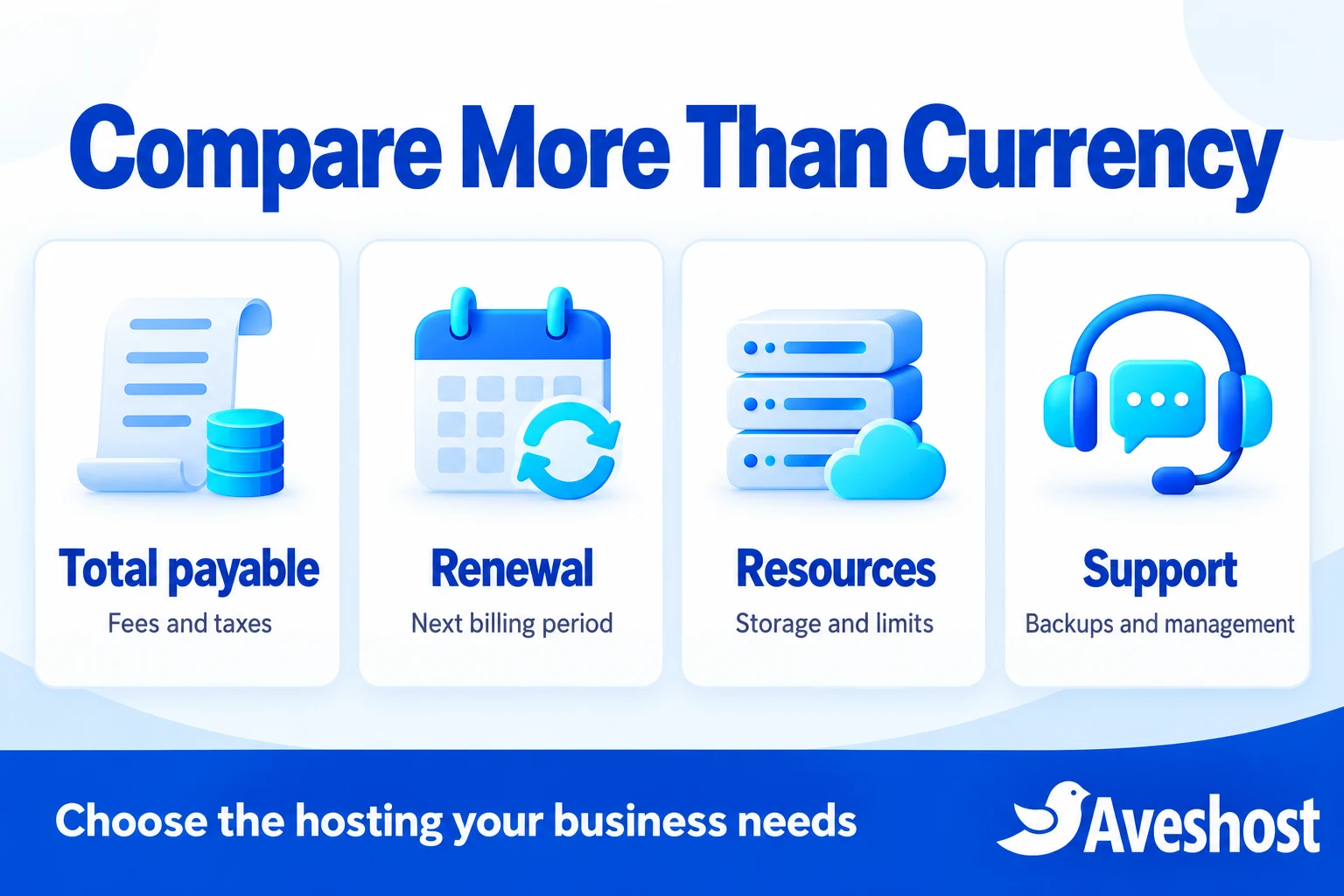
What should I compare besides the currency?
Compare resources, support and management scope, backups, domain and software renewals, payment reliability, cancellation conditions and the complete amount payable.