Security company website design in Ghana should help a corporate buyer answer three questions quickly: who operates the business, what services it can deliver and how its credentials can be checked. A polished homepage creates a useful first impression, but clear evidence and a dependable contact process make that impression credible.
A procurement officer reviewing guarding services for an office, industrial site or residential development needs more than a gallery of uniforms. The website should explain your company’s identity, operating scope, management approach and next steps for a properly scoped proposal.
At Aveshost, we help businesses build a professional online presence with domains, hosting and business email. This guide shows private security companies how to organise their websites for corporate enquiries while keeping confidential client and operational information protected. The aim is to make due diligence easier and prepare the ground for a serious business conversation.
Table of Contents
Start security company website design in Ghana with buyer questions
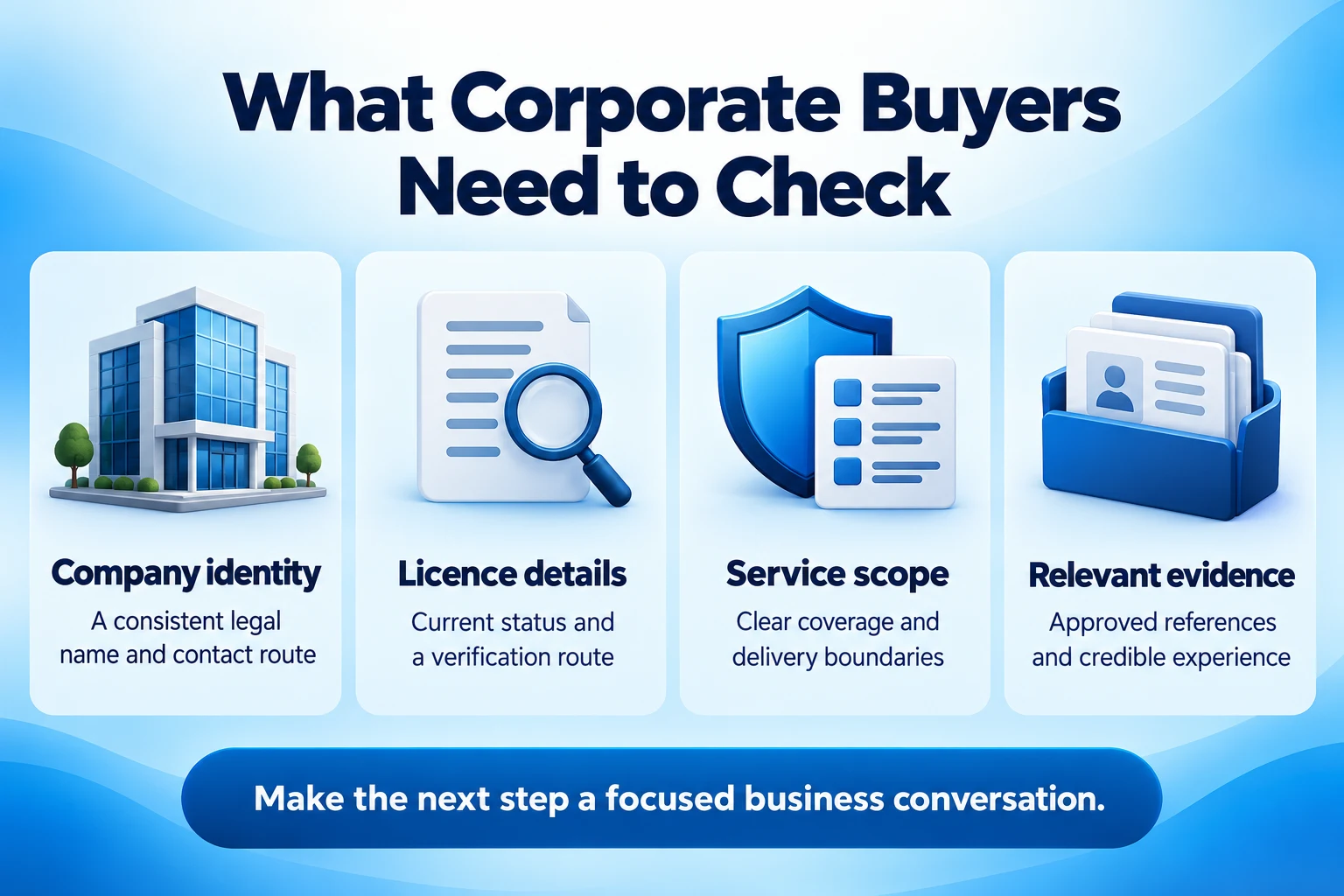
Build around the information a buyer needs to shortlist your firm: company identity, licence verification, service coverage, management responsibility, relevant experience and a clear route to request a proposal. These details should be easy to find without calling several numbers or searching through social media.
Different buyers have different requirements. A bank branch, a warehouse and a construction site may need different staffing, reporting and site-access arrangements. Explain the sectors you genuinely serve and guide visitors toward a discussion of their own requirements.
Avoid treating visual polish as proof of eligibility. A current website and company email support a professional presentation; contract awards still depend on the buyer’s procurement rules, checks, commercial evaluation and agreed service requirements. Your website should help that process move forward.
Use a simple navigation structure: About, Services, Credentials, Experience and Contact. Add a Client Login only when a protected portal actually exists. Keep recruitment and general enquiries separate from the corporate sales route so messages reach the right team.
Write in specific terms. Describe how supervision, service reviews and communication work at a useful business level. Replace unsupported superlatives with information that a buyer can understand and verify. Each page should make the next reasonable step clear.
Make the company identity easy to verify
Display the business’s legal name consistently across the website footer, company profile, proposal documents and invoices. If you trade under a different brand, explain the relationship. A buyer should not have to guess which registered entity would sign the contract.
Provide the office location, a working business phone number and a monitored company email. Use the correct digital address where appropriate. A service-area page can describe regional coverage without revealing the addresses of protected client premises.
Introduce the leadership and responsible management team using accurate names, roles and approved photographs. Brief biographies should connect experience to current responsibilities. Do not publish private identification numbers, home addresses or personnel documents as evidence of credibility.
Make the company profile downloadable in a readable, reasonably sized PDF if buyers need it. Give it an internal version owner and keep it aligned with the website. Remove obsolete phone numbers, expired credentials and unsupported service descriptions whenever the profile changes.
Keep ownership of the domain and website accounts with the company. Register using controlled business contact details and maintain access for authorised administrators. An external designer can support the site without becoming the only person who can renew its domain or retrieve its content.
Present licensing and compliance evidence clearly
Ghana’s Ministry of the Interior states that a licence is required to operate a private security company. Its licensing guidance is the appropriate starting point for the Ministry’s requirements. A company incorporation document and a private security operating licence serve different purposes.
Use a credentials page to identify the licensed legal entity, issuing authority and relevant licence reference. Keep status information current and give prospective clients a practical verification route. Do not leave an expired certificate presented as current evidence.
Link buyers to the Ministry’s register of private security organisations in good standing. Buyers can search the official source and follow up with the Ministry where clarification is needed. A copied list on your own website becomes stale and is less useful than the maintained source.
Share supporting documents according to their sensitivity and the buyer’s actual requirements. A public summary can explain what evidence is available, while appropriate procurement contacts receive necessary documents through a controlled process. Review copies for unrelated personal information before sharing them.
Keep an internal register of document owners, validity, renewal tasks and approved publication versions. Apply the same discipline to relevant tax clearance, insurance and other requested evidence. Describe the actual cover or status; one document does not establish that every contract condition has been satisfied.
Present compliance as verifiable information. Avoid government-style seals, invented approval badges or wording that suggests endorsement beyond the document’s real meaning. The buyer should be able to distinguish an operating licence, business registration, insurance evidence and management-system certification.
| Evidence | What the website should clarify |
|---|---|
| Business identity | The legal entity behind the trading name |
| Operating licence | Current status and an official verification route |
| Management-system certificate | Standard, certified entity, scope and issuing body |
| Insurance evidence | Relevant cover and a controlled document-sharing route |
Describe ISO certification accurately
If your company holds a management-system certificate, name the standard precisely and identify the certified legal entity, scope and certification body. Make clear which services and locations the certificate covers. A certificate for one entity or limited activity should not be presented as covering an entire group.
ISO explains that it develops standards and does not certify organisations or issue their certificates. Certification is performed by external certification bodies. Use accurate wording such as “certified to ISO 9001” only when the organisation holds a valid certificate covering the stated scope.
Provide an appropriate certificate reference and verification route through the issuing body or an applicable recognised database. Review current status before publishing. A certificate image, a training attendance record and membership of an association are different forms of evidence.
Do not use the ISO logo as a certification badge. Follow the issuing certification body’s rules for any permitted certification mark. Your web designer should not create an official-looking emblem simply because the site needs an attractive credentials section.
If certification is still being pursued, describe the actual stage honestly without presenting it as achieved. Buyers need reliable facts about the current organisation. Hosting, a domain name or a professionally designed website cannot confer ISO certification or replace the operating licence.
Define services, coverage and delivery standards
Give each core service its own clear page. Manned guarding, reception security, event support and electronic security installation have different scopes and responsibilities. List only the services your company is equipped and authorised to provide.
Describe coverage accurately. Identify the regions or areas you serve and explain when deployment needs a site assessment. A nationwide headline should reflect genuine capacity. Do not use an office in one city to imply an immediately available team in every region.
Explain the management approach: initial assessment, agreed duties, supervision, reporting, service reviews and escalation. Keep this at the level needed to understand the offer. Detailed guard routines, staffing gaps, patrol timings and site vulnerabilities belong in controlled operational records.
Clarify what a proposal will establish, including the scope, staffing arrangement, working hours, responsibilities, reporting expectations and commercial terms. Do not promise universal response times without the coverage, resources and contractual basis to deliver them.
Separate public sales contact hours from any contracted operational support. If an emergency or incident reporting route is available to existing clients, explain its intended use without exposing confidential escalation details publicly. A website enquiry form should not be presented as emergency dispatch.
Give buyers a structured route to request a site assessment or procurement conversation. A short initial form can establish sector, general area and service interest. Detailed site information can follow once your team has verified the enquiry and agreed the next step.
Show relevant experience without exposing clients
Use case studies to explain the type of assignment, the agreed service scope and the management process. Choose examples relevant to the buyers you want to reach. A clear account of a comparable assignment is more helpful than a wall of unexplained client logos.
Obtain permission before identifying a client, displaying its logo or publishing photographs of its premises. Some corporate clients restrict publicity even when the relationship is genuine. Respect those conditions and use an approved anonymised description where appropriate.
Report outcomes with a defined basis. For example, explain the period and measure behind a service-review improvement where publication is permitted. Avoid invented success rates or statements promising that incidents can never occur.
Use demonstration material for report samples. Mark it as a sample and remove real names, contact details, vehicle registrations, access credentials and site identifiers. Cropping a client logo is insufficient when the remaining text or photographs still reveal the assignment.
Offer references through an agreed process. Confirm the referee’s permission and contact route before giving details to a prospective buyer. A corporate buyer’s request for evidence does not require you to publish private client contacts on an open website.
Use a corporate domain and professional business email
Use a recognisable company domain for the website and email. A matching address helps buyers connect a proposal with the business they researched and gives your team a consistent communication identity. A domain by itself is not proof of licensing or service quality.
Choose a domain that is easy to read, type and repeat over the phone. A suitable .com or .com.gh can support the brand; choose according to availability and your business needs. Keep spelling consistent across signatures, printed profiles and tender documents.
Create addresses for real functions, such as enquiries, tenders and accounts, with a named owner and backup cover. A role address can be an alias, shared mailbox or separate mailbox depending on the platform and access needs. Confirm the required user accounts and licences before buying.
Give staff individual access rather than circulating a shared password. Protect accounts with multi-factor authentication, review recovery methods and remove access when responsibilities change. Limit who can change payment instructions, forward company messages or export confidential correspondence.
Configure SPF, DKIM and DMARC for the domain, covering the legitimate systems that send your mail. Google’s email sender guidance recommends these authentication methods to help receiving systems assess domain mail. They support authentication and delivery; they do not encrypt the contents or guarantee inbox placement.
Use Aveshost business email and domain services to establish the company’s communication setup. Test enquiry acknowledgements and staff replies with external recipients. Verify unexpected changes to banking details through an independently known contact route.
Create a focused corporate enquiry process
Keep the first corporate enquiry form concise. Ask for the organisation, contact name, work email, phone number, general service area and service interest. Let the visitor provide a short summary without requiring confidential documents to make initial contact.
Tell visitors not to submit access codes, detailed security layouts, personnel files or sensitive incident material through a general public form. Provide a controlled follow-up channel when your team has verified who is requesting information and what can be shared.
Show a clear privacy notice explaining the purpose of the enquiry, who handles it and how the visitor can ask a privacy question. Ghana’s Data Protection Commission provides guidance on personal data obligations under Act 843. Plan the form, retention and internal access around the actual information you collect.
Store the enquiry reliably and route a minimal notification to the responsible team. Avoid putting full confidential messages into broad mailing lists or public chat channels. An acknowledgement should identify the enquiry reference and expected next step without implying that a contract has been accepted.
Assign an owner to each opportunity and record follow-up. Keep sales enquiries separate from recruitment, supplier offers and existing-client incidents. If your form offers several categories, test that each reaches the correct person and that an unassigned message is visible to a supervisor.
Measure response time, qualified enquiries, assessments and proposals. These measures help you improve the sales process without presenting website visits as won contracts. Keep newsletter consent separate from a request for a quotation.
Separate public information from a private client portal
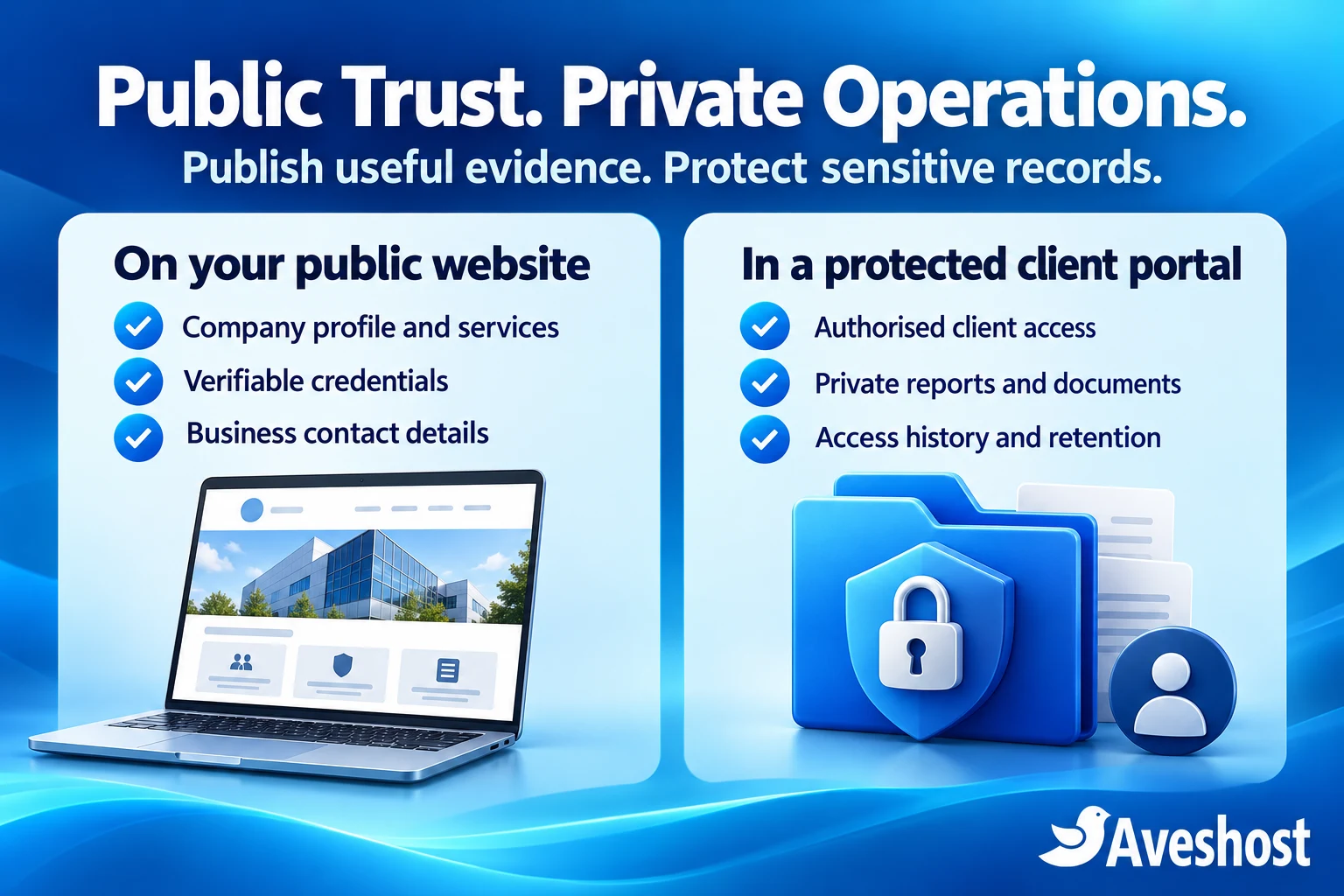
A public website introduces the business. A corporate security services portal supports an established relationship through authorised access to agreed records. Treat the portal as a separate application requirement, with a defined purpose and responsible owner.
Decide which records belong there: approved service reports, contract documents or agreed review material. Sensitive operational information needs a justified audience and appropriate controls. Do not publish live patrol routes, guard rosters, client alarm details or incident footage simply to demonstrate a feature.
Verify a user’s organisation and site access before granting a portal account. Keep permissions specific to the relevant client, locations and duties. One client’s manager must not see another client’s records by changing a URL or document identifier.
Follow the principles in OWASP’s authorisation guidance: enforce access on the server and check permissions for the requested resource. A hidden menu, an unlisted link or a WordPress page password is not a complete client-specific access model.
Protect uploaded files as well as portal pages. Keep private reports out of publicly reachable media URLs, search indexes and shared caches. Use a controlled download process, appropriate encryption and access logging. A portal login cannot protect a file that remains openly accessible elsewhere.
Define access removal, account recovery, retention, deletion and incident handling before launch. Review access when staff leave or a client contract ends. A client portal also needs maintenance and testing; purchasing hosting alone does not implement its permissions or business workflow.
Choose reliable hosting and maintain the website
Choose hosting around the actual application. A company profile site and a private reporting portal have different storage, processing and support needs. Start with the features required now and leave room for a reviewed upgrade as traffic and document volumes grow.
Aveshost WordPress hosting can support a business website. For a more involved platform, fully managed VPS hosting offers a different hosting model to discuss with our team. Server management and application development are separate responsibilities that should be stated in the project scope.
Confirm backup frequency, retention, restoration responsibilities, security controls and support arrangements for the chosen plan. Ask about any client requirements for hosting location and subprocessors before storing their records. A premium plan name does not establish that every procurement condition is met.
Keep HTTPS working, software supported and administrator access restricted. Monitor uptime and form delivery, compress images and remove unused plugins. Test restored content and the enquiry workflow; the presence of backup files alone does not prove recovery will work.
Make the website easy to use on a phone and an office computer. Use readable type, labelled fields, descriptive links and a clear contact route. Test keyboard navigation and document readability. A slow animation or oversized company profile should not prevent a buyer from finding the essentials.
Assign ongoing ownership. Someone must review credentials, service areas, staff contacts, certificate status and company documents. Keep reminders for domain renewal and account recovery within company control. A website stays credible through regular attention to the business facts it presents.
Review your website before a corporate buyer does
Review the site as a new procurement visitor. Find the legal name, credentials, service coverage and proposal contact without using inside knowledge. Check that the company profile, email signature and website describe the same organisation and current offer.
Test every contact link and form with a sample enquiry. Confirm that the record is saved, the acknowledgement arrives and the responsible staff member can follow up. Make the review practical: a working contact route matters more than a decorative contact-page photograph.
Check each public photograph and downloadable file for permission and sensitive details. Review metadata, visible site information and sample reports. Remove obsolete documents from public access rather than merely deleting a link to a file that remains available.
If you offer a portal, test two different client accounts and a revoked account. Verify that each can access only the intended records and that direct download links enforce the same restrictions. Keep a documented recovery route for legitimate users who lose access.
Build a focused corporate presence first, then expand it around demonstrated client needs. To plan your company website, domain, business email or protected portal hosting, discuss your project with Aveshost. Bring your current profile, service list and communication requirements so we can scope the right setup.
Frequently asked questions
What should security company website design in Ghana prioritise?
Prioritise a consistent company identity, verifiable credentials, clear service coverage, relevant experience and a working corporate contact process. Keep confidential client information out of public pages.
Does a private security company need an operating licence in Ghana?
The Ministry of the Interior states that a licence is required to operate a private security company. Use its licensing guidance and official register to support verification of current status.
Is company registration the same as a private security licence?
No. Incorporation identifies the registered business, while the operating licence serves a different regulatory purpose. Present each document accurately and provide a suitable verification route.
Can a website display an ISO certification badge?
Only present valid certification accurately and follow the issuing body’s mark-use rules. ISO itself does not certify organisations or issue their certificates, and its logo is not a general certification badge.
Should we publish every client logo and security assignment?
Publish client identities, logos and assignment photographs only with permission. Use approved anonymised examples where needed, and keep operational details and private client contacts protected.
Does a company email guarantee a contract award?
No. It supports a consistent professional identity, but procurement decisions still depend on the buyer’s checks, requirements and evaluation. Protect the accounts and ensure staff monitor enquiries.
Do SPF, DKIM and DMARC encrypt business email?
They support email authentication and help receiving systems assess messages from your domain. They do not encrypt message contents or guarantee delivery to every inbox.
What belongs in a corporate security services portal?
Only the agreed records that authorised clients need, such as approved reports and contract documents. Enforce client-specific permissions on pages and files, log access appropriately and remove access when it is no longer authorised.
Does every company website need a VPS?
No. Select hosting for the actual website or portal workload, storage, controls and support needs. A profile site and a document-heavy client application can require different configurations.
Can Aveshost help with a security company website?
Contact Aveshost to discuss your company website, domain, hosting and business email. For a private portal, define the intended records, user permissions and implementation requirements during project scoping.