

Want to sell your website and get the best outcome from the work you have put into it? A strong sale starts before you publish a listing. Buyers need to understand what the site earns, why people visit it, what they will own and how they can take over without rebuilding the business.
Whether you run a content website, online store, subscription service or software product, the goal is to make its value clear and its risks manageable. A polished design helps, but sustainable performance, credible records and a straightforward transfer usually matter more than a persuasive headline.
In this guide, we explain how to sell your website in eight practical steps, from preparing the assets and estimating a price to finding buyers and completing the handover. You will also find a checklist for deciding when your site is ready to list.
Table of Contents
What does selling a website include?
Selling a website can mean selling a collection of digital assets or transferring an operating online business. Those are different transactions. A domain with a few pages is not the same as an ecommerce store with inventory, suppliers, customers and recurring sales.
| Website type | What buyers may evaluate | What needs a transfer plan |
|---|---|---|
| Content site or blog | Audience, earnings, useful content and search visibility | Domain, content rights, CMS, analytics and monetisation |
| Online store | Margins, customer demand, suppliers and fulfilment | Store, inventory, customer records and service approvals |
| SaaS or subscription product | Recurring revenue, retention, product quality and costs | Code, infrastructure, billing arrangements and support |
| Pre-revenue website | Domain, original assets, functionality and buyer fit | Domain, files, intellectual property and licences |
Put the sale scope in writing. The buyer should know whether the deal includes only the website or also a brand, customer database, inventory, contracts and other assets. The scope affects the price, the review process and the work needed to close.
What makes a website valuable to buyers?
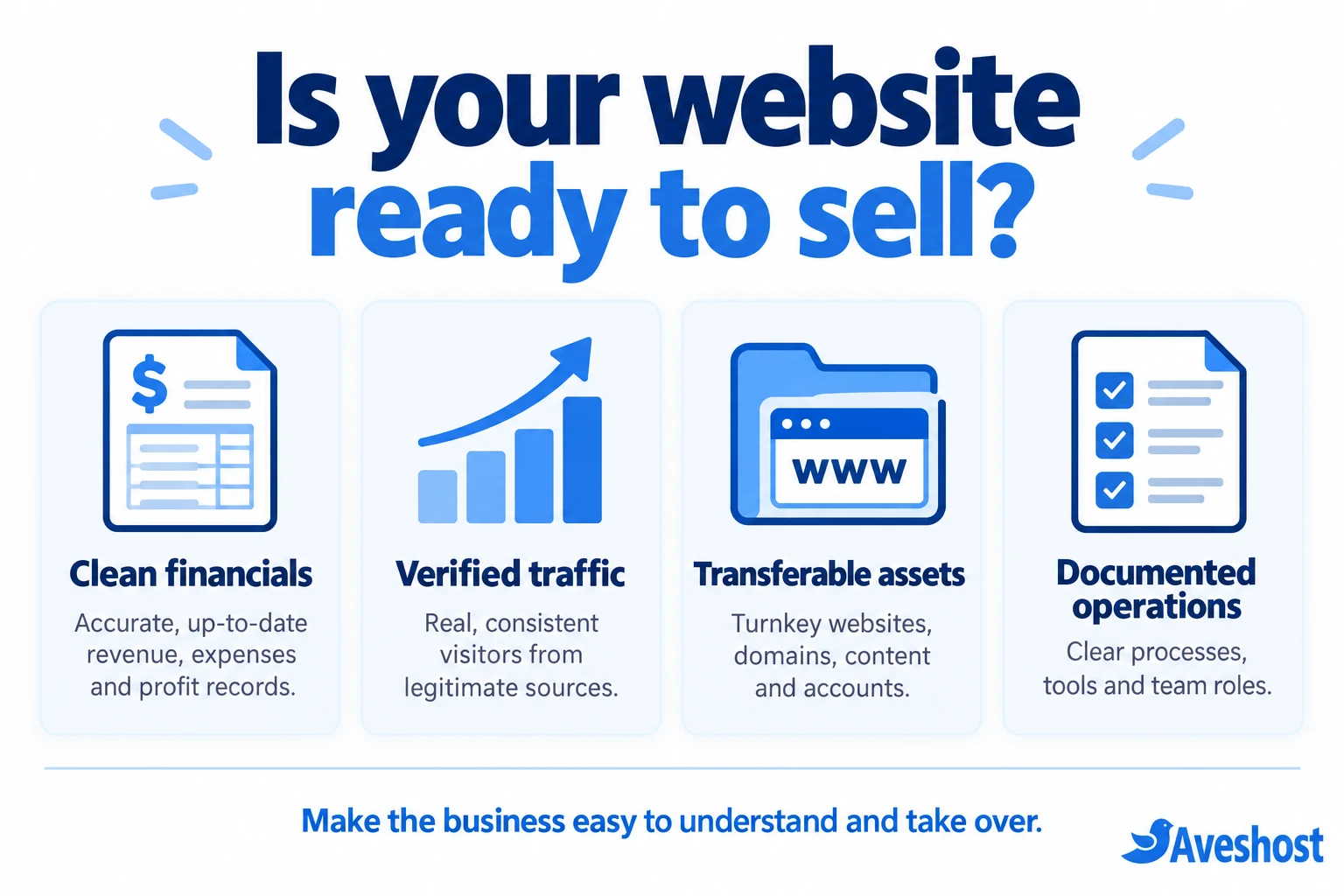
A buyer is purchasing future usefulness, supported by evidence of what the website has already achieved. They will assess how likely those results are to continue after you leave.
- Reliable earnings: revenue that remains attractive after the costs needed to run the site.
- Quality traffic: visitors with a clear source, relevant intent and a history that can be checked.
- Manageable dependence: an operation that does not rely entirely on one customer, one ranking or your personal reputation.
- Transferable assets: content, code, domains and relationships the buyer can actually use.
- Clear operations: documented tasks, predictable expenses and a realistic workload.
A growing site can still be difficult to sell if the owner cannot explain its numbers. A smaller site with clean records and simple operations may be easier for a buyer to assess. Your preparation should answer the questions that would otherwise slow down the deal.
1. Define exactly what you are selling
Start with an asset inventory. Record what you own, where it is stored, which service controls it and whether it can be transferred. Separate the website’s assets from personal accounts or other businesses you run.
- Domain name, registration details, renewal dates and DNS configuration.
- Website files, databases, source code, repositories and backups.
- Brand assets, original articles, images, product descriptions and design files.
- Analytics properties, reporting history and relevant search-performance records.
- Customer or subscriber records, supplier agreements and operational documentation.
- Software subscriptions, themes, plugins, APIs, advertising and affiliate arrangements.
Check ownership before advertising an asset as included. A contractor’s work, licensed stock image or paid plugin may have restrictions that affect the handover. The buyer may need a new licence or a separate service account. Resolve those dependencies early and list any exclusions clearly.
Also decide what remains yours: unrelated domains, personal email, another website in the same hosting account or a social profile used for several businesses. A precise asset list prevents an attractive offer from turning into a disagreement about what the buyer expected.
2. Prepare your financial and traffic records
Gather a consistent set of monthly records. For an established site, a full year helps reveal seasonality; a longer history can help explain trends. A newer site should show its actual operating history without filling gaps with forecasts.
Make revenue and expenses easy to reconcile
Prepare a monthly profit-and-loss summary and supporting records from the relevant payment, advertising or affiliate services. Include hosting, software, content production, advertising, fulfilment, refunds and other necessary costs. For stores, show how inventory and cost of goods are treated.
Separate recurring performance from unusual events. A one-off sponsorship or short promotion should not quietly become the basis for an annual earnings forecast. Explain proposed adjustments, retain the original figures and account for the work a new owner will need to replace.
Show the traffic behind the business
Use analytics and search-performance reports to explain visitor sources, important pages, conversions and trends. Identify organic search, paid campaigns, referrals and direct visits separately. A traffic spike from a campaign has a different meaning from steady demand.
Where possible, let qualified buyers review relevant reporting through controlled access. Screenshots can introduce the story, but they should not be the only evidence. Remove private information from preliminary materials and share detailed records in stages as the review progresses.
3. Improve the website before listing it
Improve the parts of the business that affect earnings, confidence and ease of ownership. Focus on changes you can measure rather than a hurried redesign that adds uncertainty.
- Fix broken checkout flows, forms, internal links and mobile usability problems.
- Update important content and remove misleading descriptions or outdated offers.
- Review hosting reliability, HTTPS, backups and recovery procedures.
- Identify unnecessary recurring costs without cutting services the business needs.
- Document publishing, customer support, fulfilment and maintenance tasks.
- Explain traffic and revenue concentration, and develop sensible alternatives where practical.
If you manage the site on WordPress, record plugin versions, licence requirements, update procedures and any custom code. Document how to recover from a failed update and where backups are stored. The buyer should not need to reverse-engineer the setup on their first day.
Allow meaningful changes enough time to produce evidence. A recent improvement is more useful when you can show its results over a relevant period. Avoid buying artificial traffic, concealing expenses or presenting untested ideas as established growth.
A dependable technical foundation also makes the handover easier. You can explore our web hosting packages if the site needs a suitable environment, and contact our support team to discuss migration planning.
4. Set a realistic asking price
For a profitable online business, a common starting point is sustainable earnings multiplied by a market-informed factor. That factor depends on the business model, recent performance, risk and buyer demand. It is not a universal rule for every website.
Empire Flippers’ valuation guidance describes an earnings-based approach and explains that a valuation can differ from the eventual listing or sale price. Use comparable completed transactions and professional input to build a range, rather than treating one automated estimate as a binding offer.
An illustrative valuation calculation
Suppose a website averages $1,000 in monthly profit after its necessary operating costs. Its annual profit is $12,000. If an illustrative negotiation uses 2.5 times annual profit, the starting estimate would be $30,000. The 2.5 figure here is an example for the calculation, not a recommended multiple or a prediction for your site.
Keep the time period consistent: an annual-profit multiple and a monthly-profit multiple are different measures. Also check how each buyer or broker defines earnings. Owner labour, one-off expenses and ongoing replacement costs can change the calculation.
A pre-revenue website or domain-only sale needs another approach. Buyers may consider the quality and usefulness of the assets, comparable domain sales or the strategic fit. The time and money you spent building the site do not automatically determine what someone else will pay.
Calculate the amount you will keep
Estimate proceeds after marketplace or broker fees, payment costs, agreed adjustments and any transition expenses. Check the current fee schedule and payment terms of the service you choose. Get appropriate professional help for the agreement and tax treatment of your transaction, particularly when the sale involves an operating business or parties in different countries.
5. Choose where to sell your website
Choose a sales channel based on the site’s size, operating history, complexity and the support you need. No single route fits every sale.
| Route | Why consider it? | What to check |
|---|---|---|
| Online marketplace | A listing can reach buyers already looking for digital assets | Current fees, eligibility, verification and transaction support |
| Specialist broker | Help presenting and managing an established business sale | Acceptance criteria, commission, exclusivity and scope of service |
| Direct buyer | A relevant company or operator may value a strategic fit | Identity, funding, independent advice and a secure closing process |
Flippa supports listings for websites and online businesses and offers tools for presenting data and managing buyer discussions. Empire Flippers is another option to evaluate for an established business. Review each provider’s current terms and acceptance process before committing.
A direct buyer might be a complementary publisher, an operator in your niche or a company that could use the product. Prepare a concise summary of the opportunity. Share detailed financials, sensitive customer records and access only after you have assessed the buyer and agreed the appropriate confidentiality arrangements.
If you use a broker, clarify which tasks they handle and which remain your responsibility. Also check whether an exclusivity agreement affects your ability to pursue other buyers during the listing period.
6. Write a clear, credible sales listing
A good listing answers the buyer’s first questions without exaggeration. Explain what the website does, who it serves, how it earns money and why you are selling. Show current results separately from possible improvements.
- A clear description of the niche, business model and operating history.
- Documented revenue, necessary costs and the resulting earnings.
- Traffic sources, trends, key pages and conversion information.
- A realistic estimate of weekly owner work and the tasks involved.
- The included assets, excluded assets and third-party dependencies.
- The reason for selling and the transition support you are prepared to provide.
Use a specific opportunity statement: “The site has an established content library and an email audience; a buyer could test a new paid product.” Avoid turning it into a promise such as “Launch one product and double revenue.” Buyers should be able to distinguish a proven result from an idea.
Be direct about weaknesses. Explain a recent traffic decline, supplier dependency or technical issue with context and supporting evidence. Finding it during due diligence is more damaging to trust than seeing it clearly explained from the start.
7. Screen buyers and negotiate the full deal
An enquiry is not an offer, and an offer is not completed payment. Assess the buyer’s identity, acquisition goals, funding arrangements and experience before granting deeper access. Use the marketplace or broker’s screening process where available, while still reviewing the terms yourself.
Prepare for due diligence
Organise a controlled document folder with financial records, reporting, the asset inventory, licence details and operating procedures. Give access only to the material needed at each stage. Buyers may ask to reconcile payments, examine traffic history, test the product and confirm ownership.
Customer information and subscriber lists need particular care. Use redacted or aggregated records for early review and establish an appropriate process for any later disclosure or transfer. Requirements depend on the information, service terms and jurisdictions involved.
Negotiate more than the headline price
Compare how much is paid at closing, whether any amount is deferred, how an earn-out would be measured and what ongoing work you must provide. A larger headline number can involve more uncertainty or a longer commitment.
Record the assets, exclusions, deadlines, payment conditions, inspection period, responsibilities and transition support in the final agreement. Define support in practical terms, such as the number of sessions, topics covered and end date. Have a qualified adviser review material legal and tax questions before signing.
8. Complete payment and transfer the website
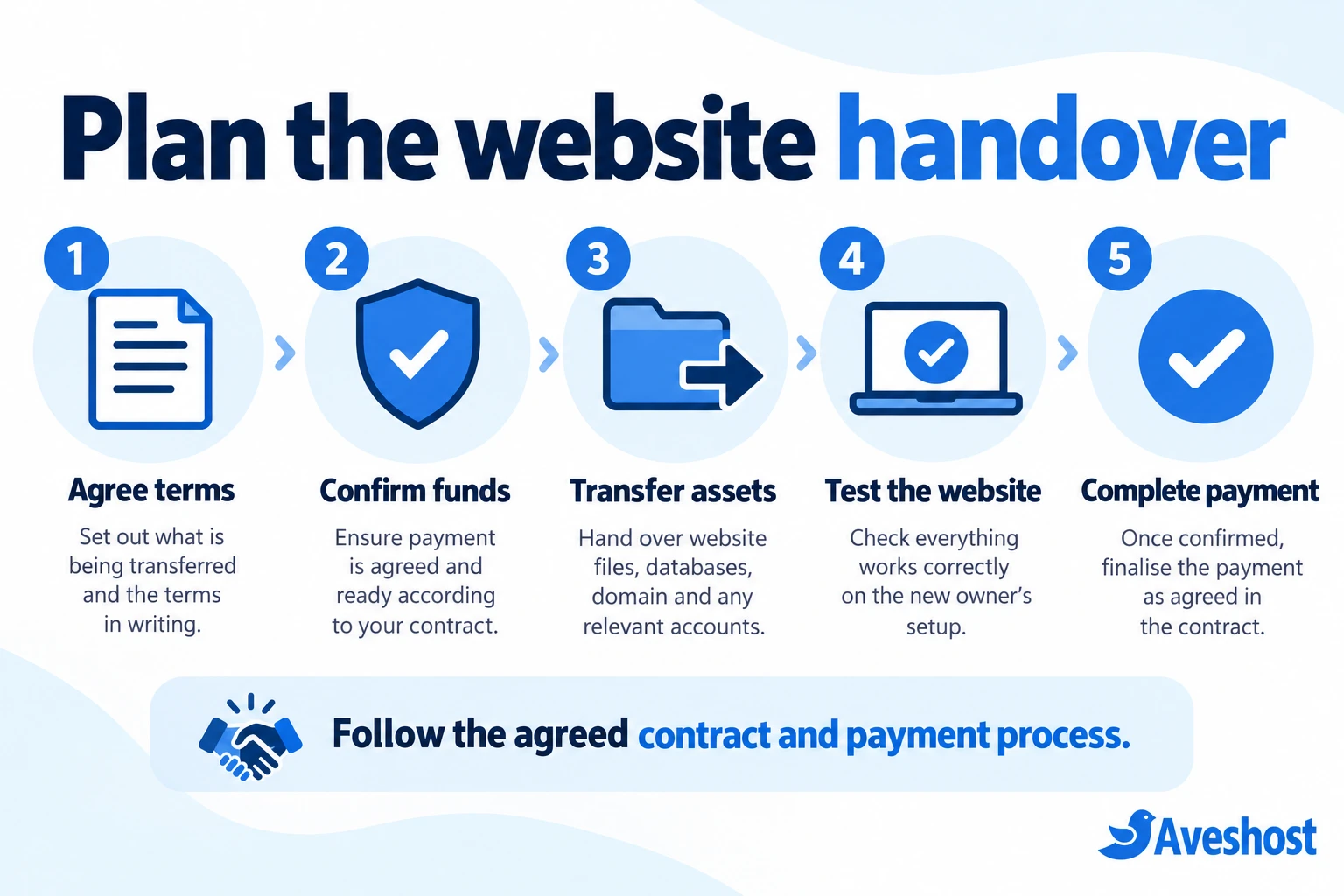
Plan closing with the buyer, payment service and relevant providers. Domain ownership, hosting, email, applications and payment arrangements are separate pieces of the transfer. A domain move alone does not deliver the working business.
Confirm the agreed payment process
A service such as Escrow.com’s domain and website escrow can hold funds under agreed conditions while assets are delivered and checked. Confirm the service’s eligibility, coverage, fees and release requirements for your specific transaction. The description of the transaction should cover the website assets, not just the domain if more is being sold.
Verify the funding status directly inside the agreed payment service before the corresponding transfer step. Do not rely on screenshots or a payment email sent by the buyer. Follow the contract and service workflow for inspection, acceptance, disputes and release of funds.
Transfer the domain and technical assets
Check the registrar’s process before fixing the closing date. A change of registrant and a transfer between registrars are different actions. For domains covered by ICANN’s transfer rules, locks can affect the schedule; see ICANN’s domain transfer FAQs. Country-code domains may have their own registry requirements.
Arrange the website migration into accounts controlled by the buyer. Take backups, document DNS records and test the destination before changing the live setup. Preserve URLs and essential configuration where possible. Check HTTPS, forms, checkout, scheduled tasks, email delivery, redirects and analytics after the move.
Do not hand over a personal hosting account containing unrelated sites. Ask the provider about transferring the specific service or migrating the site to a separate account. Keep a record of the completed assets and acceptance checks.
Complete account ownership and support
Advertising, affiliate, billing and software accounts may need provider approval or replacement accounts. Confirm their requirements before closing. Once the agreed transfer is accepted, complete payment release through the chosen process and remove obsolete access on the agreed schedule. The buyer should set up their own security and recovery methods.
Finally, deliver the promised training and operating documents. A brief walkthrough of routine tasks, renewals, backups and support contacts helps the new owner run the site with fewer interruptions.
Website-selling mistakes to avoid
- Pricing from emotion: use business evidence rather than the hours you invested.
- Mixing revenue with profit: show the ongoing costs required to produce the results.
- Changing too much before sale: a major redesign or migration without testing can introduce problems.
- Transferring accounts without checking eligibility: check platform rules and licence restrictions first.
- Neglecting the live business: maintain content, service and operations while negotiating.
- Leaving support undefined: specify what you will provide after closing and for how long.
- Transferring control on a promise: verify the agreed funding and delivery conditions.
Avoid unnecessary URL or domain changes during the handover. If a change is required, plan redirects and testing deliberately. For more on choosing a domain that fits a brand, read our guide to .ai and .com domains.
Your website sale-readiness checklist
- The asset list and ownership evidence are complete.
- Financial records reconcile with supporting documents.
- Traffic trends and the main dependencies are explained.
- The asking price has a clear basis and fees are included in your proceeds estimate.
- The sales channel, confidentiality process and buyer review are agreed.
- The contract covers payment, inspection, assets and transition responsibilities.
- The migration, domain and third-party account processes are ready.
- Backups, testing and operating documents are prepared.
Selling your website successfully means helping the right buyer understand what they are acquiring and making the transfer workable. Build the evidence first, choose a realistic price and negotiate the full terms. Then keep the website running well until the handover is complete.
If you need help planning the technical move, contact our support team. Share the website platform, current hosting arrangement and intended destination so we can discuss the hosting and migration steps relevant to your setup.
Frequently asked questions
How do I sell my website?
Define the assets included, prepare financial and traffic evidence, estimate a realistic value, choose a sales channel, create a listing and assess interested buyers. Agree the sale terms and payment process before transferring the assets, then test the handover and complete the transaction.
How much is my website worth?
Value depends on the business model, sustainable earnings, traffic quality, growth, operating workload and transferability. A profit-based estimate can be a starting point for an established business, but a domain-only or pre-revenue website needs a different assessment. An asking price is not a guaranteed sale price.
Can I sell a website that does not make money?
Yes, a buyer may value the domain, original content, software, design or audience. Without established earnings, the case usually rests on those assets and their usefulness to the buyer. Explain the site’s current results rather than presenting projected revenue as existing income.
Where can I sell a website?
Options include online marketplaces such as Flippa, specialist business brokers such as Empire Flippers, or a direct sale to a relevant buyer. Compare current eligibility, fees, confidentiality options, buyer screening and transaction support before choosing a channel.
How long does selling a website take?
There is no fixed timeline. Preparation, buyer demand, asking price, due diligence, financing and technical transfers all affect the schedule. Keep operating the website during the process and agree realistic deadlines with the buyer.
Do I have to transfer my entire hosting account?
Usually the sale can be organised around transferring the website to a buyer-controlled hosting account. Avoid handing over a personal account that also contains unrelated sites or private billing information. Confirm the migration and ownership-change options with the hosting provider.
Is escrow useful when selling a website?
Escrow can help coordinate payment and asset delivery by holding funds under agreed conditions. Confirm that the service covers the complete transaction, supports the parties and assets involved, and specifies inspection, acceptance and payment-release steps. Verify funding within the service rather than relying on an email screenshot.
Will changing the website owner affect SEO?
An ownership change does not require changing the domain or URLs. Unnecessary changes to URLs, content, hosting configuration or indexing settings can create avoidable disruption. Preserve the working setup during the handover and test redirects, analytics, indexing settings and key pages.
Can I transfer advertising, affiliate and payment accounts to the buyer?
Not automatically. Each service has its own ownership, eligibility and approval rules. Check the relevant terms and support process, and identify whether the buyer needs a new account or approval before the sale closes.
How can I improve my chances of a stronger sale?
Build sustainable results, keep clear records, fix operational problems and make the website easier for another owner to run. Buyers can assess documented performance and transferable assets more confidently than unsupported growth promises.