Secure loan portal hosting in Ghana starts with protecting the records behind every application, repayment and collection. Microfinance institutions and Susu businesses handle identity documents, telephone numbers, account histories and financial information that customers expect them to keep private.
An online portal can give customers a convenient way to submit applications, check progress and view authorised records. For staff, it can bring branch activity and collection updates into one system. To deliver those benefits, the application, server and operating procedures must work together.
At Aveshost, we help businesses choose infrastructure for their applications. This guide explains the decisions to make before hosting a loan portal, the security controls to build into it, and how to plan dependable operations as your institution grows.
Table of Contents
Start with the services your portal will offer
Define the first version of the portal before choosing a server. A public loan enquiry form, a customer statement portal and a transaction system have different risks and technical requirements. A Susu collection tool also needs clear controls over who records a collection, who checks it and how an error is corrected.
- Customer functions: applications, secure document uploads, status updates and access to the customer’s own records.
- Staff functions: assigned customer records, branch reports, collection entries and supervised approvals.
- Financial functions: repayment reconciliation, authorised integrations and a traceable record of changes.
- Support functions: account recovery, complaints, disputed collections and customer corrections.
Begin with the functions your institution can supervise properly. Keep loan decisions and disbursements within your approved processes. Adding an online form does not change who is authorised to approve credit, hold customer funds or alter an account balance.
Confirm your regulatory obligations before launch
Identify your institution’s licence, business model and applicable requirements with your compliance lead. A licensed savings-and-loans company, a credit union, a cooperative Susu business and an exclusively digital lender should each review the rules that apply to their activities.
The Bank of Ghana Cyber and Information Security Directive applies to regulated financial institutions. Its cloud-services section requires institutional governance and Bank of Ghana approval for a transition to cloud services. Complete the applicable approvals before deployment.
The accompanying proportionality framework distinguishes institution types, including microfinance banks, digital credit providers and last-mile providers such as cooperative Susu businesses. Have your compliance team confirm your classification and the controls required for your risk profile.
Businesses operating exclusively as digital credit providers should also review the Directive for Digital Credit Services Providers and its licensing process. Hosting a portal does not grant permission to lend, take deposits or launch a regulated financial service.
Assign owners for compliance, application security, server administration and incident response. Put responsibilities, service levels, access arrangements, data locations and exit procedures into the relevant agreements. Your institution remains accountable for how its customer service operates.
Map customer data and protect its use
Create a simple inventory showing what information enters the portal, why you need it, where it is stored and who can use it. Include uploaded identification, application details, guarantor information, loan records, collections, audit logs and backup copies.
The Data Protection Commission’s guidance for organisations covers registration, renewal, a trained data protection supervisor, privacy information and appropriate safeguards. Carry out a privacy impact assessment before introducing a new portal or materially changing how it processes customer information.
Publish a clear privacy notice at the point where customers provide information. Explain the purpose of collection, required and optional fields, recipients and the process for access or correction. Your compliance team should document the lawful grounds for processing and the retention periods for each record type.
Collect only the information needed for the approved service. Keep identity documents out of ordinary email attachments and staff messaging groups. For development, demonstrations and testing, use fictional records. A developer should not need a copy of your live customer database to build a screen or test a form.
Document deletion and retention procedures for documents, logs and backups. Restrict bulk exports and record who downloads them. When a customer or staff member reports inaccurate information, route the correction through a controlled review process.
Choose a secure hosting architecture
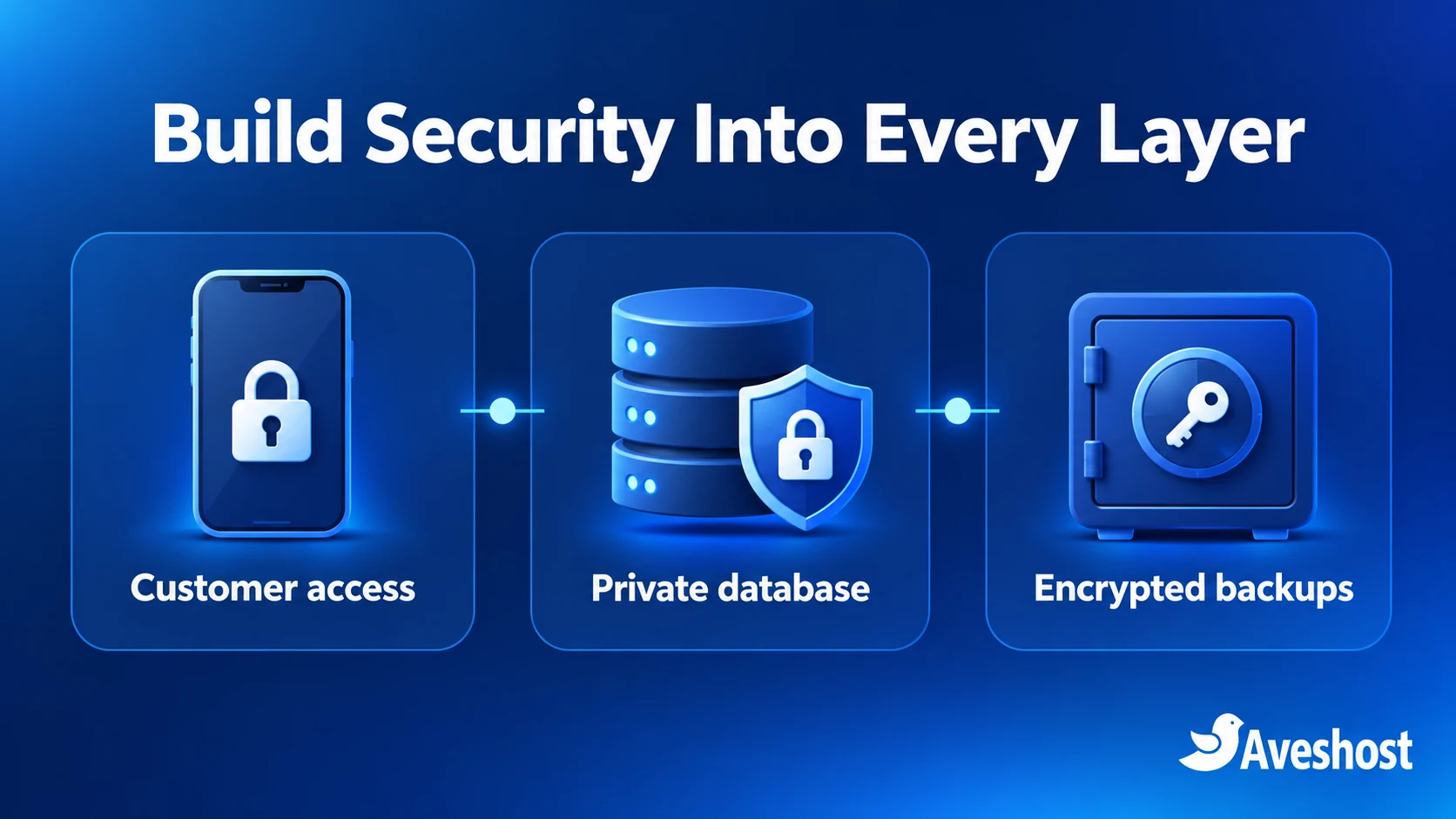
Keep the public-facing application separate from the services that hold or administer customer data. The database should accept connections only from authorised application services. Administration tools should be accessible through a restricted management path, such as a properly configured VPN, with individual administrator accounts.
| Layer | Practical protection |
|---|---|
| Public portal | HTTPS, rate limits, input validation and secure customer sessions |
| Application services | Supported software, restricted service accounts and protected configuration |
| Database | Private access, limited permissions and controlled exports |
| Document storage | Access checks on every download; no public upload directory |
| Administration | MFA, restricted network access and logged changes |
| Recovery | Encrypted backups, separate access and tested restores |
On a VPS or VDS, your technical team controls the operating system and application configuration. Use firewall rules that expose only the services customers need. Keep database, cache and queue ports off the public internet. Set resource limits so that a large report or upload cannot exhaust the whole server.
A static IP is useful for an integration that requires an approved source address. It does not replace authentication, encryption or firewall controls. Likewise, a private virtual server still needs a secure application and disciplined administration.
Keep staging separate from production. Store live credentials only in the production environment, and prevent a test deployment from sending real repayment reminders or posting transactions to a live account.
Protect customer and staff access
Give every staff member a named account and only the permissions needed for their role. A collector may enter a collection without being allowed to change an approved loan or export all customers. A supervisor can review corrections while a system administrator manages technical services.
Require multi-factor authentication for privileged staff and administrative access. Use strong password storage, secure session cookies, sensible session expiry and rate limits on login attempts. Review permissions when an employee changes role, and revoke access promptly when they leave.
Check authorisation on the server for every customer record and document request. Changing a record number in a URL must never reveal another customer’s application, identification or statement. Test this explicitly with two fictional customer accounts.
Treat password recovery and phone-number changes as sensitive workflows. Verify the customer through an approved process, expire recovery tokens and notify the customer of relevant account changes. An OTP alone should not give someone unrestricted access to staff functions or authorise a change to payment details.
For Susu collectors using mobile devices, require device locks, individual logins and a way to disable access if a phone is lost. Avoid storing unprotected customer lists on a collector’s personal device.
Secure connections, documents and secrets
Enable HTTPS across the entire portal and monitor certificate renewal. Protect connections between application services and any remote database or integration as well. Our SSL certificate services can support your certificate requirements, while your technical team configures and monitors the application’s TLS setup.
Use encryption for sensitive stored information and backup copies, with documented key ownership and recovery. Keep encryption keys and API secrets out of source code, public folders and screenshots. Separate access to keys from routine access to the data they protect.
An SSL certificate secures a connection. It does not establish regulatory approval or fix weaknesses in a portal’s code. Choose certificate validation according to your institution’s requirements and secure the complete system.
Scan uploaded documents, restrict accepted file types and sizes, and store uploads outside executable web directories. Serve downloads only after checking the requester’s permission. Prevent search engines and public links from exposing customer documents, and keep debug pages disabled in production.
Verify repayments and collection records
A repayment should enter the ledger only after the system has verified it through the authorised payment integration. A customer’s browser redirect, uploaded screenshot or SMS message is insufficient evidence that a payment has settled.
- Validate callback signatures or the authentication method specified by the payment service.
- Confirm the transaction status, reference, amount and destination through the server-side integration.
- Process repeated callbacks safely so that the same payment is recorded once.
- Reconcile portal records with settlement and collection reports.
- Route mismatches, reversals and failed transactions to an accountable staff member.
For cash collections, give each entry a unique reference and keep a traceable history of who entered, checked or corrected it. Corrections should preserve the original event and record the reason. A shared login makes this accountability much harder.
Keep payment secrets on the server. Do not place them in a mobile app, browser script or downloadable configuration file. Avoid storing card details in the portal when a hosted, authorised payment flow can handle them.
Keep automated messages discreet. A general notification that an update is available is safer than putting a loan balance or sensitive application detail into an SMS that someone else may read. Direct customers to the official portal, and never ask them to disclose passwords or OTPs.
Build backups and a tested recovery plan
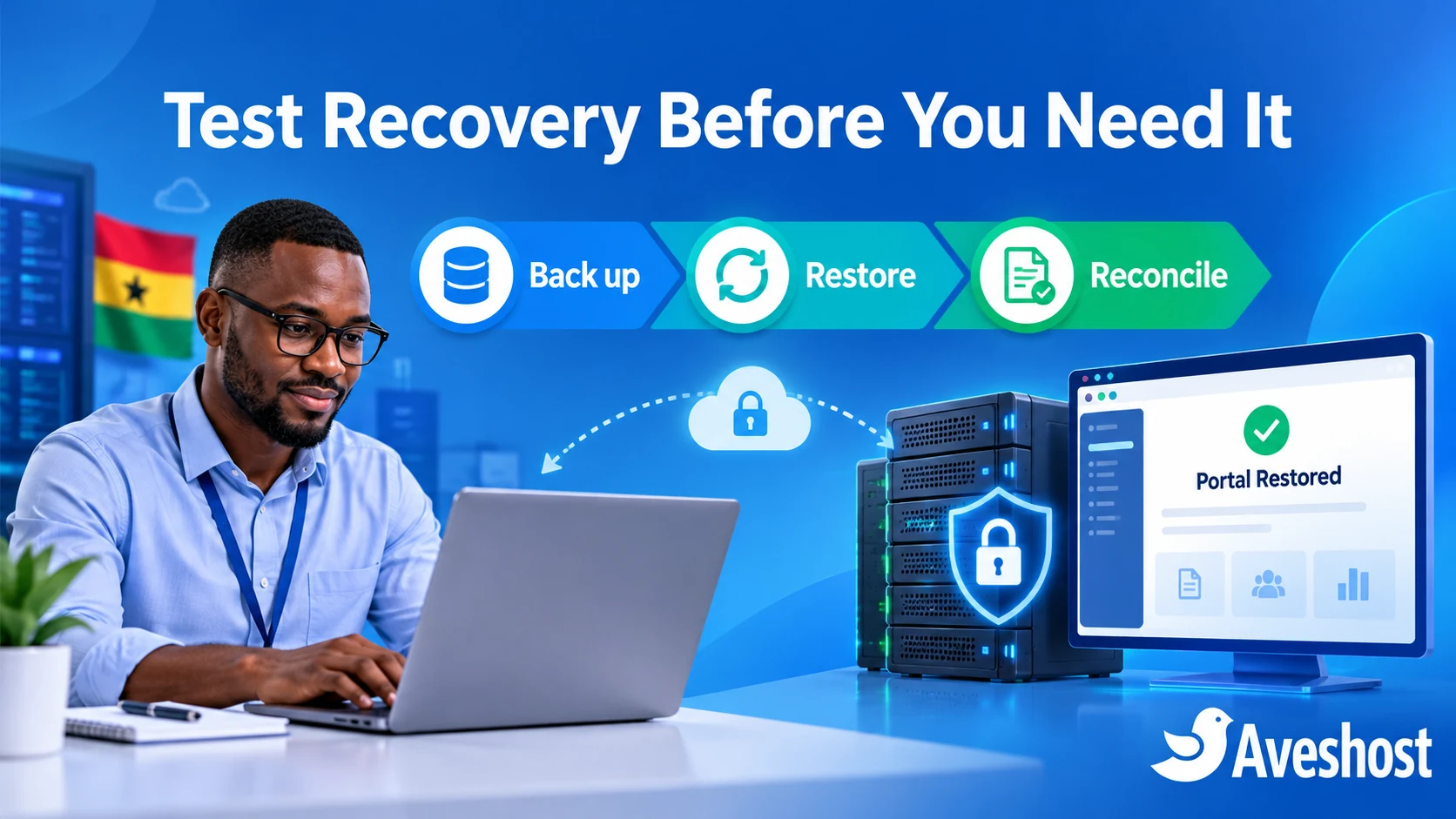
Decide how much recent work the institution can afford to lose and how quickly it needs the portal restored. These decisions establish your recovery point objective and recovery time objective. They should reflect the impact of interrupted collections and customer service.
Back up the database, uploaded documents and the configuration needed to rebuild the application. Schedule backups according to the agreed recovery target and alert the responsible team when a job fails. Use a consistent database backup method so that a restored database matches its associated files.
Encrypt backup copies and restrict who can download, restore or delete them. Keep recovery copies separate from the live server and use an appropriately independent recovery location approved by your institution. Copies in the same facility do not cover every site-wide incident.
Our Ghana VDS backup and snapshot options are hosted in Accra. Include their location in your recovery design and arrange any additional independent recovery copy your institution requires. Treat snapshots as one recovery tool alongside tested, application-consistent backups.
Run restore exercises in an isolated environment. Check sample customer records, document access, ledger totals and pending transactions. Prevent the restored test system from sending live notifications or repeating payment instructions. Record the result, recovery time and any gaps.
For a Susu business, prepare a controlled continuity process for periods when collectors cannot reach the portal. Use unique references and supervised reconciliation so that temporary records can be entered later without duplicate collections.
Aveshost hosting options and Ghana cedi pricing
Choose infrastructure according to your application’s workload, approved data location and management requirements. Our Ghana VDS plans run in Accra with dedicated resource allocations, NVMe storage, root access and a static IPv4 address. They are self-managed virtual dedicated servers.
| Ghana VDS plan | Resources | Monthly price |
|---|---|---|
| VDS S | 3 vCPU, 24 GB RAM, 450 GB NVMe | GH₵2,000 |
| VDS M | 4 vCPU, 32 GB RAM, 600 GB NVMe | GH₵2,710 |
| VDS L | 6 vCPU, 48 GB RAM, 900 GB NVMe | GH₵4,000 |
Prices and product information were reviewed at the time of writing. Budget separately for selected backup options, software licences, application development, security testing and ongoing operations. Confirm the final configuration and total at checkout.
Our fully managed VPS hosting includes DirectAdmin at no additional licence cost. Discuss your portal’s software stack and the required deployment location with our team before selecting this service. Ghana VDS and fully managed VPS are separate product options.
Load-test the application before sizing production infrastructure. Measure concurrent users, upload sizes, reporting queries and database growth. For larger or specialised deployments, discuss your requirements with Aveshost so we can help you choose the infrastructure and management scope.
Test the portal before moving real customer data
Use a staging environment with fictional customer data for acceptance testing. Include operations staff and collectors, because a technically functioning portal can still have an unclear approval process or confusing receipt workflow.
- Access: confirm that customers see only their records and staff permissions match their roles.
- Documents: test rejected uploads, restricted downloads and expired sessions.
- Transactions: test failed, repeated and reversed payments, plus collection corrections.
- Performance: simulate peak traffic, reporting jobs and intermittent mobile connections.
- Recovery: restore a backup and reconcile records before accepting the result.
- Security: complete vulnerability checks and an appropriate independent assessment; fix serious findings before launch.
- Governance: confirm applicable approvals, privacy notices, contracts and named operational owners.
Plan the migration with an agreed maintenance window, a verified source backup and a rollback procedure. Transfer records through an encrypted, access-controlled process. Compare customer counts, document counts and financial control totals before allowing normal transactions.
Move a limited, approved group first where the institution’s rollout plan permits it. Monitor errors and reconciliation closely, then expand access after the team has confirmed that the portal works as intended.
Keep the portal secure after launch
Secure loan portal hosting needs continuing attention. Keep the operating system, application framework and dependencies supported and patched. Use change control so that a routine release does not quietly remove a payment check or expose an administration screen.
Monitor failed logins, unusual exports, unexpected account changes, database errors, disk usage and backup failures. Protect audit records and avoid writing passwords, OTPs, full identity numbers or unnecessary financial information into logs. Agree who receives each alert and who responds outside office hours.
Train staff to verify unusual requests through a trusted channel. Attackers may impersonate a manager, customer or support agent to request an export, change repayment details or gain access. Our guide to cleaning a hacked WordPress site is relevant if your public website uses WordPress; maintain separate access and recovery controls for the financial portal.
Prepare an incident plan with technical, management and compliance contacts. If an incident occurs, contain affected access, preserve evidence and follow the applicable reporting obligations. Restore service only after addressing the cause and checking the integrity of customer records.
When you are ready to plan your deployment, contact Aveshost support with your application stack, expected workload, approved hosting location and management requirements. Keep customer records and credentials out of the initial enquiry. We can help you turn those requirements into a practical hosting plan.
Frequently asked questions
Can a Susu business host a customer portal?
Yes, a portal can support authorised collection and customer-service activities. Confirm the rules for your business model and complete the required approvals before launching new financial functions. Hosting does not authorise lending or deposit-taking.
What is the first step in secure loan portal hosting in Ghana?
Define the portal’s functions, identify the applicable regulatory requirements and assign responsibility for security and operations. Then choose infrastructure that meets the approved location and workload requirements.
Does a VPS make my loan portal compliant?
Compliance depends on the institution’s authorisation, governance, application controls and operating practices as well as its hosting. A VPS provides infrastructure; your institution must establish and maintain the required controls.
Should a financial portal use a dedicated IP address?
A static IP can support integrations that require source-address approval. Combine it with authenticated connections, firewall rules and restricted administrative access. The IP address alone does not protect customer records.
Is an SSL certificate enough to protect loan applications?
HTTPS protects information in transit. Also secure customer accounts, uploaded documents, stored data, application code, administration access and backups. Monitor certificate renewal so that encrypted access remains available.
Where are Aveshost Ghana VDS servers located?
Our Ghana VDS servers are hosted in Accra. They provide dedicated resource allocations, NVMe storage, root access and a static IPv4 address. These plans are self-managed virtual dedicated servers.
Does fully managed VPS include DirectAdmin?
Yes. Our fully managed VPS service includes a DirectAdmin licence at no additional cost. Confirm the application stack, deployment location and management scope with our team before ordering.
How often should a loan portal be backed up?
Set the backup frequency from your approved recovery point objective and transaction activity. Monitor failed jobs and test restoration. A completed backup is useful only when the team can restore and reconcile it successfully.
Can collectors use the portal from a mobile phone?
A mobile-friendly portal can support collectors with individual accounts, restricted permissions and secure device practices. Plan for lost phones and interrupted connectivity, and supervise the reconciliation of any temporary collection records.
How can Aveshost help with a loan portal deployment?
Contact our support team with your application stack, workload, approved data location and management requirements. We can help you choose hosting and plan the technical deployment. Send requirements first, without customer records or account credentials.