

Ghanaian vs international web hosting is a useful comparison when you are choosing where to run a business website, online store or application. The right decision comes from the plan’s resources, service quality, billing terms and fit for your users, rather than the nationality of the provider alone.
A Ghanaian provider can give your business a convenient local commercial relationship. An international provider can offer a suitable service when its platform and support match the project. In both cases, check the actual hosting location, performance, renewal cost and responsibilities before committing.
At Aveshost, we help businesses choose hosting around the website they need to operate. This guide explains the practical questions to ask and the evidence to compare, so you can make a clear decision without relying on slogans about local or foreign hosting.
Table of Contents
Ghanaian vs international web hosting: start with your website
Write down the application you intend to run: a company profile, WordPress blog, WooCommerce store, booking portal or custom application. Each has different needs. A simple public website and a busy database-backed portal should not be selected from the same checklist without adjusting the priorities.
Identify the people who will use it and where they are based. A business serving customers mainly in Accra may have different performance priorities from a Ghanaian brand selling to buyers across several countries. Include the staff who update the site and the systems it must communicate with.
Decide who will maintain the application. If you do not have a server administrator, include appropriate management and support in the requirement. A low-priced self-managed server can become costly when the business has nobody responsible for updates, monitoring and recovery.
List the features that are essential before comparing promotional offers. These might include a supported runtime, reliable checkout, private document access, email delivery or a tested backup process. Separate these requirements from optional extras that can be added later.
Use the same written brief for every provider. Comparable answers make the decision easier and reduce the chance of choosing an attractive headline price for a plan that cannot run the website properly.
| Compare | What to confirm |
|---|---|
| Application fit | Runtime, database, resources and supported features |
| Location | The selected application, data and backup regions |
| Cost | Checkout total, renewal and required extras |
| Support | Available channels and the work included |
| Recovery | Backup coverage, restoration and responsibilities |
| Control | Account ownership, exports and migration scope |
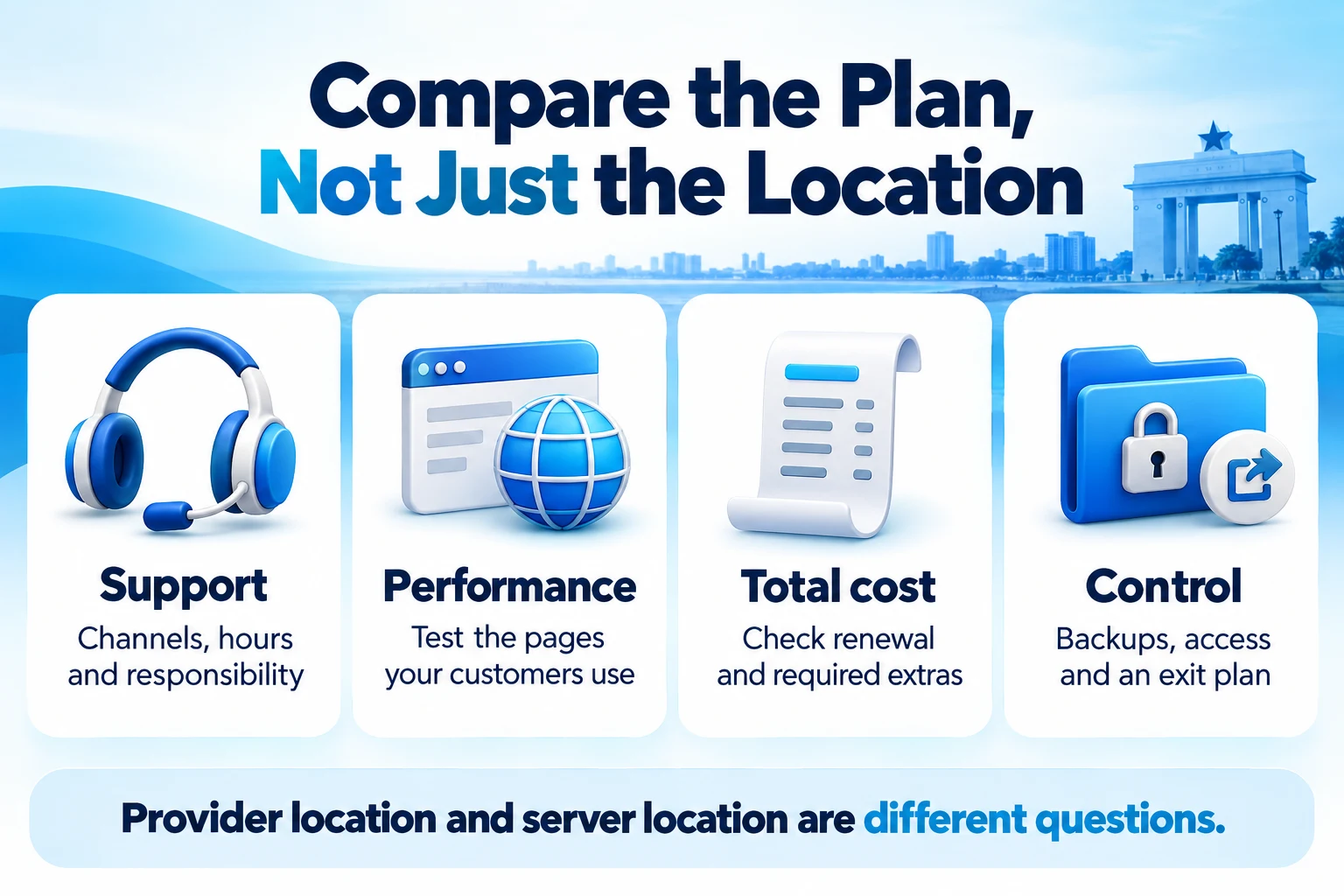
Separate provider location from server location
The provider’s business location tells you who sells and supports the service. The server location tells you where the selected hosting environment runs. They are separate facts. A provider can sell plans in several regions, so verify the location of the exact product you are buying.
Ask where the application, database and backups will be stored. Include any separate email service or storage integration in that conversation. A domain ending in .com.gh, a Ghanaian office address or a price shown in GHS does not establish where the server is hosted.
For example, Aveshost’s Ghana VDS page identifies Accra as the location for that product. That is a product-specific location statement. Check other plans on their own terms instead of extending one product’s location to the entire catalogue.
Geographic proximity can help network latency, but routing, connectivity, server response and the application also affect the experience. A nearby server with an overloaded application can still deliver a poor result. Choose location alongside measured performance and the operational requirements.
If your business has a specific data-location requirement, get the relevant locations and responsibilities documented before storing the information. Include backups, support access and third-party services; the main website server is only one part of the data flow.
Compare payments, billing and the full renewal cost
Compare what you will pay at checkout and on renewal. A Ghanaian business may prefer GHS billing and a familiar payment route for administration. Confirm the actual supported methods and currency for the selected plan instead of inferring them from the provider’s country.
If a quote is in another currency, compare the final GHS amount charged through your payment method, including any applicable conversion or transaction fees. Exchange rates can change between purchase and renewal. Keep that variation in the budget without inventing a fixed conversion for every future invoice.
Check the billing period behind a monthly-looking rate. A displayed monthly equivalent can require an annual or longer upfront payment. Record the amount due today, the initial term, the renewal term and the recurring rate as separate figures.
Include the extras your website actually requires: domain renewal, mailbox accounts, backup options, licences, management and storage or transfer overages where applicable. Compare services with the same scope. Domain-only pricing, shared hosting and a managed application package represent different purchases.
For a fictional example, a plan costing GH₵240 for its first year and GH₵480 for each of the next two years has a three-year hosting illustration of GH₵1,200. A different plan at GH₵360 each year illustrates GH₵1,080. These are invented examples explaining the calculation, not provider quotations.
Keep domain costs separate in your comparison. Our domain price guide for Ghana explains registration, renewal and transfer charges. A domain included for an initial term can still have a later renewal cost.
Check support hours, channels and responsibility
Confirm how you reach support: ticket, email, chat or phone, and the hours each channel operates. If your business needs help outside office hours, ask how an urgent service problem is escalated. A local address does not by itself establish around-the-clock technical availability.
Ask a practical question before purchasing, such as how an existing WordPress site would be moved or how a failed backup restore would be handled. Evaluate the clarity and relevance of the answer. A fast greeting is useful, but the team also needs to understand the issue.
Distinguish response time from resolution time. Some issues need investigation, a software fix or action by another service provider. Review any written service commitments and exclusions rather than reading a chat response promise as a guarantee that every fault will be fixed immediately.
Define the boundary between hosting support and application work. Server availability, plugin conflicts, custom code defects, payment-provider failures and content changes involve different responsibilities. A managed label should come with a clear description of the work included.
Local market knowledge can help when discussing billing and business workflows, while specialist technical knowledge matters for the application itself. Assess both through the actual service offered. Neither a familiar accent nor a foreign brand name replaces a clear support agreement.
Match resources and management to your application
Review the plan’s CPU, memory, storage, database and traffic limits, including how they are enforced. Storage capacity does not tell you how much simultaneous application work the account can handle. Check file-count limits, background jobs and any restrictions relevant to your software.
Treat unlimited descriptions according to the provider’s terms and acceptable use rules. They do not create unlimited processing capacity. Ask what happens when the site reaches an account limit and how you will be informed before that affects customers.
Choose a shared hosting plan when it fits the application and expected demand. Choose a VPS or another server product when you need its resources or control, along with the ability to administer it or an appropriate management service. A bigger server is not automatically a better fit for a small business website.
Verify the runtime, database and deployment features your application needs. A WordPress site, a Node.js service and a background worker can require different capabilities. Ask about persistent processes, scheduled tasks, supported versions and the upgrade path before selecting a plan.
For self-managed hosting, assign responsibility for the operating system, security configuration, application deployment, monitoring and backups. For managed hosting, confirm what the provider handles and what remains with your developer. Keep those responsibilities written into the project plan.
Test performance where your customers are
Test representative pages from the locations and networks your users rely on. Include mobile browsing in Ghana and any important overseas audience. Use the same website content and comparable configuration when evaluating environments, rather than comparing unrelated demonstration sites.
Measure more than the homepage. Product search, login, checkout and form submission can behave differently from cached public pages. Include the actions that make the site useful to customers and staff, particularly where they require database work or an external service.
Google’s web.dev guidance on Time to First Byte explains how the time before the response begins includes connection and server-side factors. It is useful diagnostic information, but it is not the complete experience of a page becoming visible and usable.
A content delivery network can help deliver suitable cached content from locations closer to visitors. It does not remove every request to the application server. Cloudflare’s default caching guidance, for example, explains that HTML and JSON are not cached by default.
Configure caching around the application. Private account pages, carts and personalised responses need appropriate handling. A fast cached image does not establish that an uncached checkout or authenticated portal will respond quickly.
Repeat meaningful tests and record the conditions, including device, network, location and whether content was cached. Combine those results with real-user feedback after launch. One speed score from one location is insufficient evidence for a blanket conclusion about all Ghanaian or international providers.
Review security, privacy and data handling
Ask which security controls the plan includes and which depend on the website owner. HTTPS, account isolation, firewalls and malware scanning serve different purposes. None removes the need to keep the application supported and control administrative access.
Use individual accounts for the people who manage the website and enable suitable multi-factor authentication. Review recovery methods, permissions and access removal. A well-protected hosting platform can still be undermined by a compromised administrator account or an outdated plugin.
If the website handles personal information, review the actual collection and processing arrangements. Ghana’s Data Protection Commission guidance for organisations is a useful starting point under Act 843. Local hosting alone does not complete the business’s privacy responsibilities.
Confirm where personal data goes, who can access it and which subprocessors or integrations are involved. A payment gateway, email service, analytics tool and off-site backup can introduce additional data flows beyond the hosting account.
For a private portal, require application-level permissions for each client and document. Choosing a local server or an enterprise plan does not implement those permissions. Have the developer demonstrate the access controls as part of the application’s acceptance checks.
Check backups, restoration and reliability terms
Ask how often backups run, how long they are retained, what they include and where they are stored. Confirm whether databases, email, private files and configuration are covered. Keep an appropriate independent copy under the business’s control where the recovery plan requires it.
Test restoration of a suitable backup. A backup entry in a dashboard is not proof that a complete working site can be recovered. Define who starts the restore, what it costs where applicable and how you will check the result.
Set recovery needs according to the workload. A company profile updated occasionally and a store receiving orders throughout the day can tolerate different amounts of lost data. Select backup frequency and recovery processes around the business consequences.
Read uptime commitments alongside their measurement rules, exclusions and remedies. A service-credit policy is different from a promise that no interruption can happen. Check the scope of the commitment for the selected service rather than relying on a generic homepage percentage.
Keep an incident contact route and an operational fallback. A store may need a way to track customer enquiries during disruption, while a portal may need a controlled manual process. Reliability includes the ability to communicate and recover, as well as normal uptime.
Keep control of migration, domains and an exit plan
Before moving, identify what must migrate: files, databases, mailboxes, DNS records, scheduled jobs and external integrations. Check whether the existing application can be transferred directly. A proprietary website builder may require a rebuild rather than a standard hosting migration.
Agree the migration scope, access method, timing and validation. Keep the current service available until the destination has been tested and the required DNS changes are working. For a store, plan how new orders and other changing data remain consistent during the move.
Domain registration management and hosting are separate. You can often point an existing domain to a different hosting service without transferring the registration. Preserve email-related DNS records and other integrations when changing nameservers or the website address records.
Keep control of the business’s domain, hosting account and recovery contacts. Give a developer the access needed for the work without making their personal account the only route into the system. Record who can approve changes and renew services.
Ask how to export the website, database and private files if you later leave. Review cancellation, backup retention and any exit assistance. An accessible export route matters for both Ghanaian and international services and helps the business retain control of its online assets.
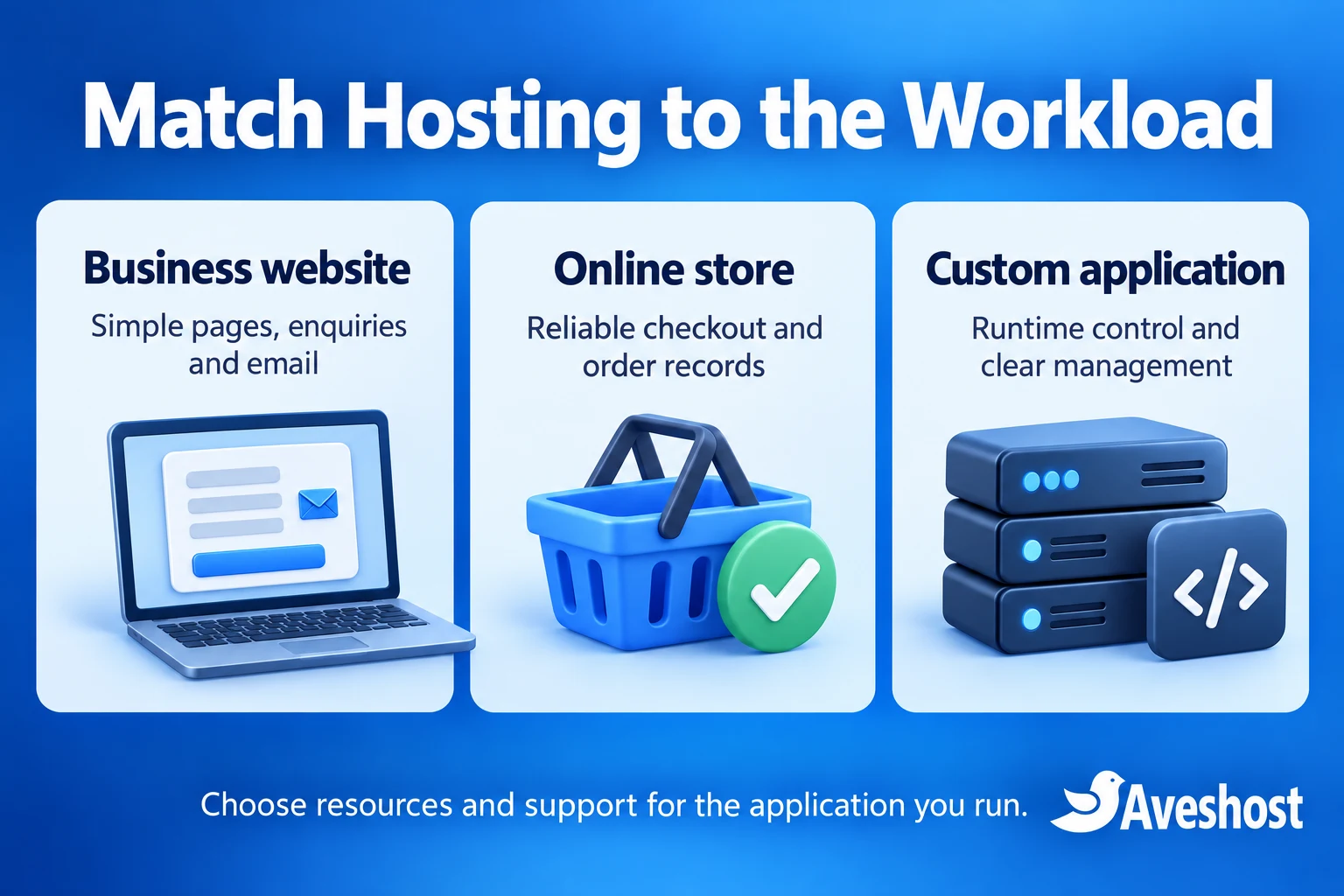
Choose according to the website you run
For a small Ghanaian business website, prioritise clear billing, dependable contact support, suitable WordPress resources and a working enquiry process. Shared hosting can be a practical starting point when the actual site fits the plan’s limits.
For a WooCommerce store, give more weight to checkout performance, database capacity, current order backups and payment integration. Compare uncached transactions and the recovery plan, rather than choosing solely on a public homepage speed test.
For a diaspora-facing brand, test the website from Ghana and the countries where customers buy. Review CDN use, media size and the application server’s responsiveness. The provider’s registered office is only one factor in that cross-border customer experience.
For a custom application, start with runtime and operational requirements. Your developer should specify the needed database, processes, deployment method, monitoring and recovery. Choose a service that supports the workload and a management arrangement the team can sustain.
For an organisation with strict procurement or data requirements, compare written service terms, storage locations, access arrangements and responsibilities. Complete that review before uploading sensitive records. A familiar brand or a local server does not replace the required evidence.
Compare Aveshost options against your requirements
Use Aveshost’s web hosting plans to compare the account resources and features for a business site. Read the selected plan’s limits and backup schedule. Choose the package for the workload you have, with a practical route to expand as demand grows.
Review WordPress hosting, managed WordPress hosting and WooCommerce hosting according to the application and the maintenance you need. Confirm the difference in included management rather than treating every WordPress-labelled service as identical.
For a server-based application, compare self-managed VPS hosting with fully managed VPS hosting. If an Accra location is a requirement, discuss the Ghana server products specifically and confirm their management scope.
Before ordering, collect the plan, region, term, renewal amount, essential licences, backup arrangement and support scope in one comparison. Reject an option that cannot meet a required capability before weighing optional benefits or discounts.
To choose with our team, contact Aveshost with the website type, current platform, expected users, audience locations and the management work you need. We can help you compare the relevant options and plan a suitable setup for your business.
Frequently asked questions
How should I compare Ghanaian vs international web hosting?
Compare the actual plan’s application support, resources, location, full renewal cost, support scope, backups and exit process. Use the same requirements for every option.
Does a Ghanaian hosting provider always keep servers in Ghana?
The business location and server location are separate. Confirm the region of the selected hosting product, database and backups before ordering.
Will hosting closer to Ghana always make my site faster?
Network proximity can help latency, but routing, server response, application work and caching also matter. Test the pages your users need from relevant locations and networks.
Does a CDN remove the need to evaluate the hosting server?
No. Cached content can be delivered closer to visitors, but uncached and personalised application requests still need suitable backend performance and correct cache rules.
What costs should I compare beyond the first invoice?
Include renewals, domain charges, required mailboxes, licences, management, backup options and any relevant usage charges. Confirm the billing period and final GHS cost for the selected payment route.
Is local hosting enough for data protection compliance?
No. Review collection purpose, access, processing arrangements, storage locations and the organisation’s applicable obligations. Local server placement does not complete those responsibilities.
Should every business choose a VPS?
No. Use a VPS when its control or resources fit the application and the team has appropriate administration or management. Shared hosting can suit a website that fits its limits.
Does managed hosting include fixing all custom code?
Check the written scope. Infrastructure management, application maintenance, custom development and third-party integration support are different responsibilities.
Must I transfer my domain to move my website?
Not always. You can often connect an existing domain to different hosting through suitable DNS changes. Plan website, database, email and DNS work separately.
Can Aveshost help choose the right hosting?
Yes. Share the application, audience locations, expected demand, storage needs and required management. Our team can help compare the relevant hosting options and migration requirements.