

The world of SEO is always buzzing with new tools and techniques. If you’ve been following recent trends, you’ll notice that ChatGPT for SEO has quickly become a game-changer, as Artificial Intelligence (AI) moves from a futuristic concept to an indispensable part of digital marketing. And at the forefront of this AI revolution, especially for SEO professionals and content marketers, is ChatGPT.
But here’s the burning question: can you really use ChatGPT for SEO? And more importantly, how can you leverage it effectively to boost your search rankings in 2026 and beyond?
The answer is a resounding YES! However, it’s not about letting ChatGPT do all the work. It’s about using it as a super-powered assistant, a co-pilot that can significantly amplify your efforts. Think of it as having an incredibly fast, always-on intern who can brainstorm, research, draft, and refine content at your command.
Table of Contents
In this comprehensive guide, we’re going to dive deep into how you can harness the power of ChatGPT across a wide range of SEO tasks. We’ll explore practical prompts, smart strategies, and essential tips to integrate this AI marvel into your SEO workflow—helping you work more efficiently and make your campaigns more impactful.
Let’s get started and unlock the full potential of AI-powered SEO!
Understanding ChatGPT’s Role in Modern SEO
Before we jump into the “how-to,” it’s crucial to set realistic expectations. ChatGPT, while incredibly powerful, is a language model. It excels at understanding and generating human-like text. This makes it phenomenal for tasks related to content creation, analysis, and ideation.
What it isn’t (yet) is a substitute for:
- Human creativity and strategic thinking: It can assist, but the ultimate vision and strategy still come from you.
- Real-time data: ChatGPT’s knowledge cutoff means it won’t have access to the absolute latest market trends or competitive data in real-time.
- E-A-T (Expertise, Authoritativeness, Trustworthiness): While it can help produce content, the inherent E-A-T comes from your brand, your subject matter experts, and your unique insights.
Think of ChatGPT as a force multiplier. It automates the tedious, speeds up the slow, and helps you overcome writer’s block, allowing you to focus on the higher-level strategic work that truly moves the needle.
Core Areas Where ChatGPT Shines in SEO
Let’s break down the key areas where ChatGPT can become your SEO secret weapon:
- Keyword Research & Analysis
- Content Creation & Optimization
- On-Page SEO Elements
- Technical SEO Assistance
- Local SEO Support
- Reporting & Analysis
- Idea Generation & Brainstorming
Now, let’s explore each area with specific prompts and strategies!
Area 1: Keyword Research & Analysis
Keyword research is the bedrock of SEO. While ChatGPT can’t replace dedicated keyword tools (like Ahrefs, Semrush, or Google Keyword Planner) for exact volume and difficulty metrics, it’s fantastic for generating ideas, clustering keywords, and understanding user intent.
Prompts & Strategies:
Brainstorming Seed Keywords
Seed keywords are the starting point of your SEO research. They represent the core topics people associate with your niche, product, or service.
Use these prompts to uncover broad keyword ideas:
- “Give me a list of 20 seed keywords related to [your niche/product/service].”
Ideal for identifying high-level topics to build your website or blog around.
Example: Give me a list of 20 seed keywords related to wireless headphones.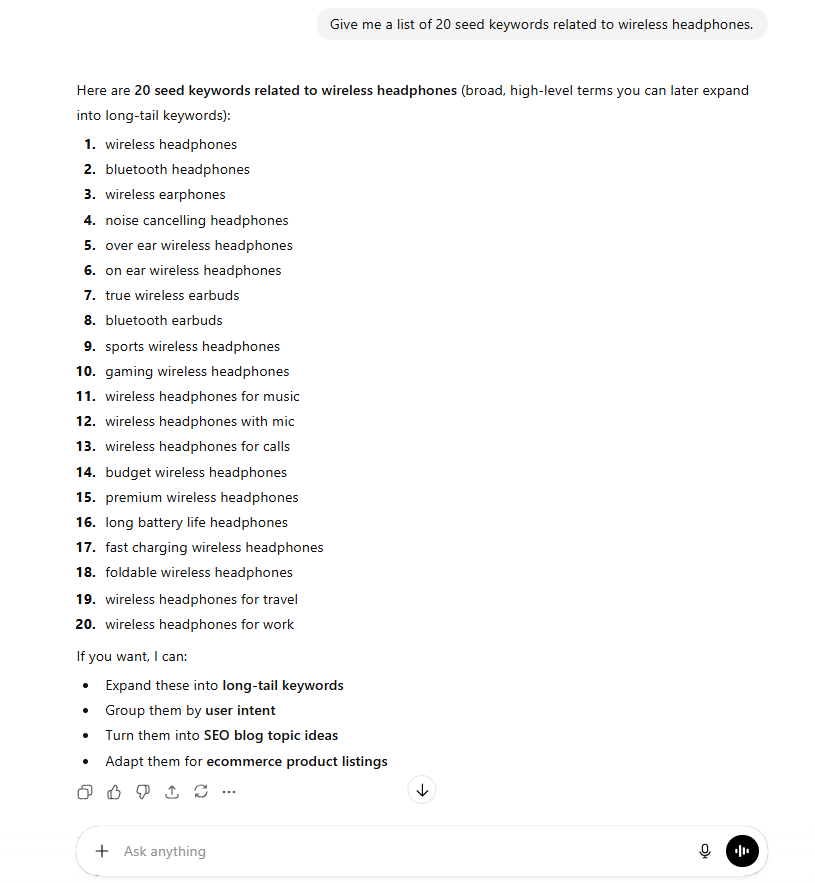
- “What are common problems people try to solve when searching for [your niche/product/service] online?”
Great for discovering problem-based keywords and pain-point searches.
Example: What are common problems people try to solve when searching for wireless headphones online?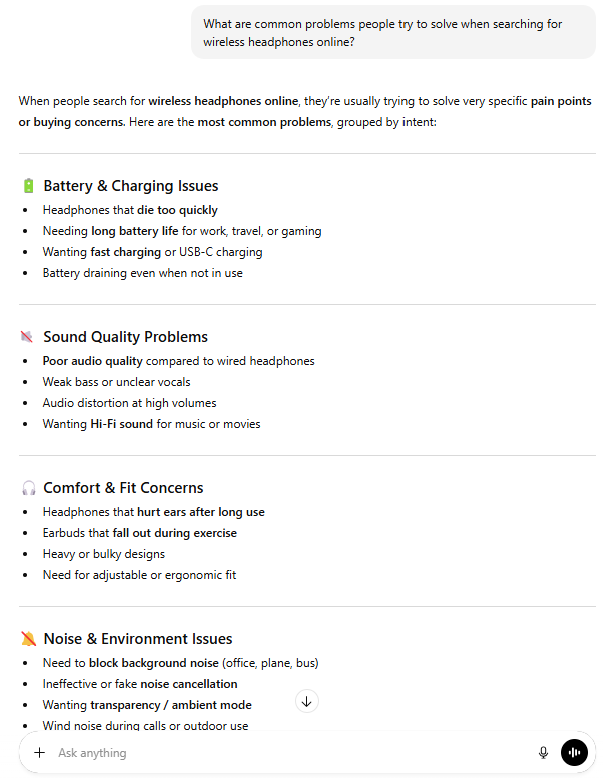
- “Generate 15 popular search queries for someone interested in [topic].”
Helps you understand how real users phrase their searches.
Example: Generate 15 popular search queries for someone interested in wireless headphones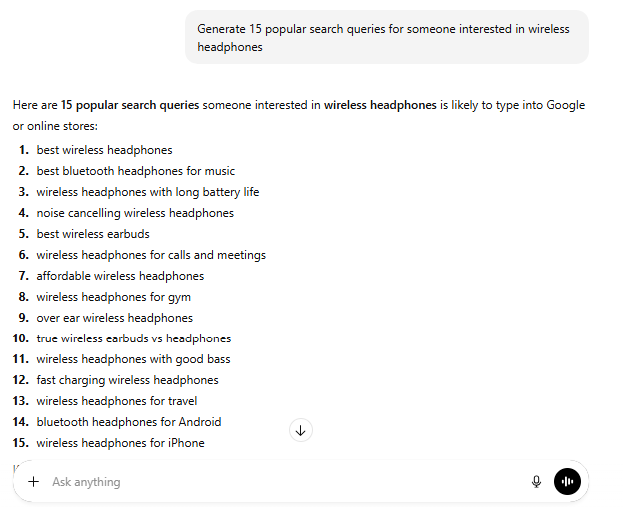
Expanding Keyword Lists (Long-Tail & LSI Keywords)
Once you have seed keywords, expand them into long-tail and semantically related keywords to capture more targeted traffic and rank for lower-competition searches.
Try these prompts:
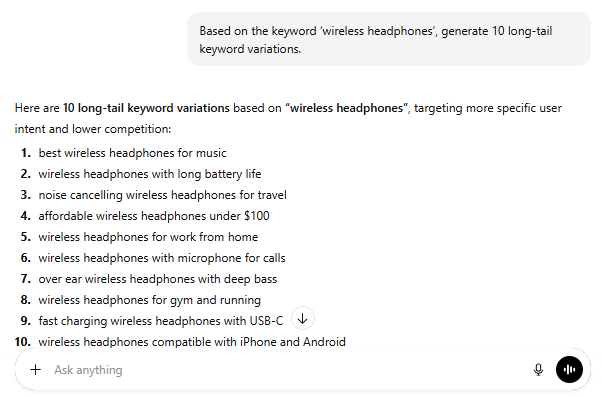
- “Based on the keyword ‘[seed keyword]’, generate 10 long-tail keyword variations.”
Useful for blog titles, landing pages, and FAQs.
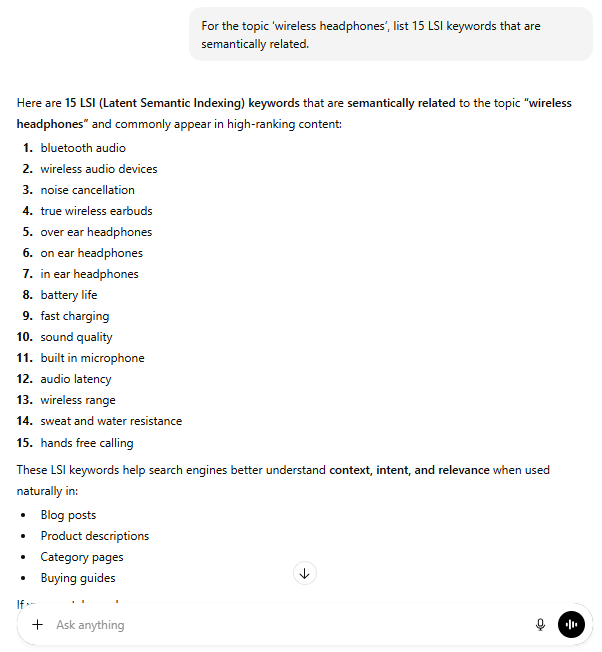
Example: Based on the keyword ‘wireless headphones’, generate 10 long-tail keyword variations.- “For the topic ‘[topic]’, list 15 Latent Semantic Indexing (LSI) keywords that are semantically related.”
Helps search engines better understand your content’s context.
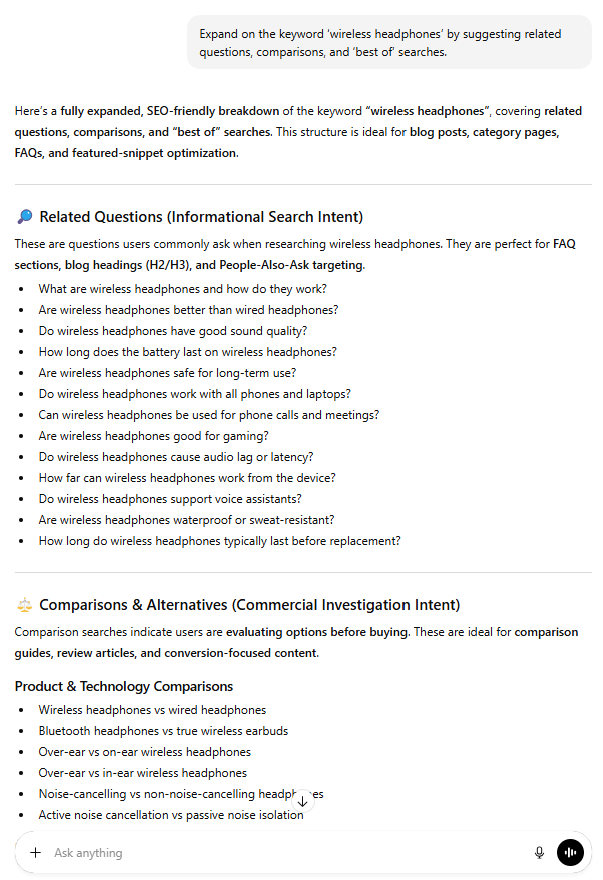
Example: For the topic ‘wireless headphones’, list 15 LSI keywords that are semantically related.- “Expand on the keyword ‘[keyword]’ by suggesting related questions, comparisons, and ‘best of’ searches.”
Perfect for featured snippets, comparison articles, and buyer-intent content.
Example: Expand on the keyword ‘wireless headphones’ by suggesting related questions, comparisons, and ‘best of’ searches.
Understanding Search & User Intent
Matching content to user intent is critical for ranking and conversions. These prompts help you determine why users are searching.
- “What are the typical user intents (informational, navigational, transactional, commercial investigation) behind the keyword ‘[keyword]’?”
Helps you decide whether to write a blog post, landing page, or product page.
Example: What are the typical user intents behind the keyword ‘wireless headphones’?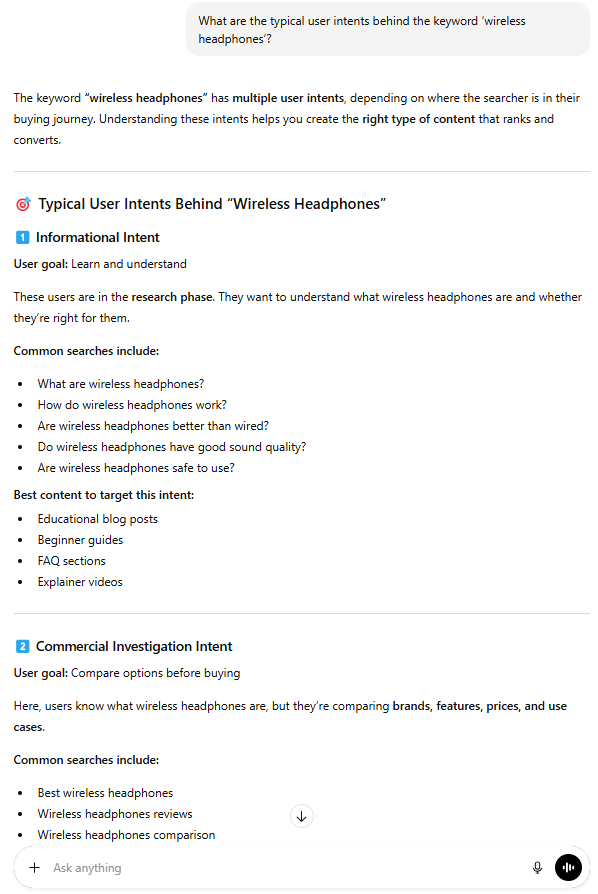
- “If someone searches for ‘[keyword]’, what are they likely trying to learn, compare, or purchase?”
Improves content relevance and on-page SEO optimization.
Example: If someone searches for ‘wireless headphones’, what are they likely trying to achieve?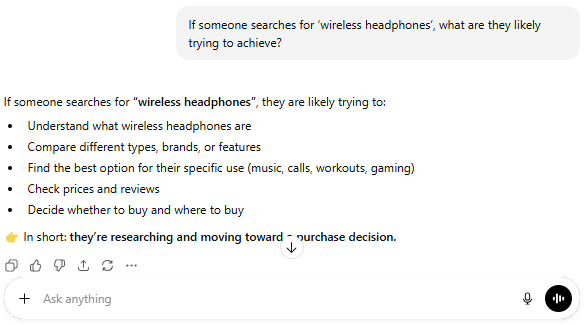
Keyword Clustering & Content Structuring
Keyword clustering allows you to group related keywords into topic clusters, improving topical authority and internal linking.
Use these prompts:
- “Group the following keywords into logical clusters based on semantic relevance and user intent: [list of keywords].”
Ideal for organizing existing keyword lists.
Example: Group the following keywords into clusters: wireless headphones, noise cancelling headphones, cheap wireless headphones, wireless headphones for gaming, wireless vs wired headphones.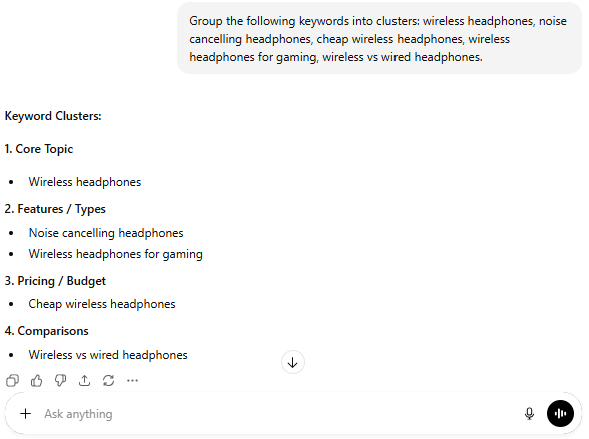
- “Given these 20 keywords for a blog, suggest 5 main topic clusters and assign keywords to each cluster.”
Perfect for building pillar pages and supporting articles.
Example: Given these 20 keywords for an eCommerce blog, suggest 5 topic clusters and assign keywords.
Tip: Always validate AI-generated keyword ideas with professional SEO tools like Google Keyword Planner, Ahrefs or SEMrush.
🔹 ChatGPT is best for ideation, structure, and intent analysis.
🔹 Keyword tools provide real search volume, keyword difficulty, and competition data.
Used together, this approach helps you build data-driven, search-optimized content that actually ranks
Area 2: Content Creation & Optimization
This is where ChatGPT delivers the fastest and most visible results. It helps streamline the entire content lifecycle—from ideation and outlining to drafting, rewriting, and optimization—allowing you to produce high-quality SEO content much faster.
Prompts & Strategies
Content Outlines & Structure
Use ChatGPT to build clear, search-friendly structures that improve readability and topical coverage.
- “Create a detailed blog post outline for the keyword ‘[main keyword]’ with 5–7 subheadings and relevant topics for each.”
Perfect for structuring SEO-friendly articles before writing.
Example: Create a detailed blog post outline for the keyword wireless headphones with 5–7 subheadings. - “Generate an outline for an article titled ‘[article title]’ focusing on comprehensive and actionable advice.”
Perfect for how-to guides and educational content.
Example: Generate an outline for an article titled How to Choose the Right Wireless Headphones. - “Suggest a logical flow for an evergreen content piece about [topic], including an introduction, main sections, and conclusion.”
Perfect for long-term ranking content and pillar pages.
Example: Suggest a logical flow for an evergreen article about wireless headphone buying guides.
Drafting Content Sections
- “Write an introductory paragraph for a blog post about ‘[topic]’ that hooks the reader and clearly states the article’s purpose.”
Perfect for engaging readers and reducing bounce rate.
Example: Write an introductory paragraph for a blog post about wireless headphones. - “Expand on the heading ‘Benefits of [product/feature]’ with 3–4 detailed paragraphs, focusing on [target audience].”
Perfect for feature explanations and product pages.
Example: Expand on the heading Benefits of wireless headphones for remote workers. - “Draft a conclusion for an article on ‘[topic]’ that summarizes key points and includes a call to action.”
Perfect for driving conversions and next steps.
Example: Draft a conclusion for an article on buying wireless headphones online. - “Generate 5 unique selling propositions (USPs) for [product/service] that can be used in landing page copy.”
Perfect for marketing pages and product highlights.
Example: Generate 5 USPs for wireless headphones.
Content Rewriting & Improvement
- “Rewrite the following paragraph to be more engaging and SEO-friendly, targeting the keyword ‘[keyword]’.”
Perfect for refreshing old or underperforming content.
Example: Rewrite this paragraph to be more SEO-friendly for wireless headphones. - “Improve the readability of this section by simplifying sentences and using active voice.”
Perfect for improving UX and content clarity.
Example: Improve the readability of this product description. - “Adapt the following text to a [specific tone of voice].”
Perfect for matching brand voice and audience expectations.
Example: Adapt this text to a friendly and conversational tone.
Creating FAQs
- “Generate 10 frequently asked questions (FAQs) about ‘[topic]’ that potential customers might have.”
Perfect for FAQ sections and featured snippet targeting.
Example: Generate 10 FAQs about wireless headphones. - “Answer the following question in a concise and helpful manner: ‘[question]’.”
Perfect for short-form answers and support content.
Example: Answer the question: Are wireless headphones good for calls?
Content Brief Generation
- “Create a content brief for a blog post targeting ‘[main keyword]’ including audience, word count, subtopics, and internal linking ideas.”
Perfect for guiding writers and maintaining content consistency.
Example: Create a content brief targeting wireless headphones.
Tip: Always fact-check and refine content generated by ChatGPT. Add your unique voice, insights, and examples to ensure it meets your brand’s quality standards and genuinely helps your audience. AI-generated content is a fantastic first draft, not a final product.
Area 3: On-Page SEO Elements
Beyond the main body copy, ChatGPT can help you craft compelling and optimized on-page elements that draw clicks and improve relevance.
Prompts & Strategies
Meta Titles & Descriptions
- “Generate 5 compelling meta titles (under 60 characters) and 5 meta descriptions (under 160 characters) for a page about ‘[topic]’ targeting the keyword ‘[keyword]’.”
Perfect for improving click-through rate (CTR) from search results.
Example: Generate 5 meta titles and descriptions for a page about wireless headphones targeting wireless headphones.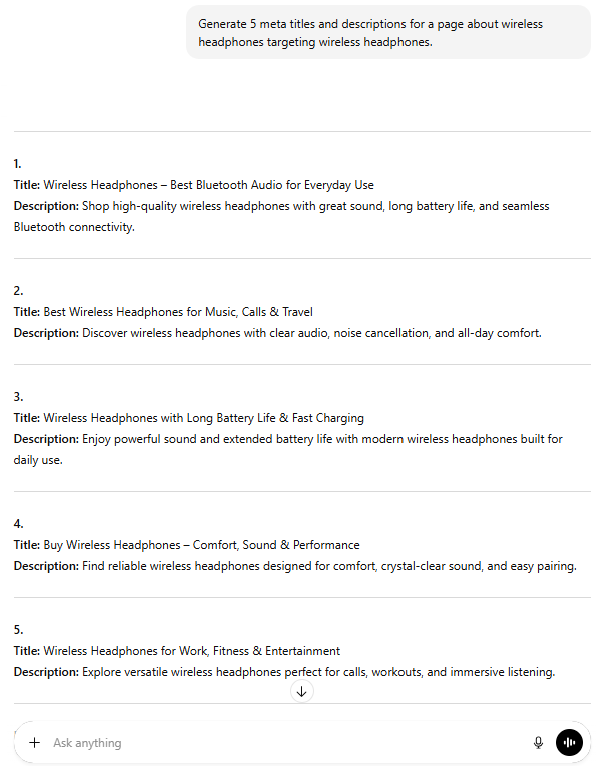
- “Craft a meta description for this article that encourages clicks: [article summary].”
Perfect for rewriting weak or missing meta descriptions.
Example: Craft a meta description for an article about how to choose wireless headphones.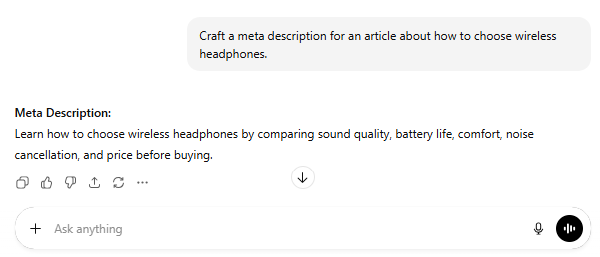
Header Tags (H1, H2, H3)
- “Suggest a compelling H1 title for a blog post about ‘[topic]’ that includes the keyword ‘[keyword]’.”
Perfect for optimizing page titles and on-page SEO.
Example: Suggest an H1 for a blog post about wireless headphones using the keyword wireless headphones.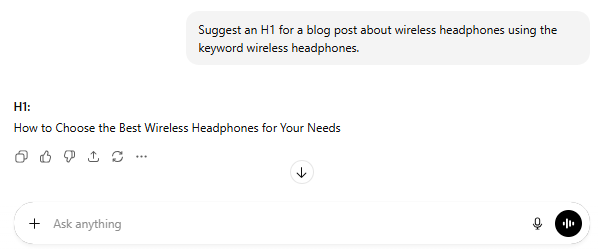
- “Based on this outline, propose clear and keyword-rich H2 and H3 headings: [outline].”
Perfect for structuring content and improving topical relevance.
Example: Propose H2 and H3 headings based on a wireless headphones buying guide outline.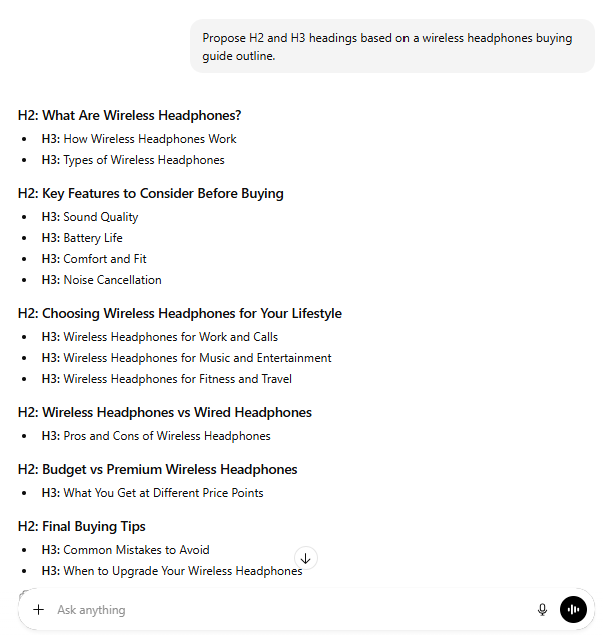
Internal Linking Ideas
- “Given this article about ‘[topic]’, suggest 3–5 relevant internal articles I can link to naturally.”
Perfect for improving internal linking and SEO authority.
Example: Given an article about wireless headphones, suggest internal pages to link to. - “Identify opportunities for internal linking within the following text, linking to pages about [related topic 1] and [related topic 2].”
Perfect for optimizing existing content without rewriting it.
Example: Identify internal links to noise cancelling headphones and cheap wireless headphones.
Image Alt Text
- “Generate descriptive and keyword-rich alt text for an image showing ‘[image description]’ for a page about ‘[topic]’.”
Perfect for image SEO and accessibility.
Example: Generate alt text for an image showing a person wearing wireless headphones. - “Write 3 variations of alt text for an image of [describe image] that includes the keyword [keyword].”
Perfect for optimizing multiple images on a page.
Example: Write 3 alt text variations for an image of wireless headphones on a desk using wireless headphones.
URL Slugs
- “Propose a concise and SEO-friendly URL slug for a blog post titled ‘[blog post title]’.”
Perfect for clean URLs and better rankings.
Example: Propose a URL slug for How to Choose the Best Wireless Headphones.
Area 4: Technical SEO Assistance
While ChatGPT can’t directly crawl your site or fix broken code, it can provide explanations, best practices, and even draft basic code snippets for common technical SEO tasks.
Prompts & Strategies:
- Understanding Technical Concepts:
- “Explain what a canonical tag is and why it’s important for SEO in simple terms.”
- “What is the difference between a 301 and a 302 redirect, and when should I use each?”
- “Describe the purpose of a robots.txt file and common directives it contains.”
- Schema Markup Generation (Basic):
- “Generate basic JSON-LD schema markup for a ‘[type of schema – e.g., Article, FAQPage, Product]’ for the following information: [provide relevant details like title, author, date, product name, price, reviews, questions/answers].”
- “Provide an example of LocalBusiness schema markup for a business named ‘[Business Name]’ located at ‘[Address]’ with phone number ‘[Phone Number]’ and website ‘[Website]’.”
- Regex for Google Search Console/Analytics:
- “Write a regex expression to filter URLs in Google Analytics that contain either ‘blog’ or ‘article’ in the path.”
- “Create a regex pattern to exclude all subdomains except ‘shop.example.com’ from a Google Search Console query.”
- htaccess Rules (Basic):
- “Generate an .htaccess rule to redirect all HTTP traffic to HTTPS for my domain example.com.”
- “Write an .htaccess rule for a 301 redirect from ‘old-page.html’ to ‘new-page.html’.”
Warning: Always TEST any code (schema, regex, .htaccess rules) generated by ChatGPT in a staging environment or with appropriate validators before implementing it on a live site. Incorrect technical implementations can break your site or harm your SEO.
Area 5: Local SEO Support
Prompts & Strategies:
Google Business Profile Descriptions
- “Write a compelling and keyword-rich business description (under 750 characters) for a ‘[type of business]’ located in ‘[city, state]’ that specializes in ‘[unique selling points]’.”
Perfect for optimizing Google Business Profiles and improving local visibility.
Example: Write a compelling and keyword-rich business description (under 750 characters) for a waakye joint in Accra, Ghana specializing in authentic Ghanaian waakye and free Wi-Fi.
Local Content Ideas
- “Suggest 10 blog post ideas for a local business in ‘[city, state]’ that sells ‘[product/service]’, focusing on local events, landmarks, or community interests.”
Perfect for attracting local traffic and building community relevance.
Example: Suggest 10 blog ideas for a fitness center in Accra, Ghana.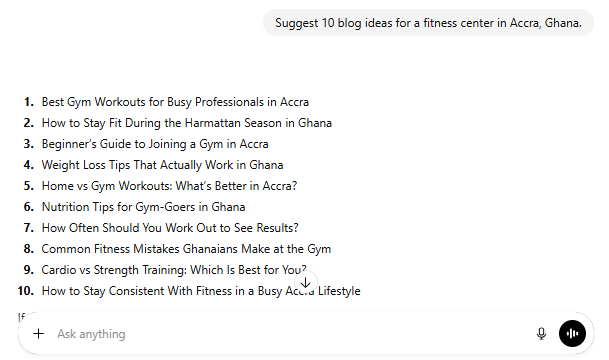
- “Generate content for a ‘things to do in [city]’ page, highlighting attractions relevant to a local tourism website.”
Perfect for local guides and tourism-focused SEO pages.
Example: Generate content for a things to do in Accra page, highlighting attractions relevant to a local tourism website.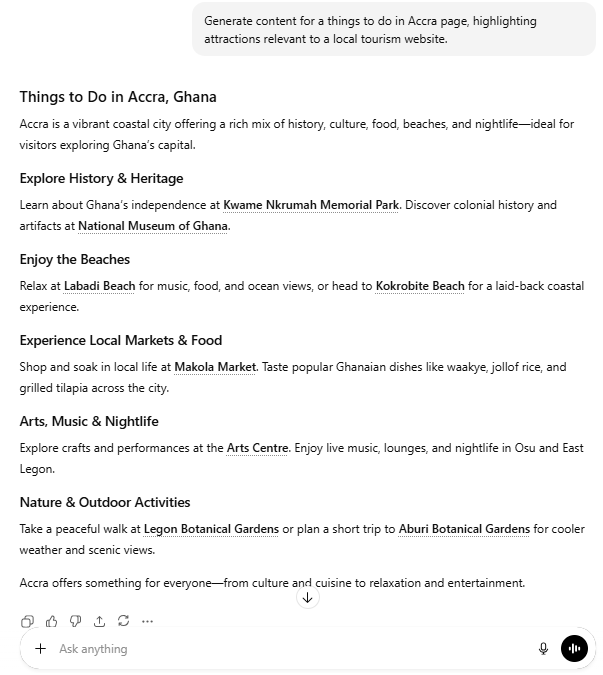
Review Response Generation
- “Draft a polite and professional response to a 3-star customer review for my ‘[type of business]’ mentioning ‘[specific feedback]’.”
Perfect for reputation management and customer trust.
Example: Draft a polite and professional response to a 3-star customer review for my restaurant mentioning slow service but good food. - “Write a thank-you response to a 5-star review for ‘[business name]’ praising ‘[specific aspect]’.”
Perfect for reinforcing positive customer relationships.
Example: Write a thank-you response to a 5-star review for ABC Salon praising friendly staff.
NAP (Name, Address, Phone) Consistency
- “Format my business information (Name: [Name], Address: [Address], Phone: [Phone]) consistently for use across local directories.”
Perfect for maintaining NAP consistency across citations and listings.
Example: Format my business information (ABC Electronics, Accra, +233 XXX XXX XXX) consistently for use across local directories.
Tip: Local SEO thrives on authenticity. Ensure that any AI-generated content still reflects the true voice and offerings of your local business.
Area 6: Reporting & Analysis
While ChatGPT can’t directly interpret live data from Google Analytics or Search Console (due to its knowledge cutoff), it can help you structure reports, explain metrics, and summarize findings.
Prompts & Strategies
Explaining Metrics
- “Explain the difference between ‘Impressions’ and ‘Clicks’ in Google Search Console.”
Perfect for helping clients or stakeholders understand SEO reporting metrics. - “What does ‘Bounce Rate’ mean in Google Analytics, and what’s considered a good bounce rate for a blog?”
Perfect for clarifying analytics performance and engagement metrics.
Drafting Report Summaries
- “Write an executive summary for an SEO performance report based on the following key findings: [list of bullet points].”
Perfect for client reports and management-level SEO updates.
Example: Write an executive summary for an SEO performance report based on the following key findings: Organic traffic up 15%, Keyword ‘wireless headphones’ ranked #1, Conversion rate dropped by 2% on mobile. - “Based on these numbers [provide some data], explain the impact of our recent content updates on organic traffic.”
Perfect for linking SEO actions to measurable results.
Example: Based on these numbers (organic sessions increased from 20,000 to 24,000, average position improved from 9 to 6), explain the impact of our recent content updates on organic traffic.
Structuring Reports
- “Generate an outline for a monthly SEO performance report that includes key metrics, achievements, challenges, and next steps.”
Perfect for creating repeatable and professional SEO reports. - “Suggest sections for an SEO audit report for a small e-commerce website.”
Perfect for technical reviews and SEO audits.
Tip: Always input your actual data points for ChatGPT to process. It excels at summarizing and explaining your data, not fetching it.
Area 7: Idea Generation & Brainstorming
Beyond specific tasks, ChatGPT is an incredible brainstorming partner. Stuck for ideas? Need a fresh perspective? ChatGPT can help.
Prompts & Strategies:
Content Calendar Ideas:
- “Generate 20 content ideas for a blog focused on [niche] for the next quarter, including a mix of evergreen and seasonal topics.”
Perfect for planning long-term content and staying consistent.
Example: Generate 20 content ideas for a blog focused on wireless headphones for the next quarter, including a mix of evergreen and seasonal topics. - “Suggest a content calendar theme for [month/quarter] that aligns with current trends in [industry].”
Perfect for aligning content with trends and campaigns.
Example: Suggest a content calendar theme for Q2 that aligns with current trends in the consumer electronics industry.
Marketing Campaign Angles
- “Brainstorm unique marketing angles for promoting a new [product/service] that focuses on [specific benefit/audience].”
Perfect for campaign messaging and product launches.
Example: Brainstorm unique marketing angles for promoting a new wireless headphone model that focuses on remote workers. - “What are some creative ways to leverage user-generated content for SEO in the [industry] niche?”
Perfect for content differentiation and trust-building.
Example: What are some creative ways to leverage user-generated content for SEO in the consumer electronics niche?
Website Improvement Ideas
- “Suggest 5 ways to improve the user experience (UX) on an e-commerce website selling [product type].”
Perfect for CRO and on-site optimization ideas.
Example: Suggest 5 ways to improve the user experience on an e-commerce website selling wireless headphones. - “What are common reasons for high bounce rates on blog posts, and how can I address them?”
Perfect for diagnosing engagement issues and improving performance.
Suggested Reading: The Power of Artificial Intelligence: An Inside Look at ChatGPT’s Language Capabilities
Best Practices for Using ChatGPT for SEO in 2026
1. Be Specific with Your Prompts
The “garbage in, garbage out” rule is more relevant than ever. In 2026, the most successful SEOs use Persona-Based Prompting to give the AI a clear role. Instead of a generic request, tell the AI who it is and who it is writing for.
- Bad Prompt: “Write about SEO.”
- Good Prompt: “Act as a Senior Technical SEO Consultant with 15 years of experience. Write an engaging, 200-word introduction for a blog post titled ‘Mastering Technical SEO for Beginners’ targeting non-technical small business owners. Focus on the ‘why’ before the ‘how,’ include the keyword ‘website health,’ and use a supportive, expert tone.”
2. Iterate and Refine
Think of your first prompt as the start of a conversation, not a final order. If the output is too generic, “nudge” the AI.
- Prompting Tip: Use “Chain of Thought” prompting. Ask the AI to first outline the logic of an article, then write the headers, and finally fill in the text. This prevents the “rambling” effect common in long AI drafts.
3. Provide Examples (Few-Shot Prompting)
If you have a specific brand voice—perhaps you’re witty and irreverent, or academic and precise—feed ChatGPT 2–3 examples of your past work.
- Action: Say, “Here are three examples of my writing style. Analyze the tone, sentence structure, and vocabulary, then write a new section on [Topic] using this exact style.”
4. Fact-Check Everything
“AI Hallucinations” remain a challenge. In 2026, search engines like Google are hyper-sensitive to factual accuracy as part of their Trustworthiness signal.
- Strategy: Never publish a statistic or historical fact generated by AI without verifying it through a primary source. Use the “Search” feature within ChatGPT (Pro versions) to verify data in real-time, or cross-reference with tools like Google Scholar.
5. Inject Human Expertise & E-E-A-T
Google’s E-E-A-T (Experience, Expertise, Authoritativeness, and Trustworthiness) guidelines are the “final boss” of SEO. ChatGPT lacks one thing: Experience. It hasn’t “felt” anything or “tried” a product.
- How to fix it: Add “First-Person Proof.” If you’re writing a review, add your own photos and specific anecdotes (e.g., “When I tested this at 10°C, the battery lasted 4 hours”). This “Experience” is what separates top-ranking content from AI-generated noise.
6. Don’t Over-Optimize
In 2026, search algorithms prioritize Semantic Depth over keyword frequency. If you force ChatGPT to include a keyword 20 times, the text will lose its “Natural Language” flow, which can trigger spam filters.
- Focus: Ask the AI to cover a “Topic Cluster” rather than a single keyword. This ensures you’re answering the user’s entire query, not just hitting a word count.
7. Ethical Considerations & Transparency
As AI content becomes more common, Transparency builds brand loyalty. If a large portion of a guide was AI-assisted, a small disclaimer (e.g., “Research assisted by AI; human-verified for accuracy”) can actually increase user trust in some niches.
The Future of SEO with AI
As we move through 2026, the integration of AI into SEO workflows will only deepen. We are shifting from “Search Engine Optimization” to “Generative Engine Optimization” (GEO). Tools like ChatGPT are becoming sophisticated enough to offer real-time data integration and a nuanced understanding of user intent.
The SEO professionals who will thrive are those who embrace AI as a powerful ally. By using ChatGPT to handle the heavy lifting—like schema markup generation, keyword clustering, and meta-tag drafting—you free up your brain for the high-level strategy that AI can’t touch.
Suggested Reading:
- The Future of Web Hosting: Trends & Innovations you Should Know
- How to Make Your WordPress Website Load Under 2 Seconds
- How to Get a Free Domain Name – Here’s How (No Tricks)
- How to Fix DNS_PROBE_FINISHED_NXDOMAIN Error (10 easy ways to fix it)
- What Is WordPress? Beginner’s Guide Explained
- What is VPS Hosting? Complete Introduction to VPS Hosting
How to Use ChatGPT for SEO in 2026 FAQs
Can ChatGPT really be used effectively for SEO in 2026?
Yes, ChatGPT can be a powerful assistant for SEO by amplifying efforts in content creation, keyword research, and optimization, though it should complement human strategy rather than replace it.
How do I avoid my content sounding “robotic” or like AI?
To humanize your text, vary your sentence length and structure. AI often produces very balanced, medium-length sentences. Add personal anecdotes, specific case studies, and original data that a machine wouldn’t know. Also, avoid overusing typical AI transition words like “In conclusion” or “Furthermore.”
How can ChatGPT assist with keyword research and analysis?
ChatGPT helps brainstorm seed keywords, generate long-tail and LSI keyword variations, understand user intent, and cluster keywords for content structuring, though it should be paired with dedicated keyword tools for metrics.
What are some practical prompts for brainstorming seed keywords?
Prompts like ‘Give me a list of 20 seed keywords related to [your niche]’ or ‘What are common problems people try to solve when searching for [your product] online?’ can uncover broad keyword ideas.
How does ChatGPT help with expanding keyword lists?
It can generate long-tail keyword variations, list semantically related LSI keywords, and suggest related questions, comparisons, and ‘best of’ searches based on seed keywords.
Why is understanding user intent important, and how can ChatGPT help?
Matching content to user intent (informational, navigational, transactional, etc.) is key for rankings and conversions. ChatGPT can analyze keywords to determine likely user goals and intents.
What core areas of SEO can ChatGPT support?
ChatGPT can assist with keyword research, content creation and optimization, on-page SEO elements, technical SEO, local SEO, reporting, analysis, and idea generation.
Is ChatGPT a substitute for human creativity in SEO?
No, ChatGPT acts as a force multiplier to automate tedious tasks and speed up processes, but human creativity and strategic thinking remain essential for vision and high-level strategy.
How can ChatGPT aid in content structuring and keyword clustering?
By grouping related keywords into topic clusters, ChatGPT helps improve topical authority and internal linking, allowing for more organized and effective content planning.
What should SEO professionals keep in mind when using ChatGPT in 2026?
Use ChatGPT as a co-pilot to enhance efficiency, but always verify its outputs with real-time data and tools, and ensure content reflects your brand’s unique expertise and E-A-T.
Can I use ChatGPT to fix technical SEO issues?
ChatGPT can’t crawl your site to find errors, but it can help you solve them. You can use it to generate Schema markup, write complex Regex for Google Search Console, or draft .htaccess redirect rules. Always test any code in a staging environment before going live!
Will using ChatGPT to write my content get my site penalized by Google?
No, Google does not penalize content solely because it was written by AI. Their guidelines focus on quality and helpfulness. As long as your content is accurate, provides value, and includes human oversight (E-E-A-T), it can rank well. However, publishing “thin” or unedited AI text that offers no new information is a risky strategy.