To turn your Instagram business into an online store in Ghana, keep Instagram as your visual discovery channel and connect it to a self-hosted e-commerce website where customers can browse live stock, select sizes or options, calculate delivery fees by zone, and pay through a verified Mobile Money or card checkout. Instead of answering repetitive direct messages to confirm whether an item from an older Reel is still available, you send shoppers straight from your bio link or Story sticker to a product page that closes the order automatically.
Instagram is one of the strongest places in Ghana to launch a fashion label, beauty brand, electronics shop, bakery, or home decor business. Reels, carousels, and Stories let buyers see your products in action before they spend a cedi. However, as daily enquiries grow, relying on direct messages and manual Mobile Money transfers creates bottlenecks: older posts get buried in your grid, two buyers try to pay for the same last piece, and staff spend hours chasing delivery landmarks and checking payment screenshots.
Key takeaways for Ghanaian Instagram sellers: First, Meta restricts supported markets for Instagram Shopping and native in-app checkout to specific countries, and Ghana is not on that list—so a dedicated website gives you full catalogue and checkout control. Second, keeping Instagram for discovery while your website handles stock deduction, delivery pricing, and payment verification lets you take orders around the clock. Third, a connected payment gateway confirms Mobile Money and card payments via server webhooks before marking an order paid. Fourth, every website order builds a searchable customer record that you own independently of social media algorithms.
Table of Contents
Why Ghanaian Sellers Outgrow Instagram DMs
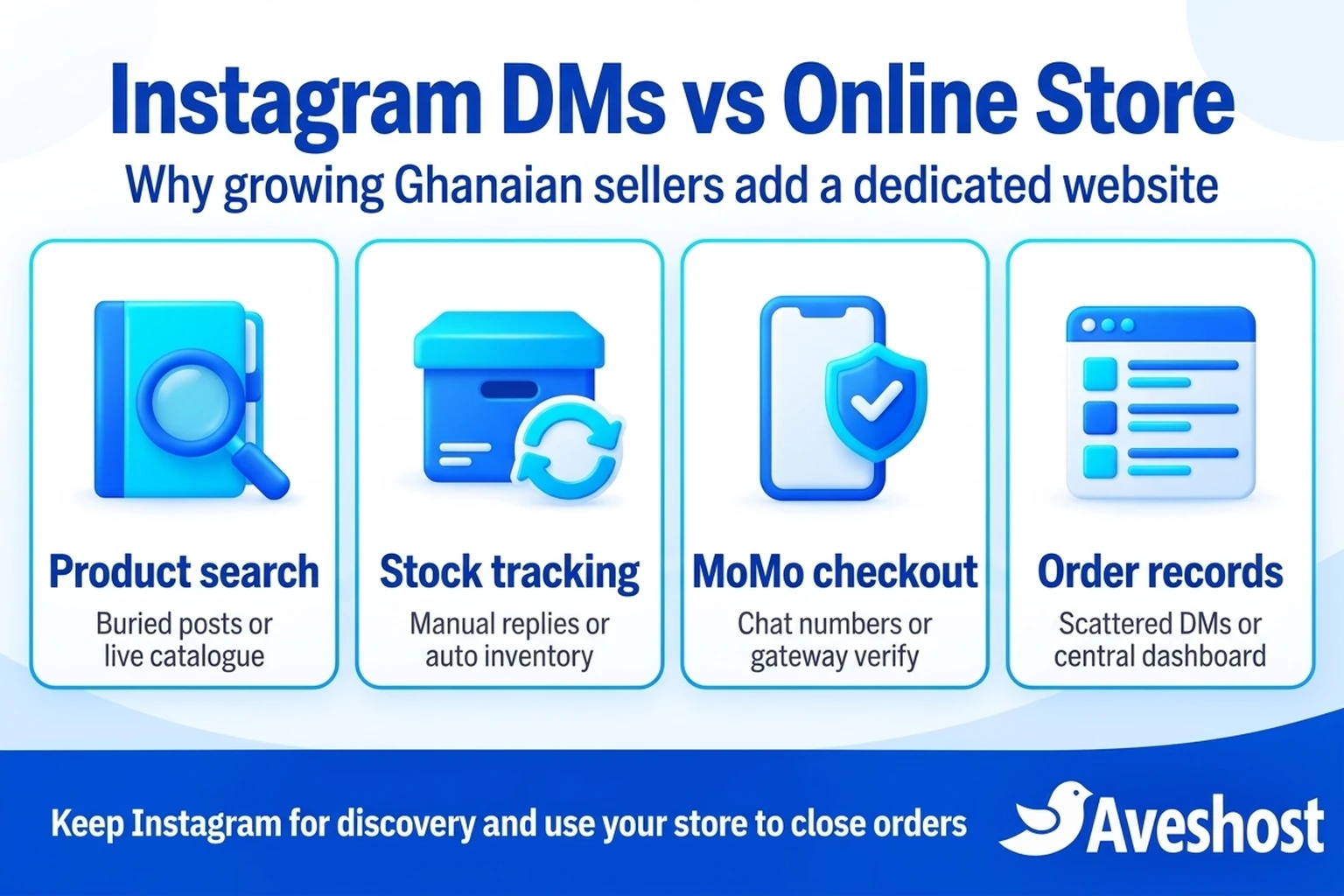
Selling through Instagram direct messages works well when you handle three or four orders a week. A buyer sends a screenshot of a dress, pair of sneakers, or skincare bundle, asks for the price, confirms their size, and sends money to your number. The trouble begins when a Reel gains traction or a seasonal promotion brings dozens of enquiries at the same time.
First, an Instagram grid is a chronological feed rather than a searchable product catalogue. When a new follower discovers your page, they cannot filter your posts by size, colour, price range, or what is currently in stock. They have to scroll past dozens of videos and send a message asking, “Is this still available?” If you are busy packing parcels or asleep, that buyer often moves on before you reply.
Second, manual chat selling creates inventory collisions. When you have only two units of a popular item left and five shoppers ask for payment details in your DMs (or after moving the chat to WhatsApp), two people can transfer Mobile Money at the same time for the final unit. Refunding disappointed customers costs transaction fees and damages trust.
Third, manual DM selling scatters your order history across chat threads, voice notes, and phone contacts. When a rider asks for the buyer’s landmark or alternative phone number, scrolling back through screenshots wastes valuable dispatch time.
For example, if replying to availability questions, confirming sizes, quoting delivery rates, and cross-checking Mobile Money alerts takes 12 minutes per buyer, handling 20 enquiries in a day consumes four hours of staff time—even when half of those chats never convert into paid orders. Turning your Instagram business into an online store replaces that repetitive typing with a live product page that answers price, stock, and delivery questions instantly.
Why You Need Your Own Website Instead of Native Instagram Checkout
Many Ghanaian entrepreneurs first look inside the Instagram app for a built-in shop button or product tagging tool. According to Meta’s official Instagram Shopping availability documentation, native commerce surfaces and in-app checkout are restricted to businesses located in a specific set of approved markets. Because Ghana is not listed among those supported countries, Ghanaian accounts cannot enable native Instagram checkout.
Even where social platforms offer basic profile catalogues, you still need a checkout engine that works with how people actually pay and receive goods in Ghana. Local shoppers expect to pay in Ghana cedis (GH₵) using MTN MoMo, Telecel Cash, AT Money, or local bank cards, and they need delivery pricing that reflects Accra, Kumasi, Takoradi, Tamale, or intercity courier zones.
Building your own website on your own domain solves both problems. Using Instagram’s profile links and Story link stickers, you can place direct links to your store in your bio, on your daily Stories, and inside your DM automated greetings. When you turn your Instagram business into an online store on your own domain, you are not waiting for platform eligibility changes—you own the storefront, the checkout flow, and the customer database.
| Store Operation | Selling via Instagram DMs Only | Instagram Connected to Your Own Online Store |
|---|---|---|
| Product browsing | Scroll through chronological posts and Highlights | Search and filter by category, size, colour and availability |
| Price and stock visibility | Buyer often sends a DM to ask price or check stock | Live cedi prices and automatic stock counts on every item |
| Checkout and payment proof | Manual MoMo transfers and chat screenshots | Automated gateway checkout with webhook verification |
| Delivery calculation | Back-and-forth negotiation over location and rider cost | Pre-set delivery zones added automatically at checkout |
| After-hours sales | Orders pause until someone replies to messages | Customers complete and pay for orders at any hour |
| Customer records | Buried across Instagram DMs and phone contacts | Structured order dashboard with exportable buyer history |
What to Prepare Before You Build Your Online Store
The fastest way to convert an Instagram business into an online store is to organise your existing content into structured catalogue data before touching any website settings. Because you already post photos and videos on Instagram, you have most of the raw material ready.
Start by grouping your products into clear collections that match how buyers shop—for instance, “Ready-to-Wear Dresses”, “Office Two-Pieces”, and “Accessories”, or “Cleansers”, “Serums”, and “Complete Skincare Kits”. Avoid dumping fifty items into a single uncategorised page. Three to six top-level categories make mobile navigation effortless for shoppers tapping through from Instagram.
Next, standardise your product visuals and specifications. On Instagram, a 9:16 vertical Reel grabs attention, but inside an online store, consistent square (1:1) or portrait (4:5) product photos make category grids look clean and professional.
For every item in your initial launch catalogue, prepare four essential details: a descriptive product title (for example, Adowa Linen Midi Dress – Emerald Green rather than a short caption hook), your clear base price and any sale price in Ghana cedis (GH₵), exact variations and stock counts for each size, colour, or bundle option, and practical buyer notes such as fabric measurements, ingredients, or warranty terms so customers do not have to DM you before buying.
Finally, write down your store policies in plain language. A short Delivery and Returns section explaining dispatch cut-off times, exchange eligibility for wrong sizes, and how buyers can reach your team gives first-time website visitors the confidence to pay online.
Choose Your Domain Name, Store Platform and Hosting
When followers tap the link in your Instagram bio, the web address they see immediately signals whether your brand is an established business or a temporary side page. Registering a custom domain name that matches your Instagram handle—using either a .com or a local .com.gh / .gh extension through Aveshost Ghana domain registration or our standard domain search—keeps your branding consistent across social media, packaging, and receipts. You can review our guide to domain name prices in Ghana to compare registration and renewal terms.
For the store engine itself, WooCommerce on WordPress is the most practical choice for Ghanaian sellers turning an Instagram business into an online store with full ownership and local payment flexibility. Unlike closed monthly subscription builders that charge foreign-currency platform fees plus additional third-party payment gateway surcharges, WooCommerce is open-source software that runs on your hosting account and connects directly to Ghana Mobile Money gateways. For a detailed cost and feature breakdown, see our comparison of WooCommerce vs Shopify in Ghana.
Your hosting plan determines how quickly product galleries load when hundreds of Instagram viewers tap a Story link at the same time. At Aveshost, our WooCommerce hosting plans start at GH₵30 per month on the Woo Basic plan (which includes 15GB SSD storage, free SSL, staging tools, and daily scheduled backups; always check the current billing term, renewal rate, and included scope at checkout). Pairing your store with professional business email—such as [email protected]—also ensures order confirmations and gateway registration emails look credible. Learn more in our guide on how to create a business email address in Ghana.
Step-by-Step: How to Turn Your Instagram Business Into an Online Store
Once your domain and hosting are active, follow a structured launch sequence so your store is ready to accept real orders before you announce the link on Instagram.
Step 1: Install WordPress, SSL, and WooCommerce. Activate HTTPS so the padlock icon appears in mobile browsers, then run the WooCommerce setup wizard. Set your store location to Ghana and your currency to Ghanaian cedi (GH₵) so all catalogue prices, shipping rules, and receipts display in local currency.
Step 2: Choose a fast, mobile-first storefront theme. Nearly all traffic coming from Instagram arrives on smartphones inside Instagram’s in-app browser. Pick a lightweight WooCommerce theme with a sticky “Add to Cart” button, thumb-friendly size selectors, and compressed WebP product images so pages load smoothly on mobile data.
Step 3: Create variable products with stock tracking. Instead of creating separate products for every colour or size, use WooCommerce Variable Products. Enable stock management at the variation level so that when a customer buys the last Medium in black, that specific size automatically marks itself “Out of stock” while Large remains available.
Step 4: Streamline the checkout form. Instagram shoppers abandon long, complicated forms. Remove unnecessary fields such as company name, fax, or secondary street lines. Keep only what you and your dispatch rider actually need: full name, active Ghana phone number, email address, region/city, delivery zone, and a landmark or GhanaPostGPS code notes field.
Following these four steps turns your Instagram business into an online store that feels just as fast as tapping through Stories, while giving your back office structured order data.
Set Up Verified Mobile Money and Card Checkout
A genuine online store does not ask customers to copy a personal phone number at checkout and send a payment screenshot on Instagram. Screenshots can be edited, delayed SMS alerts can hold up dispatch, and manual reconciliation breaks down during busy sales.
Instead, connect a licensed payment gateway that supports Ghana Mobile Money (MTN MoMo, Telecel Cash, and AT Money) alongside Visa and Mastercard payments. Providers such as Paystack Ghana (which lists a 1.95% collection fee on local transactions) and Flutterwave Ghana (which lists 2% for Mobile Money and 2.6% for local card transactions, excluding applicable taxes) offer official WooCommerce gateway plugins.
Keep in mind that installing a payment plugin is only the technical half of turning your Instagram business into an online store: merchant approval, compliance verification, live API keys, and a configured webhook URL are required before your website can process live payments. When a shopper enters their wallet number at checkout and approves the PIN prompt on their phone, the gateway sends a cryptographically signed webhook to WooCommerce, which automatically updates the order status from Pending payment to Processing and reduces stock. For a complete setup walkthrough, read our guide on how to accept MTN MoMo payments on your website in Ghana and our overview of payment gateways in Ghana.
Configure Accra, Kumasi and Nationwide Delivery Zones
One of the biggest reasons Instagram chats drag on is delivery pricing. A buyer asks how much delivery costs to East Legon, Tema Community 25, Kasoa, or Adum in Kumasi, and the seller pauses to call a dispatch rider before quoting a total. By the time the delivery fee is confirmed, the buyer has gone offline.
In WooCommerce, you can eliminate that delay by configuring Shipping Zones with flat-rate delivery tiers that match how your courier partners charge. When the customer selects their area at checkout, the exact delivery fee is added to the cart total before they approve their Mobile Money payment.
You can also offer a “Store Pickup” or “Dispatch Rider Fee Paid on Delivery” option for locations outside standard zones, provided the checkout wording clearly states whether the customer is paying for the item plus delivery upfront or paying only for the item online and settling the rider fee upon arrival. Setting up automated WordPress SMS order alerts further reassures Instagram buyers by sending an instant text confirmation the moment their payment clears and another alert when their package is handed to the rider.
| Example Delivery Zone | Typical Coverage Areas | Checkout Configuration Approach |
|---|---|---|
| Zone 1: Central Accra | Osu, Cantonments, Airport, Dzorwulu, Labone, Ridge | Flat-rate same-day or next-day rider fee added at checkout |
| Zone 2: Greater Accra Extended | East Legon, Spintex, Achimota, Dansoman, Madina, Adenta | Standard metro flat rate calculated automatically in cart |
| Zone 3: Outer Greater Accra | Tema, Kasoa, Prampram, Amasaman, Dodowa | Outer-zone courier rate or scheduled dispatch day option |
| Zone 4: Regional Cities (VIP / STC / Courier) | Kumasi, Takoradi, Cape Coast, Tamale, Ho, Sunyani | Intercity parcel terminal rate or nationwide courier flat fee |
| Store / Studio Pickup | Customer collects from your shop or pickup point | Zero delivery fee with pickup hours and location instructions |
Connect Your Instagram Profile, Reels and Stories to Your Store
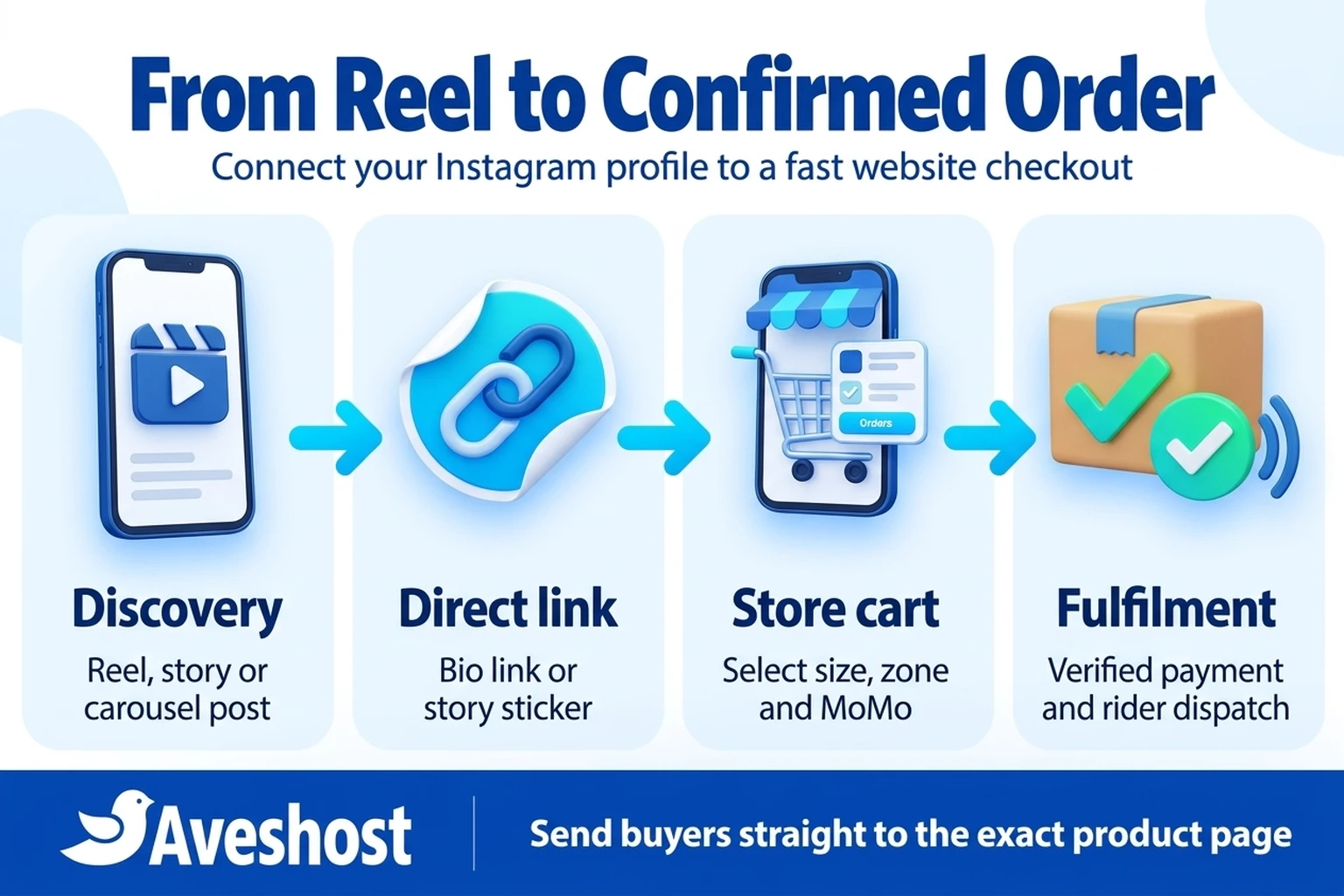
After you turn your Instagram business into an online store, your daily Instagram content should work as a bridge that moves followers from discovery to checkout in two taps. Do not make buyers hunt for products on your homepage when they saw a specific item in a Reel.
First, optimise your profile bio link. Place your primary store URL in your Instagram profile Links field, or link to a lightweight, fast-loading “Shop Our Instagram” landing page hosted on your own domain that features your latest drop, bestsellers, and order tracking.
Second, use Story Link stickers on every product Story. Whenever you post a Story showing new stock or restocked sizes, attach a Link sticker pointing directly to that specific product URL or collection page, and customise the sticker label to read Shop This Dress – GH₵250 or Order Online Here.
Third, update your Pinned Posts, Story Highlights, and DM saved replies. Pin a “How to Order on Our Website” post at the top of your grid and save a permanent Story Highlight showing a 15-second screen recording of how easy it is to select a size and pay with Mobile Money on your site. When followers still message you in DMs out of habit, send a warm quick reply with the direct product link so they can lock in their item before stock runs out.
If you also use WhatsApp for high-ticket or custom orders, see our guide on how a WhatsApp shop and your own website work together in Ghana so your Instagram, WhatsApp, and website channels reinforce each other without duplicating work.
What It Costs to Turn Your Instagram Business Into an Online Store
Budgeting to turn your Instagram business into an online store in Ghana is straightforward when you separate fixed annual infrastructure from per-order transaction fees. Unlike renting a physical boutique that requires a multi-year lease advance, an online store has predictable digital operating costs.
Consider an illustrative cedi example for the fixed foundation: hosting a store on Aveshost’s Woo Basic plan at GH₵30 per month works out to GH₵360 over twelve months, and adding an example domain registration of GH₵200 per year brings the core infrastructure example to GH₵560 per year (check current checkout rates and renewal terms for your exact domain extension and hosting tier).
Gateway transaction charges apply only when you make a sale. For instance, if your store processes 80 orders in a month at an average order value of GH₵250 (GH₵20,000 in monthly gross sales) through a gateway charging 1.95%, the processing fee is GH₵390 for the month, leaving GH₵19,610 settled to your business account. If you use pre-paid SMS order alerts or hire a web designer to build your initial catalogue layout, budget those as separate one-off or usage-based items.
These figures illustrate the calculation; check the current invoice and provider pricing sheets when preparing your budget. Even with gateway fees included, automating 80 orders saves tens of hours of manual DM coordination and prevents lost sales during peak evening browsing hours.
Common Mistakes When Moving From Instagram to a Website
When Ghanaian brands transition from social selling to an e-commerce site, a few avoidable mistakes can hurt conversion rates in the first month. The first is uploading raw, uncompressed camera files: uploading 8MB photos straight from a phone makes mobile product pages load slowly inside Instagram’s browser. Resize and convert product images to WebP before uploading so galleries open immediately on 4G connections.
A second mistake is forcing mandatory account creation before checkout. First-time buyers tapping through from a Reel want to check out in under a minute. Enable Guest Checkout in WooCommerce and allow optional account creation after the order is placed.
A third mistake is leaving out stock counts on one-of-one items. Thrift stores, vintage sellers, and bespoke fashion brands often sell single pieces; if you do not set the stock quantity to 1 in WooCommerce, two followers can still buy the same item. Equally important, always display your physical pickup area, active customer support phone number, and a link back to your verified Instagram profile in the website footer so first-time shoppers know a real Ghanaian business stands behind the store.
Beyond Instagram traffic, turning your Instagram business into an online store also opens a second customer acquisition channel: search engines. Once your product pages and category descriptions are live, shoppers searching Google for your product category in Accra or Ghana can discover your brand even if they have never seen your Reels. Read our guide on how to get your business found on Google in Ghana to set up your search visibility properly.
Launch Your Online Store With Aveshost
Turning your Instagram business into an online store does not mean abandoning the social community you worked hard to build. It means giving your followers a reliable, fast, 24/7 checkout experience while freeing yourself from endless DM price checks and screenshot verification.
If you want to build your store yourself, start with Aveshost WooCommerce Hosting, register your brand’s .com.gh or .com domain name, and add professional business email—all payable in Ghana cedis using Mobile Money or card. If you prefer to have our team set up your storefront layout, product categories, delivery zones, and Mobile Money checkout integration for you, explore our professional web design services or contact our support team to discuss your store.
Frequently asked questions
Can I use Instagram Shopping and native in-app checkout in Ghana?
No. Meta restricts native Instagram Shopping product tagging and in-app checkout to businesses in a specific list of supported markets, and Ghana is not currently on that list. Ghanaian sellers turn an Instagram business into an online store by building a website on their own domain and linking it through their Instagram bio, Story link stickers, and DM replies.
How do customers pay with MTN MoMo on my online store?
You connect your WooCommerce store to an approved payment gateway operating in Ghana, such as Paystack or Flutterwave. At checkout, the customer selects Mobile Money, enters their wallet number, and approves the PIN prompt on their phone. The gateway verifies the payment and updates your website order automatically.
Do I need a registered business to accept Mobile Money automatically on my website?
Payment gateways in Ghana require merchant identity and business verification before enabling live collections and bank or wallet settlements. Check the exact onboarding documents required by your chosen gateway, as starter and registered corporate accounts have different collection limits and compliance rules.
Should I stop taking orders in Instagram DMs once my website is live?
You do not have to shut off DMs. Use DMs to answer sizing or styling questions, and then send the shopper the direct link to that item on your website to complete payment and delivery selection. That way every order is recorded in one dashboard and inventory stays accurate.
How do I prevent two Instagram followers from buying the last item in stock?
Enable stock management in WooCommerce and enter the exact quantity available for each product or size variation. As soon as a customer completes a verified payment at checkout, WooCommerce deducts the stock count and marks the item out of stock if the quantity reaches zero.
How do I handle different delivery fees for Accra, Tema, and other regions?
Use WooCommerce Shipping Zones to create flat-rate delivery tiers for central Accra, extended Greater Accra suburbs, outer zones like Tema or Kasoa, and regional intercity courier deliveries. The checkout page adds the selected zone fee to the order total before payment.
Is WooCommerce or Shopify better for an Instagram seller in Ghana?
WooCommerce on WordPress gives Ghanaian sellers lower predictable cedi hosting costs, full ownership of store files, and direct integration with local Mobile Money plugins without extra platform surcharges on third-party gateways. Shopify is a hosted subscription billed in foreign currency that adds a third-party transaction fee when Shopify Payments is unavailable.
Where should I put my store link on Instagram?
Add your store URL in your profile settings under Edit Profile → Links, attach clickable Link stickers to your daily product Stories linking directly to the featured item, and save a pinned post or Story Highlight showing followers how to order on your website.
Can I pay for my domain name and online store hosting in Ghana cedis?
Yes. With Aveshost, you can register your domain name and pay for WooCommerce or WordPress hosting in Ghana cedis (GH₵) using MTN Mobile Money, Telecel Cash, AT Money, or bank card.
What if I do not have time to build the online store myself?
You can prepare your product photos, prices, and category list and have Aveshost’s web design team build the WooCommerce storefront, configure your delivery zones, and connect your verified payment gateway so you can focus on creating content and fulfilling orders.