
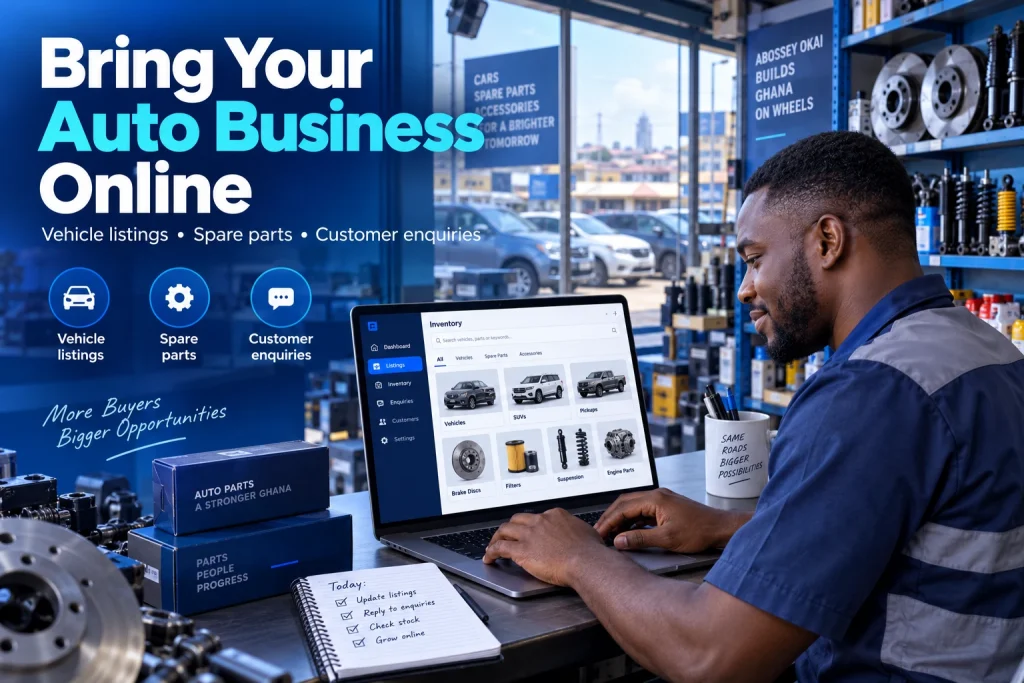
A car dealership website in Ghana should help a buyer answer practical questions before calling: what is available, what condition is it in, how much does it cost and where can I inspect it? For a spare-parts dealer, the questions are just as specific: which part is this, will it fit my vehicle and can I collect it today?
For businesses in Abossey Okai, along Spintex Road and across Ghana, a useful website is more than a gallery of cars or boxes on a shelf. It turns your inventory into searchable information and gives customers a clear route to an enquiry, an inspection or a suitable parts order.
This guide shows how to plan vehicle listings and a WordPress spare-parts store, add search filters, manage stock and use WhatsApp for customer enquiries. Start with accurate data and a workflow your team can maintain; add automation once the basics work.
Table of Contents
What buyers need from a car dealership website in Ghana
A visitor may arrive from a search engine, a social post or a link shared by a mechanic. Give each vehicle or part its own page so staff can send a precise link rather than asking the customer to browse an entire social feed.
| Buyer | Information needed | Next action |
|---|---|---|
| Vehicle buyer | Vehicle details, condition, price and location | Ask a question or request an inspection |
| Mechanic | Part number, specifications and verified fitment | Confirm the right part and availability |
| Parts customer | Price, condition, stock and delivery options | Place a suitable order or request help |
| Fleet buyer | Relevant stock and supply arrangements | Request a quotation |
Use clear photographs, readable specifications and a business contact number. Include your trading location, opening hours and collection process. A buyer should know who they are dealing with before sending a payment or arranging a visit.
Publish the information you can substantiate. If a vehicle has been reserved, say so. If a part requires compatibility confirmation, make that step visible. Accurate expectations build a stronger customer experience than an attractive listing that staff cannot fulfil.
Choose WordPress tools for vehicles and spare parts
Use WordPress for the business pages and a maintained inventory tool for vehicle listings. Use WooCommerce when you need a parts catalogue, stock counts, product variations, payments and shipping. A business selling both vehicles and parts can have two clearly labelled sections on the same site.
A vehicle enquiry is different from a normal retail purchase. Many dealerships will begin with listing pages and inspection requests rather than a full-value car checkout. Keep the sales, documentation and handover process with your team.
If you are searching for a car sales script for WordPress, evaluate the actual features and maintenance record. Check vehicle fields, filters, listing status, photo galleries, mobile display and enquiry handling. Test the tool with your inventory before paying for a licence.
- Choose supported software from the developer or a legitimate marketplace.
- Check compatibility with your WordPress version and theme.
- Confirm how vehicle and customer data can be exported.
- Review renewal charges and what support includes.
- Avoid nulled themes, pirated plugins and scripts from untrusted download sites.
Do not install several overlapping inventory and checkout systems. Define which component owns vehicle records, which owns parts stock and where enquiries are stored. A smaller, maintained set of tools is easier to update and troubleshoot.
Choose a business domain and hosting
Register a domain that matches the business name and is easy to say on the phone. A .com or suitable .com.gh name can give your website and email a consistent identity. Keep the domain in an account controlled by the business, with renewal reminders and protected access.
Explore our domain services and Ghanaian domain options. Give a designer the access needed for the project while retaining the registration, billing and recovery information.
For a business site with an enquiry catalogue, start with our web hosting or managed WordPress hosting. For a parts store with active checkout, explore our WooCommerce hosting.
Choose resources for your catalogue size, image storage and expected traffic. A large collection of vehicle photos and complex fitment searches can demand more storage and database work than a small brochure site. Measure response times and discuss an upgrade when the actual workload needs it.
Use HTTPS, domain-based email and a backup process. Hosting is the platform for the website; inventory data entry, design, integrations and ongoing application work need their own project scope. Our team can help you plan those services together.
Build accurate vehicle inventory pages
Give every vehicle a unique stock reference. Keep it consistent in the listing, enquiry message and internal records. A customer saying “the silver car on your site” is less useful than a reference that identifies one exact vehicle.
- Make, model, model year and relevant variant.
- Mileage with its unit, and whether the reading has been verified.
- Transmission, fuel type, engine details and body style.
- Condition and known issues described accurately.
- Asking price in Ghana cedis and what that price includes.
- Current location, availability and inspection route.
Photograph the actual vehicle from useful angles: exterior, interior, dashboard, luggage area and relevant features. Avoid stock images that could be mistaken for the vehicle being sold. Show known damage clearly rather than relying on editing to hide it.
Keep ownership, import and registration documents in a controlled sales process. Do not publish personal identity documents, signatures or full document scans in the photo gallery. Buyers can review the appropriate documentation through your team during due diligence.
A listing should not imply that photographs replace inspection. Explain how to arrange a viewing and allow the buyer to ask relevant questions. Record changes in price or condition and remove misleading old descriptions when a listing is updated.
Use statuses such as available, reserved and sold. A reserved vehicle should not silently remain an ordinary available listing. Decide whether sold pages stay as clearly marked archive examples or are redirected to current inventory; avoid leaving a broken link where customers previously shared it.
Prepare a searchable spare-parts catalogue
An auto parts ecommerce website in Ghana depends on consistent product information. Begin with a manageable selection of stock rather than importing thousands of incomplete descriptions. A clear page for a verified item is more useful than a huge catalogue full of uncertain compatibility.
| Field | Purpose |
|---|---|
| Internal SKU | Identify and track the item in your store |
| Manufacturer part number | Compare the exact component with verified catalogues |
| Brand and product name | Describe what the customer will receive |
| Specifications | Show dimensions, side, connector or other relevant details |
| Condition | Distinguish new, used, refurbished or aftermarket items |
| Fitment records | Describe the supported vehicle combinations |
| Stock and price | Set availability and the selling price in Ghana cedis |
Your internal SKU and the manufacturer’s part number are different identifiers. Store each in the appropriate field. Add verified cross-reference numbers only when you can substantiate them, and explain if a number is a reference rather than the manufacturer of the supplied part.
Photograph labels, connectors and relevant mounting details without exposing supplier or customer documents. Describe what is included in the box. If an item is sold individually, as a pair or as a kit, make that clear near the price.
Use product categories such as braking, lighting or suspension to organise the catalogue. Use consistent attributes for specifications buyers need to filter. Create variations only where they represent genuinely purchasable options, each with the right SKU, price and stock.
Do not label every aftermarket item as genuine or original. Explain the supplied brand and condition accurately. A compatibility statement should come from verified manufacturer or supplier information, with a staff review when there is uncertainty.
Help buyers search without promising unverified fitment
WooCommerce’s Product Filters block supports attributes, price, availability and other catalogue criteria. With a compatible block theme, add it beside the relevant Product Collection in the catalogue template and configure the fields that help your buyers.
For parts, useful filters can include category, brand, vehicle family and availability. For vehicle listings, choose an inventory tool with the make, model, year, body type, transmission and price filters you actually need. Test the filters on mobile as well as desktop.
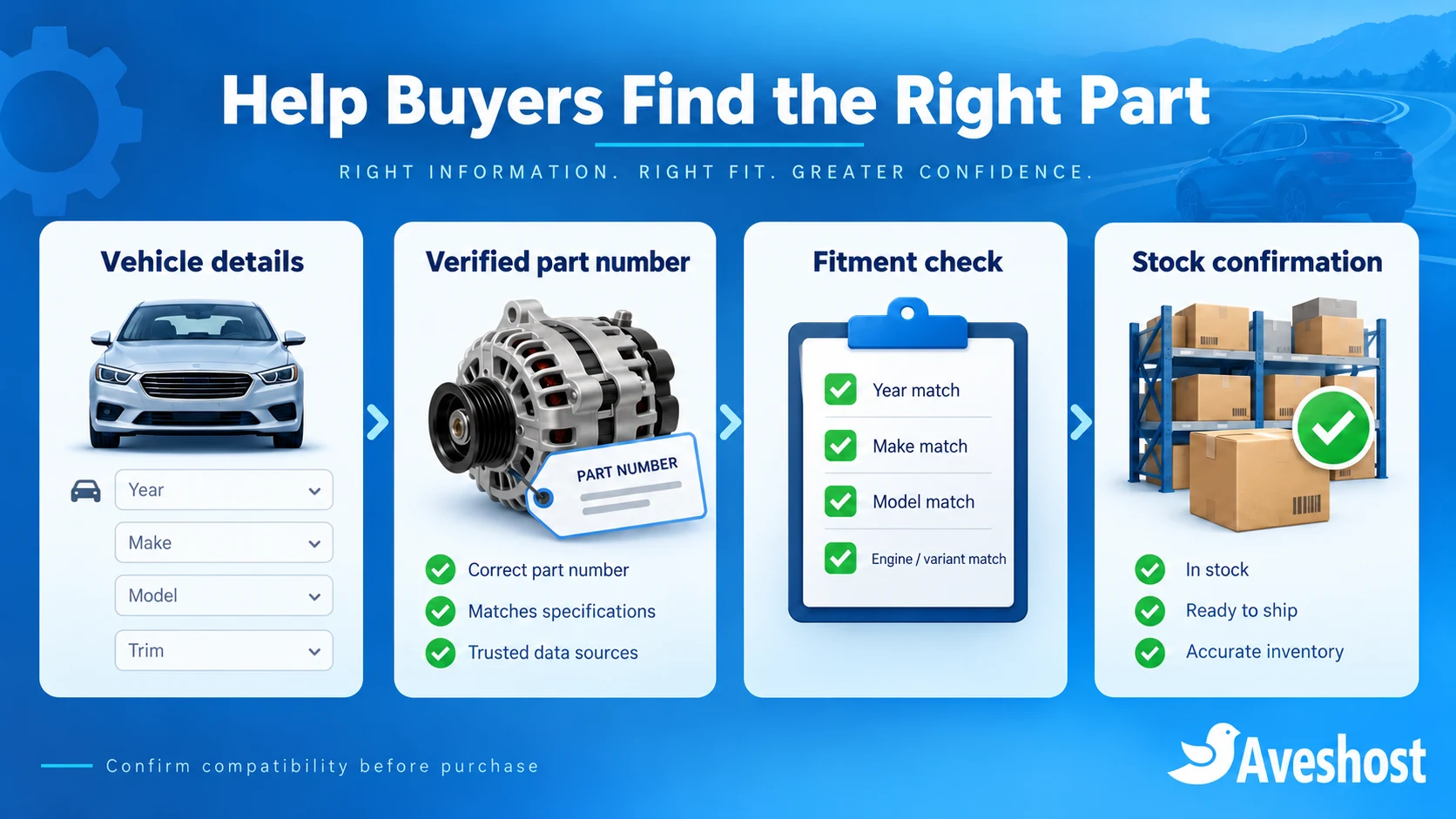
Generic attributes are not a complete vehicle-fitment engine. If a part fits Model A in one year and Model B in another, independent model and year tags can produce a false combination. Store fitment as verified vehicle combinations rather than an unrelated list of values.
For a large catalogue, choose a maintained fitment extension or a custom data model that preserves make, model, year, engine and variant relationships. Test known compatible and incompatible examples before presenting a search result as a match.
- Allow customers to search the exact part number where your search tool supports it.
- Show a useful no-results message with a contact route.
- Keep availability filters linked to the current stock source.
- Check how punctuation and alternative part-number formats are handled.
- Provide a compatibility-confirmation step for uncertain purchases.
Ask for the vehicle details needed to verify fitment. If a chassis or VIN reference is required, collect it through the appropriate private channel and protect it. Do not encourage customers to post registration documents in public reviews or comments.
Keep online and counter stock aligned
WooCommerce can track product quantities and stock status when configured. Its inventory settings control stock management, while the product editor holds the item’s SKU, quantity and related settings. Enter an accurate opening balance and review the low-stock process.
That does not automatically synchronise a sale at the Abossey Okai counter, a WhatsApp order and an online checkout. Define one stock source and make every sales channel update it. You can begin with a disciplined staff procedure, then integrate your POS or inventory system when the volume justifies it.
Use reservations deliberately. If a customer pays for the last item online while staff are arranging collection for another buyer, the team needs a rule for which order owns that stock. Test pending, paid, cancelled and refunded orders against the agreed policy.
A real-time display is only as current as the data feeding it. If synchronisation fails, flag the problem and stop treating stale quantities as reliable. Give staff a reconciliation report and record who corrects differences between physical and recorded stock.
- Count opening stock and map each item to one SKU.
- Record counter and WhatsApp sales promptly.
- Test stock changes after online payment and cancellation.
- Disable backorders unless you have a defined supply process.
- Reconcile returns and damaged items before putting them back on sale.
Keep vehicle reservations and parts stock distinct. One vehicle is a specific unit, while a spare-part SKU may have several identical units. The stock model should reflect those differences instead of applying one quantity rule to everything.
Turn WhatsApp enquiries into confirmed appointments
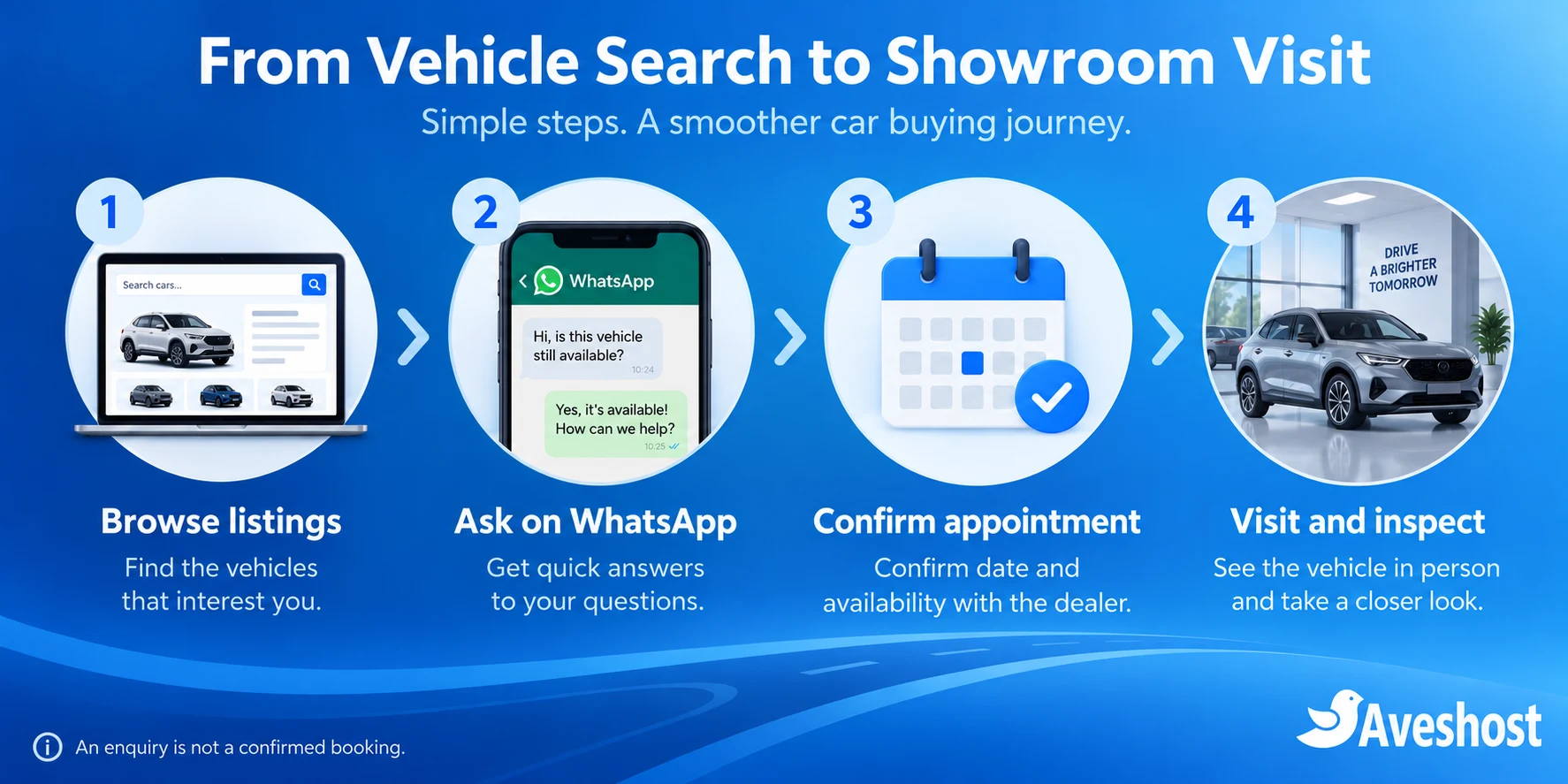
Add a clear WhatsApp enquiry button to each vehicle and part page. Include the stock reference and page link in the suggested message so staff know what the customer is asking about. The visitor should send the message themselves; opening a chat is not confirmation of an appointment.
WhatsApp’s official click-to-chat guide uses a full international number and supports a URL-encoded pre-filled message. For a Ghanaian number, use the correct 233 international format without the plus sign, spaces or the domestic leading zero.
https://wa.me/YOUR_INTERNATIONAL_NUMBER?text=YOUR_URL_ENCODED_MESSAGEThe template above contains placeholders. Replace them with your business WhatsApp number and encoded text. A vehicle message could say: “Hello, I would like to inspect vehicle stock reference AUTO-001. Please confirm its availability and the next viewing time.” Use a real stock reference from the listing.
Ask staff to confirm the vehicle, date, location and contact details before marking an appointment as booked. If you need a calendar with available time slots, integrate a maintained booking tool and connect it to the team’s actual schedule.
Test the button on a phone and through WhatsApp Web. Provide a telephone or website enquiry alternative. Publish response hours so a customer does not expect an immediate reply outside the time your staff manage enquiries.
Do not collect identity documents in a pre-filled URL. Keep the initial message focused on the item and the enquiry. If later sales verification needs sensitive documents, use a controlled process with access and retention rules.
Accept payments for parts and define reservation terms
For parts ready for online sale, configure WooCommerce with Ghana cedis, the correct stock rules and delivery options. Connect a supported gateway and complete the merchant verification process before enabling live payments.
Paystack provides an official setup route for WooCommerce in its integration guide, and supports Ghanaian mobile-money payments as described in its MoMo documentation. Use the verified plugin route, test keys while testing and live keys only when the store is ready.
- Test a successful payment and its order confirmation.
- Test failed, abandoned and pending payments.
- Confirm that stock follows the agreed order-status rules.
- Verify the delivery charge and total before payment.
- Check customer emails and the refund process.
A customer’s payment screenshot or return to a thank-you page is not enough to release goods. Use the gateway-confirmed transaction status and your store’s order process. Keep secret keys restricted to authorised administration settings.
For a vehicle reservation deposit, define the exact purpose, amount, reservation period and cancellation or refund terms before collecting it. Explain whether the payment holds the vehicle, covers an inspection or forms part of the sale price. Give the buyer clear terms and confirmation rather than a vague “book now” button.
Do not treat an online payment as a substitute for vehicle inspection, ownership verification or the required sale and handover documentation. Keep that process with the dealership team. The website should make the next step clear, including what must happen before the sale is complete.
Plan collection, delivery and returns
Offer collection when it fits your operation and show where customers should go. For delivery, define supported areas, charges and dispatch times. Test addresses in Accra and outside your delivery zones so checkout does not promise service you cannot provide.
Parts vary in weight, size and handling needs. Arrange delivery methods suitable for the items you sell, including any special requirements for batteries, fluids or fragile components. Do not apply one small-parcel rate to every item without checking the courier arrangement.
Provide a return process that explains how customers report a wrong or damaged item. Record the fitment information used at sale and inspect returned stock before reselling it. Have the terms reviewed for your business and applicable requirements rather than copying another store’s policy.
Make the invoice and order record identify the supplied item accurately. Include a contact route for post-sale questions and preserve the information needed to resolve an enquiry. Keep unnecessary identity documents out of routine delivery notifications.
For a complete store setup walkthrough, follow our guide to starting an online store in Ghana. Apply its store structure alongside the vehicle and fitment data your auto business needs.
Test, launch and maintain your auto website
Launch with a catalogue your staff can maintain. Have a team member act as a buyer, find a vehicle, enquire through WhatsApp and purchase a test part. Check every step through to staff handling, not just the page appearance.
- Review vehicle facts, product specifications and prices.
- Test compatible and incompatible fitment searches.
- Verify available, reserved, sold and out-of-stock displays.
- Open WhatsApp buttons and check the suggested stock reference.
- Test payment outcomes, stock updates and confirmation emails.
- Check collection and delivery charges for different locations.
- Test catalogue use on a small screen and mobile connection.
- Back up files and the database, then test restoration.
- Give staff individual accounts and remove unused access.
- Keep WordPress, themes and extensions supported and updated.
Compress display images, avoid oversized galleries on catalogue pages and load detail photographs only where needed. Follow our WordPress performance guide, then measure your actual site rather than promising a fixed load time from the theme description.
Record enquiries and completed sales so you can see which listings help customers take action. Do not confuse page views or WhatsApp button clicks with confirmed appointments or paid orders. Review unanswered enquiries and update the pages that repeatedly cause confusion.
Start with the right data, a clear sales process and reliable hosting. As the catalogue grows, improve search and connect stock systems around the needs you have measured. A well-maintained inventory site can become a useful extension of your physical business.
Ready to bring your auto business online? Explore our e-commerce hosting and business domains, or discuss your dealership website or parts store with our team. Tell us your inventory size, search requirements, stock system and payment plans so we can design the right setup.
Frequently asked questions
What should a car dealership website in Ghana include?
Provide accurate vehicle pages, prices, condition details, availability, location and a clear inspection or enquiry route.
Can I sell spare parts with WooCommerce?
Yes. Configure product data, verified fitment information, stock, payments and delivery around your actual sales process.
Do ordinary filters guarantee a part will fit?
No. Preserve verified vehicle combinations and confirm compatibility where necessary. Independent model and year tags can produce false matches.
Will WooCommerce automatically update counter sales?
Only when the counter workflow or a working integration updates the same stock source. Online stock management alone does not connect every sales channel.
Should each vehicle have a stock reference?
Yes. A unique reference lets staff identify the exact vehicle in listings, enquiries and reservations.
Does a WhatsApp enquiry book a test drive?
No. Staff must confirm availability, date and location, or use a booking tool linked to the actual schedule.
Can customers pay for parts with MoMo?
Yes, through a supported gateway and an approved merchant account. Test payment confirmation and stock handling before launch.
Should I take vehicle reservation deposits online?
Only with a defined reservation process and clear payment, cancellation and refund terms. Payment does not replace the dealership’s sale checks.
Do I need a VPS to start?
A small site or parts store can begin on a suitable web or WooCommerce hosting plan. Choose larger infrastructure when the measured workload requires it.
Can Aveshost build the website for my auto business?
Yes. Contact support with your vehicle or parts catalogue, fitment search, stock workflow and integration requirements.




