
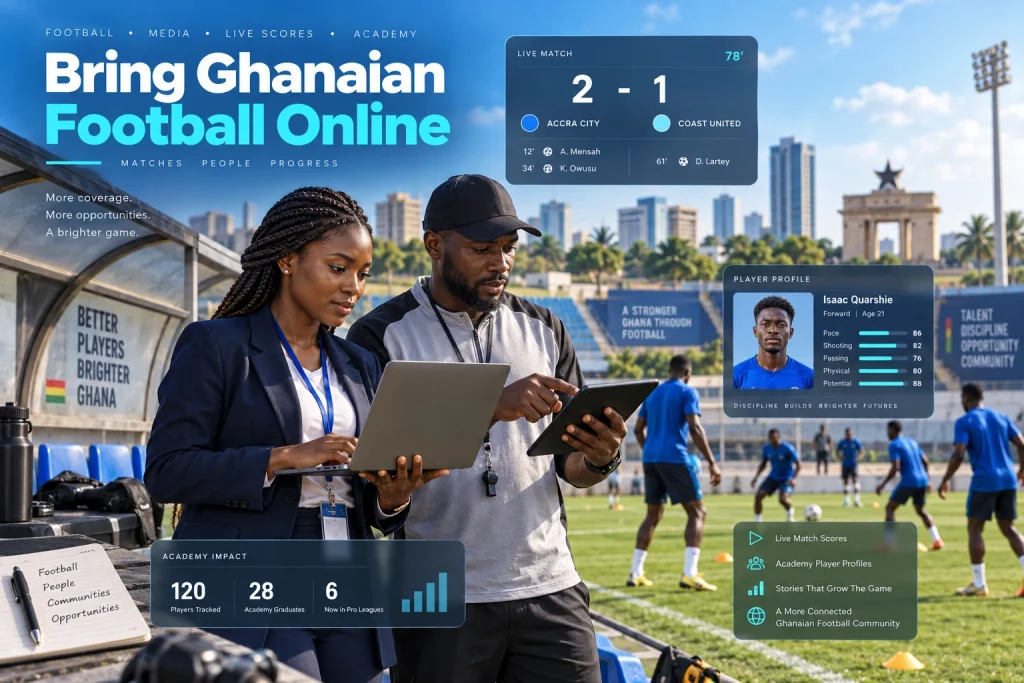
Sports website design in Ghana can bring match coverage, fixtures and football academy profiles into one dependable portal. For sports publishers, the priority is accurate coverage that stays available when a match attracts attention. For academies, it is a professional place to present approved player information, video highlights and a clear contact route.
Start with a focused service: cover the competitions you can verify, publish profiles your academy can maintain and make the site easy to use on a phone. Exposure depends on good information and relationships; a website cannot guarantee a trial, scouting invitation or player contract.
This guide uses WordPress and SportsPress for the content foundation, then explains the additional work behind fresh score updates, Cloudflare caching and video delivery. It also covers the privacy and safeguarding decisions that matter when a football academy portal includes young players.
Table of Contents
Plan sports website design in Ghana around your audience
Choose the main audience before building the homepage. A regional sports newsroom, an academy showcase and a league administration website have different daily workflows. They can share a platform, but each needs a named content owner and a clear reason for visitors to return.
| Audience | Useful first-release content | Main action |
|---|---|---|
| Fans and local sports readers | Fixtures, confirmed scores, match reports and short clips | Follow a match or read the report |
| Academy players and families | Approved profiles, team news and academy information | Review agreed public information |
| Scouts and club representatives | Relevant football information, contextual video and academy contact | Send an enquiry to authorised staff |
| Competition organisers | Fixtures, results and standings under the actual competition rules | Verify or correct competition information |
Set an editorial boundary. For example, cover one academy and its fixtures, or a defined regional competition. Expanding to every league before you have reliable sources creates stale pages and correction work. A smaller current database is more useful than a large directory of outdated profiles.
Define who can report a score, approve a player profile and respond to an enquiry. Publish a contact route for corrections and concerns. If the website represents an academy, show the organisation’s real identity, staff contact details and services without inventing affiliations or international partnerships.
Separate website pages, score updates and video
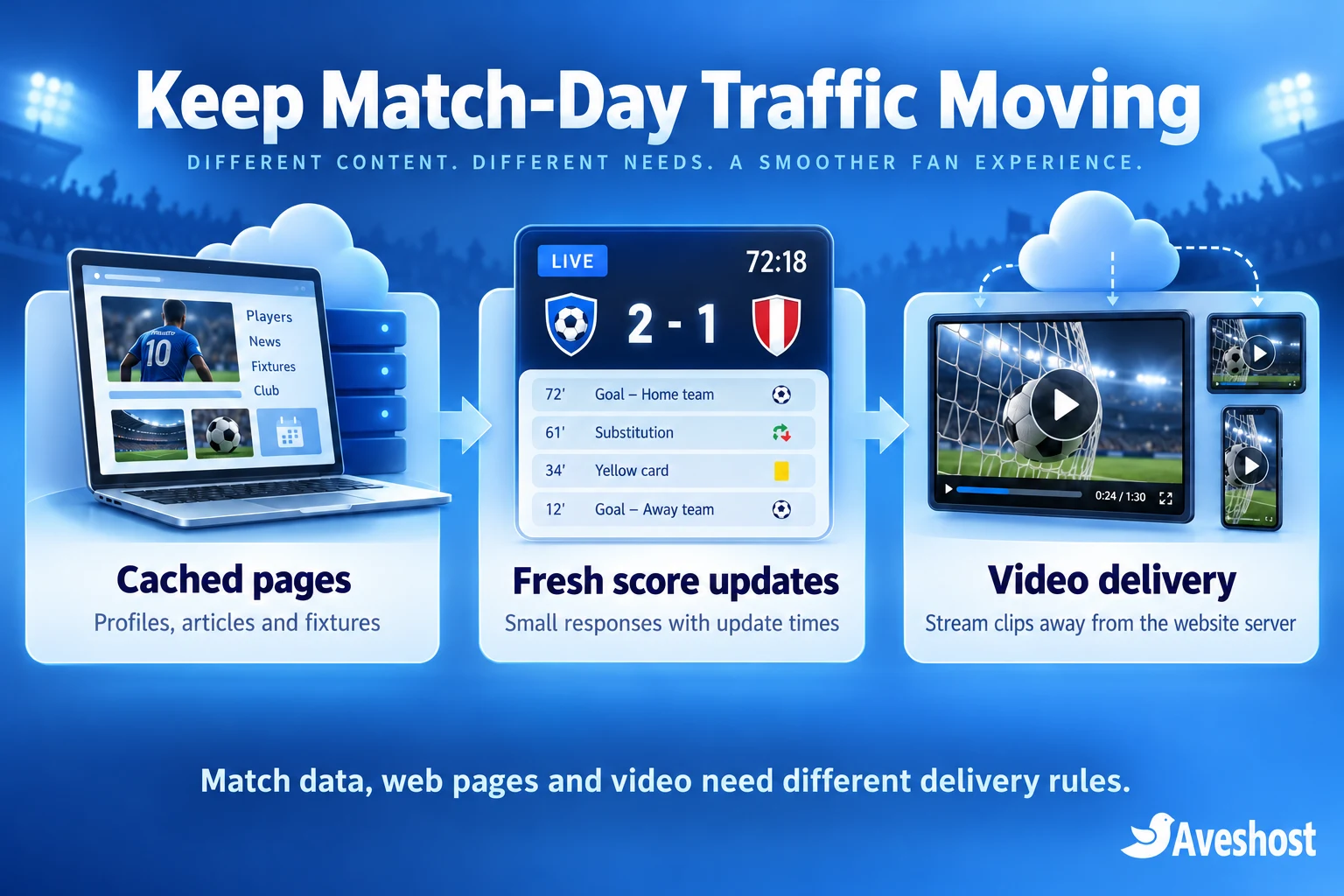
A sports portal has three different delivery jobs. Articles and public profiles can often be cached. An active score display needs a defined freshness policy. Video needs storage, encoding and delivery capacity of its own. Treating all three as ordinary uncached WordPress pages makes match-day traffic harder to handle.
| Layer | What it serves | Practical approach |
|---|---|---|
| Website | Articles, public profiles, fixtures and navigation | WordPress with appropriately configured page and asset caching |
| Score service | Small public match status responses | A maintained integration or a tested custom component with controlled refresh |
| Video | Approved highlights and match footage | A suitable video service or permitted streaming infrastructure |
| Private operations | Editorial tools, consent records and scouting enquiries | Authenticated access with shared caching excluded |
Keep one authoritative record for each match and player. The live component should not create a competing set of final results that editors have to reconcile by hand. Use stable internal IDs and map any external feed IDs to the correct competition, season, home team and away team.
Begin with the simplest implementation your staff can operate. A clearly labelled editor-updated match page is a valid first release. Automatic refresh, external data feeds and streaming are additional functions to configure or build, rather than features implied by the words “sports portal”.
Choose your domain and hosting foundation
Choose a name that works for the publication or academy. A .football, .club or .com domain can suit the project, subject to availability and renewal costs. Use our domain search and register the name in the organisation’s own account, with recovery and renewal contacts it controls.
A small content-led site can start on suitable managed WordPress hosting. Our plans include SSD storage, SSL and staging tools. Size the plan for the actual theme, plugins, media library and peak workload. A monthly visitor estimate alone does not describe the load of a popular match being watched at the same time.
For a custom score API, background import worker or other application services, consider our self-managed Linux VPS plans. They come with SSD storage and root access. On a self-managed VPS, your administrator maintains the server and application services. Agree management responsibilities before choosing the deployment.
Keep the website, database and private records protected, and plan independent backups from the start. A CDN helps distribute eligible content, but it does not increase database capacity or repair slow application code. Load-test the finished design before a major fixture.
Create a staging site for configuration and updates. Keep it out of search results and prevent test forms from contacting real scouts or families. Use fictional sample teams and adult demonstration profiles while building.
Set up fixtures, results and teams with SportsPress
Install WordPress with HTTPS and a lightweight supported theme. In Plugins → Add New, search for SportsPress – Sports Club & League Manager, confirm the official listing, then install and activate it in staging. Check current compatibility and licence requirements for any extensions you intend to add.
SportsPress core provides fixtures, results, league tables and team and player profiles. Advanced presentation tools are available separately in SportsPress Pro. A scoreboard design is not the same as an automatic live-data service; test the exact update behaviour you need.
Follow the official football league setup guide: choose the football preset, create competitions and seasons, add teams and venues, then create the fixtures. Match administration labels can vary with your configuration. Use the correct timezone, Africa/Accra, and show kick-off times clearly to international readers.
Configure scoring, table columns and tie-break rules to match the actual competition. Keep friendly matches separate from league fixtures. Test a sample result and verify the table before importing a season of data. Postponed, abandoned and corrected matches need an editorial process rather than a guessed score.
Build a Fixtures & Results page and an Academy Players page. Create the relevant calendar and player list, copy their generated shortcodes, and paste them into WordPress Shortcode blocks. ThemeBoy’s shortcode guide explains the elements. A layout example is:
[event_list id="123"]
[player_list id="456"]
Replace 123 with your calendar’s ID and 456 with your player list’s ID, or use the exact generated shortcode. These are different records, not arbitrary match and player IDs. Preview the output on a phone, check links and confirm that only approved fields are visible.
Build useful player profiles and an academy directory
A useful player page gives a football professional enough context to understand the player’s role and the evidence behind the presentation. Keep public material concise: an approved display name, position, team, relevant football background and selected clips. Include the season and source for statistics.
Avoid vague labels such as “international standard” or inflated performance totals. A short coach-written summary linked to identifiable matches is more credible. Distinguish training footage from competitive match footage, and explain whether a statistic covers a full season, a tournament or a selected set of appearances.
| Public profile material | Keep restricted |
|---|---|
| Approved football biography and position | Full birth certificate, passport or identity numbers |
| Selected video with publication permission | Medical records and injury documentation |
| Contextual match and season statistics | Family contacts and home or school addresses |
| Academy business contact route | Private coach assessments and safeguarding reports |
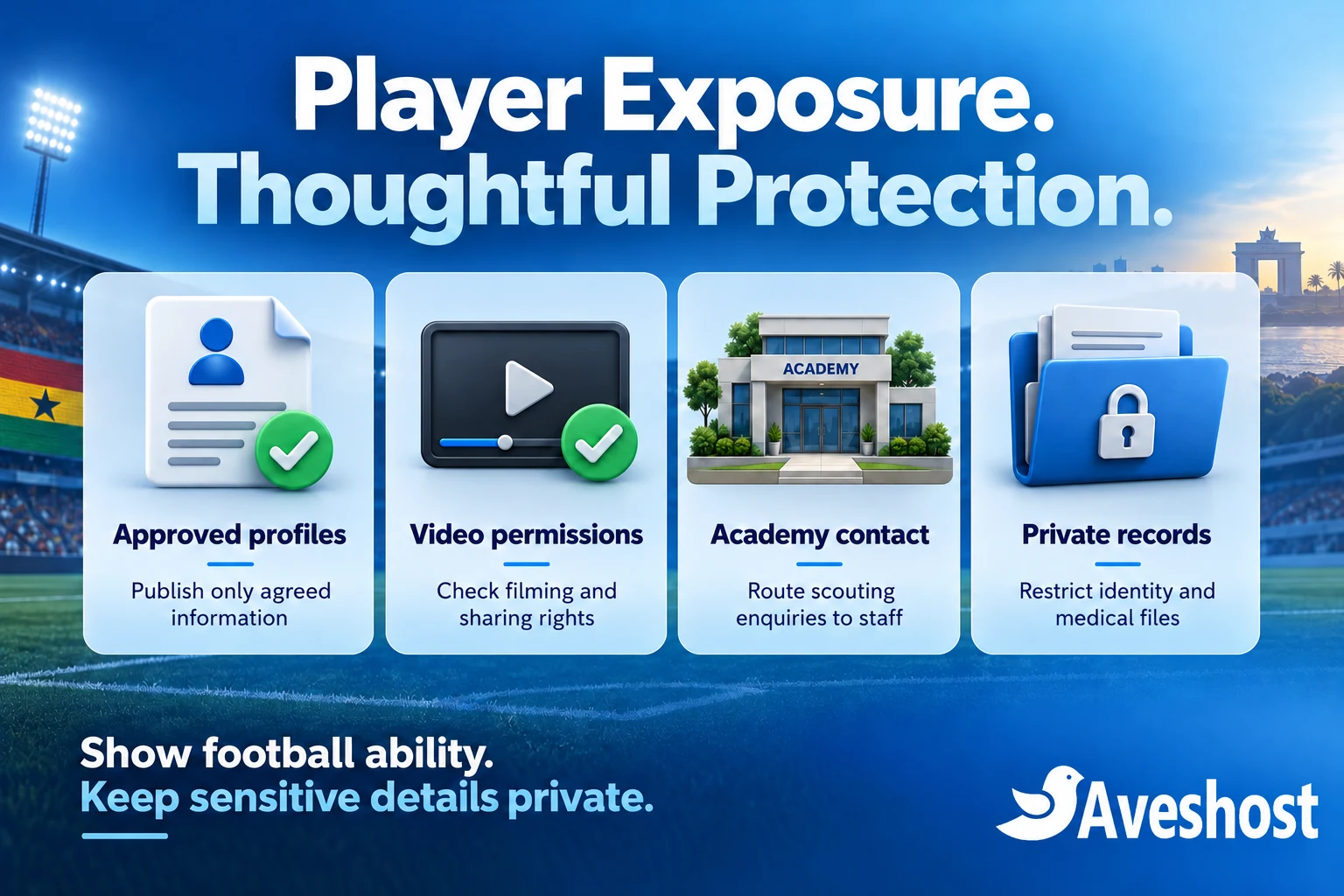
For young players, publish less identifying information. Use an appropriate age band where a public age label is useful; keep full dates of birth and supporting identity documents in controlled records. Separate media approval from joining an academy, and give families a practical route to review or remove public material.
Set a review schedule. Retire outdated information when a player changes team, a family changes its publication preference or the original purpose ends. A profile should make clear who maintains it and how someone can request a correction.
Choose a reliable live-score workflow
Choose between two sources: your own authorised match reporters or a licensed data provider with the required competition coverage. For academy fixtures, your own verified reporting may be the practical source. Confirm coverage before buying an external feed; a package advertising global football does not establish that it covers your local competition.
For a first release, staff can update a match page and clearly label it Editor-updated, with the time of the latest confirmed change. Preview what readers see after each update, including cached copies. Do not label a scheduled fixture “Live” simply because its kick-off time has passed.
For automatic refresh, add a maintained, compatible integration or commission a small score component. SportsPress core supplies the content foundation; a tested reporter interface, public read endpoint and refresh behaviour are separate requirements. An old live-score plugin demonstration is insufficient evidence of current support.
Define the component’s public response before development. This fictional example shows the fields a fan-facing score card needs:
{
  "match_id": "demo-042",
  "home_team": "Accra Example FC",
  "away_team": "Tema Example FC",
  "home_score": 2,
  "away_score": 1,
  "status": "second_half",
  "minute": 72,
  "updated_at": "2026-10-15T16:12:00Z",
  "source": "academy_reporter"
}
This is a design example, not a working endpoint. The component must authorise writers, validate score changes and retain a correction trail. Keep provider keys and write credentials on the server. The public response should contain match information only, without private staff or player records.
Poll only active matches at a sensible interval, pause hidden browser tabs and back off after errors. Show “Updates delayed” when the last confirmed event is old. Never replace a failed response with 0–0. On full time, stop live polling and publish the verified final result to the main match record.
Obtain permission for any data feed, fixtures database or third-party content you reuse. Confirm display, redistribution, attribution and caching terms. Logos, photographs, commentary and footage also need their own permissions; a public webpage is not a licence to republish it.
Configure Cloudflare without freezing the scoreboard
Use Cloudflare as an additional delivery layer with the right DNS and HTTPS configuration. Before changing nameservers, copy and verify all required records, including mail records. Install a valid origin certificate, enable proxying for the intended web hostnames and use Full (strict) encryption. Check website and email operation after the change.
Cloudflare’s default cache behaviour does not mean every WordPress page or JSON response is automatically cached. Configure public-page caching deliberately and exclude administration, login, account pages, submissions and private responses. Test with ordinary accounts as well as logged-out visitors.
Give live-score responses their own policy. During the pilot, bypass long-lived CDN and browser caching for that endpoint, while your application uses a short shared server-side cache to avoid repeating the same database work. Test actual freshness after every layer. A cache-busting query added by every visitor defeats efficient caching and is a poor scaling strategy.
At the time of writing, Cloudflare’s Edge Cache TTL settings list minimums of two hours on Free and one hour on Pro. Those settings are unsuitable for a score that needs a short freshness window. If you introduce edge caching for scores, choose a supported mechanism and plan, then test expiry and invalidation. Do not apply a blanket long cache rule to the scoreboard.
Measure the score request rate. For example, 1,500 active viewers polling every 30 seconds generate about 50 read requests per second before retries. That calculation is a planning example, not a hosting capacity promise. Test the server, connection limits and database behaviour under the expected pattern.
Keep public pages lightweight, optimise image dimensions and use a tested object or application cache where appropriate. Purge affected public pages after approved changes. For more WordPress performance work, follow our WordPress speed optimisation guide.
Publish video highlights with the right permissions
Use footage you own or have permission to publish. Academy permission does not automatically cover every participant, broadcast clip, background music track or venue restriction. Record what you may film, edit, share and retain before publishing highlights.
Prepare short clips with useful context: competition, match, date, player role and the relevant action. Avoid deceptive edits that change what happened. Add a poster image and captions where useful, and make playback a visitor choice instead of starting several videos when a page opens.
Use a video service for encoding and delivery, then embed its player in the portal. Cloudflare Stream is one option for live and on-demand video with separate usage costs. Ordinary website CDN caching should not be treated as a complete video streaming service or an unlimited bandwidth entitlement.
For restricted scouting material, use a service that enforces access at the video layer. Cloudflare documents signed video access; your application still has to authorise the viewer before issuing a short-lived token. Hiding an embed or using an unlisted URL does not provide the same access control. Signed access also cannot prevent screen recording.
Keep original footage and permitted working copies in your private archive. Preserve permission records and an independent recovery plan. Review storage, processing and viewing charges as the library grows, rather than filling the WordPress server with full-match uploads.
Protect young players and private academy records
Make safeguarding part of the publishing workflow. Follow the academy’s policy and relevant responsibilities, with FIFA Guardians guidance as a useful football-specific resource. Appoint a responsible staff contact and give players and families a clear reporting route.
For children’s material, obtain and record the appropriate guardian permission and involve the player in an age-appropriate decision about publication. Define the approved channels and purpose. Support withdrawal and removal requests, including removal from public profiles, video access and cached copies under your control. Consent does not make unnecessary disclosure appropriate.
Keep direct child-to-scout messaging, personal telephone numbers, school details, travel plans and identity documents off public profiles. Route enquiries to academy staff. Review photographs for location clues and remove unnecessary metadata. Publicity should show football ability without making a young player easier to contact or locate privately.
Private files need access checks on each request. A login-protected page can still link to a public WordPress media file. Test downloads while logged out and from an unrelated account, and check previews, attachments and API responses. Keep medical information and safeguarding reports outside the public sports content system.
Address applicable requirements under Ghana’s Data Protection Act, 2012 (Act 843), including registration and the handling of children’s and sensitive information. Use the Data Protection Commission’s guidance to plan accountability, processors, security and retention. Hosting a portal does not establish compliance by itself.
Route scouting enquiries through the academy
Use an academy-controlled enquiry form or business email address on player pages. Ask for the organisation, representative’s name, professional contact details, relevant player reference and purpose of the enquiry. Keep the form short and do not ask strangers to upload passports or other sensitive documents.
Verify the representative through independently obtained contact details before arranging private discussions. Give a named staff member responsibility for responding. Public profile interest should not become unsupervised contact with a minor or a promise of a trial, transfer, contract or visa.
Keep enquiries in a restricted system with access logs and a retention policy. Protect forms against spam and rate abuse, and confirm that notifications reach the academy’s inbox. Our business email provides an organisation-owned contact identity for these conversations.
If you add user submissions, keep them in a moderation queue. Review football accuracy, rights and safeguarding before publication. Use separate staff accounts with the minimum permissions required, and remove access when a contributor leaves.
Test match-day traffic and maintain the portal
Rehearse a complete match before launch. Schedule a fictional fixture, submit a goal, correct it, pause updates, restore the connection and mark full time. Follow the result from the reporter interface to the public page on another connection. Record the version and settings that passed the test.
| Check | Expected result |
|---|---|
| Fixtures and tables | Correct season, teams, timezone and competition rules |
| Score update freshness | Readers see the confirmed update within the intended window |
| Stale or failed score feed | A delay notice appears without an invented score |
| Cache boundaries | Private pages stay private and public changes invalidate correctly |
| Video playback | Approved clips load on mobile without overloading the website server |
| Profile safeguarding | Only approved information appears in pages, APIs and downloads |
| Scouting enquiry | Message reaches staff and is unavailable to unauthorised users |
| Restore test | Website records, configuration and needed media recover in isolation |
Run a controlled load test against infrastructure you are authorised to test. Include the actual polling interval, cached pages and a realistic mix of requests. Monitor response time, errors, CPU, memory, database connections and cache behaviour. Repeated full-page refreshes and multiple video embeds can be more expensive than the static homepage suggests.
Back up the database, application files, private configuration and permission records, with independent copies and a tested restoration procedure. Keep external media access records recoverable too. Test updates in staging, especially changes to SportsPress templates, privacy controls and score integrations.
Assign a match-day editor, an escalation contact and an after-match verification step. Track corrections, failed enquiries, stale profiles and rejected updates. A portal earns trust by publishing information that people can use and staff can keep accurate.
Ready to build your sports website or football academy portal in Ghana? Explore our WordPress hosting, Linux VPS plans and sports domain options, or discuss your portal with our team. Tell us your competitions, player-profile workflow, video needs and expected match-day audience so we can plan the right setup.
Frequently asked questions
Can WordPress support sports website design in Ghana?
Yes. WordPress and SportsPress can provide fixtures, results, teams and player profiles, with additional integrations for automatic score updates and video delivery.
Does SportsPress automatically provide a live football data feed?
No. Choose a verified reporting workflow or licensed feed and test a compatible integration for automatic refresh.
Can a football academy portal in Ghana help players gain exposure?
It can present approved profiles, contextual statistics and video to relevant visitors. It does not guarantee a trial, contract or scouting outcome.
Should every page use the same CDN cache rule?
No. Public articles, active score responses and private account pages have different freshness and privacy requirements.
Can I host full-match videos directly on a basic WordPress plan?
Use an appropriate video delivery service or permitted infrastructure after checking storage, encoding, traffic and terms. A normal website CDN is not a complete streaming service.
Can I publish broadcast highlights from another sports channel?
Only when you have the required permission or licence. Ownership of a website does not grant rights to third-party footage or music.
Should young players have public personal contact details?
No. Route scouting enquiries through authorised academy staff and keep unnecessary identifying information private.
Are unlisted video links private?
Anyone with the link may be able to watch. Restricted material needs enforced access controls at the video layer.
Do I need a VPS for live score website hosting?
A small content site can start on suitable WordPress hosting. Custom APIs, workers or heavier activity may require a VPS and an administration plan.
Can Aveshost help build a sports media or academy portal?
Yes. Contact support with your fixtures, profiles, score update and video requirements to discuss the project.




